Tag: Career and Leadership Development

  • 5 Ways to Leverage your Travel Experience on a Resume

    5 Ways to Leverage your Travel Experience on a Resume

    In addition to holding on to a lifetime of memories, Greenheart Travel Alumni can also use their experience abroad to land your next dream job.  The first step in looking for a job is making sure your resume is on point.

    Here are five ways to leverage travel for professional growth:

    Show Concrete Accomplishments from Your Travels

    List your travel experience as either a professional or volunteer position on your resume and think about your accomplishments.

    • What unique contributions did you make while abroad?
    • What interesting cross-cultural projects did you work on?
    • Who did your program positively impact?

    List 2-3 points under your title that will make you stand out to an employer. Here are some great examples we’ve seen our alumni use on their resumes:

    Example #1:

    English Teacher

    Chiang Mai, Thailand

    • Co-taught intermediate English reading and writing comprehension skills to seventh grade students with a native Thai teacher at a local school.
    • Maintained a safe and respectable learning environment in and out of the classroom, while creating unique lesson plans and innovative techniques for gauging students’ growth.
    • Developed and implemented varied teaching styles to accommodate multiple learning abilities and utilized discipline strategies that weigh heavily on positive reinforcement.

    Example #2

    Volunteer at Ecological Reserve

    San Carlos, Costa Rica

    • Assisted with conservation projects at an animal rescue center in Costa Rica, which uniquely focuses on rehabilitating animals and releasing them back into the wild.
    • Lived with a local volunteer host family, cooked traditional Costa Rican foods, and conversed in Spanish daily.

    Example #2

    Teach English in a Homestay tutor

    Sicily, Italy

    • Designed and taught personalized English lessons to two children aged 11 and 13 for 15 hours a week.
    • Lived with a local volunteer host family, cooked traditional Italian foods, and conversed in Italian daily.
    • Gained a deeper sense of cross-cultural communication and Italian values.


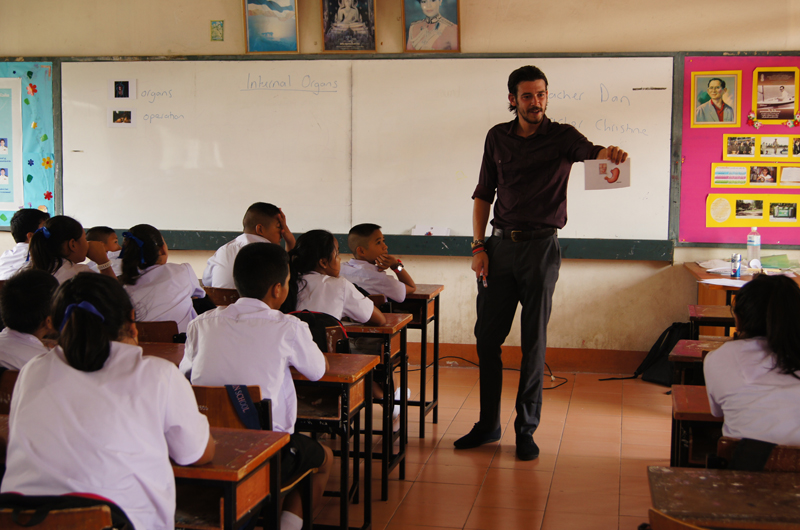
    A foreign English teacher with students in Thailand.

    Demonstrate Relevant Skills Gained from Travel

    Your resume can also demonstrate your character and personal development. Include a relevant skills section, which highlights both your job-specific skills and your overall character strengths.

    Your “soft skills” are often put to the test when traveling alone in a foreign country. For instance, what communication or conflict resolution skills did you improve or gain from your program abroad? Later, in the job interview, you will be able to expand on how your travel experiences further shaped these skills.

    Many Greenheart Travel alumni also receive TEFL certification. For this type of certification and any other specific skill you may have gained from your program abroad, consider listing it underneath as an accomplishment of your program. However, if it directly relates to the position you’re applying for, then go ahead and list it under relevant skills.

    Show Off Your Communication Skills 

    Many Greenheart Travel participants like to blog and take photos during their program overseas. While it may seem like just a personal project at the time, these examples of your writing and photography skills may be very attractive to a future employer.

    Consider sharing the link to your blog in your resume and on your LinkedIn profile, which allows employers to learn more about your writing and your travels. If you’re interested in journalism or design consider making a portfolio of your travel photos.  This will not only demonstrate your creative side, but also your organizational skills and your ability to self-promote your work.

    Articulate Your Leadership Skills

    Again, think about how you can articulate concrete examples of the skills you developed while traveling. Were you a recipient of a scholarship for your program abroad? Scholarships demonstrate dedication and hard work, and may further validate your travel experience to employers as a real program and not just a vacation. You may list these under a special section called “Awards and Recognition.”

    Also, make sure you mention any public recognition for your program abroad such as media coverage (even if it’s your hometown paper) or a host country community event in your honor.

    Lastly, if you were the first person to go on a new program or to a new location with Greenheart Travel, consider that an honor in itself (ex. “I was selected as one of the first participants to volunteer at a new cultural exchange program in Sri Lanka”). An employer will appreciate these accomplishments and see you as a candidate who goes above and beyond what is normally expected and not afraid to take risks.

    Make Sure You Stand Out with a Second Opinion

    When listing your travels on your resume, consider reaching out to someone in your desired field such as an acquaintance, friend or family member for help. Having a second pair of eyes on your resume will ensure that your points are coming across clearly and will resonate with an employer.

    Simply rearranging the order of your resume, or changing how you phrase an accomplishment while abroad, could make a big difference. Lastly, please remember to be your biggest fan. You resume should give you confidence and be a place to brag about all the amazing things you have done in your life!

    We hope these tips help you land your next job! For further support, join Greenheart Travel’s Alumni Network on LinkedIn and see how your peers are sharing their travel experiences.


  • Using a TEFL Certification and Travel Experience to Further Your Career

    Using a TEFL Certification and Travel Experience to Further Your Career

    As part of our mission-based blog series on how travel helps advance careers and creates leaders, we reached out to TEFL-certified, world traveler, Brian Thacker. In our latest interview, Brian shares his first-hand experience on how he used his experiences abroad to help land his most recent job.

    Q: You have an MBA, a great job and you have taught abroad. How did you make it work to travel and still land your dream job?

    I left to work abroad when I was 22. I had been working in an office environment for a few months but, as many college grads discover of their first job out of school, it was pretty boring.

    I wasn’t ready to just dig in and start “climbing the ladder.” What I really wanted to do was travel. Specifically, I wanted to live in a big city in Latin America and eventually I decided on Buenos Aires, because I’d heard a lot of good things about it and I knew there would be plenty of opportunities to teach.

    When I look back on the whole experience and think about how it helped me get to where I am now, the key is that I have a story to tell. A lot of people can talk about what they do, but far fewer people are able to form a compelling story around why they do it. Teaching abroad wasn’t the “safe” thing for me to do, but it helped me grow and differentiate myself in ways that more traditional career choices can’t match.

    Patagonia, Argentina | © Lauren Thacker

    Q: What advice do you have for students and graduates who are focused on their career goals but want to travel?

    I’ve never really had anyone tell me: “Oh, that time I spent abroad after college was such a waste,” or “Yeah, I’m really glad I decided to not to travel after school.” It’s always the opposite. Taking time away from your career is a difficult decision primarily because nothing is guaranteed when (or if) you come back.

    But if it is something that truly interests you, I can all but guarantee that you’ll seriously regret not doing it a few years down the line. Be honest with yourself and with your manager(s) and DON’T burn bridges.

    Brian-traveling-in-india
    Brian traveling in India during business school | © Brian Thacker

    Q: When you were a student, what made you decide to take the time to travel abroad and how did that affect your career goals?

    Curiosity was probably the biggest factor. Also Urbana, Illinois was starting to get kind of boring after two years.  My decision to study abroad in Ecuador, specifically, was made with the help of my advisor at the study abroad office who had studied there a few years earlier. I remember him telling me how nearly everyone looking to study Spanish abroad will default to Spain, but that Latin America offered lots of great opportunities as well.

    In terms of how that experience impacted my career goals, it made me want to go back to South America after school (to teach) and then that kind of snowballed into wanting to join a company (General Electric) that had a big presence in that region so I could go back again!

    Q: How do you feel your travel experiences abroad have helped you stand out on job interviews?

    Job interviews are all about differentiation. The basic question a potential employer is looking for you to answer is: “Why should I hire you over the 15-20 other people I’ve interviewed?”

    Having international work experience (as an American citizen) is something companies love because it shows that you can adapt to different cultures and can bring a fresh perspective to their company.

    In my case, it also helped me become fluent in Spanish. With this type of experience, there’s a much better chance that your interviewer will at least be able to make a positive association with your name. The rest really comes down to how well you can tell your story.

    Brian-traveling-and-graduating
    Graduating with an MBA | © Brian Thacker

    Q: What travel experiences did you feel made the greatest impact on you leading up to your current career opportunity?

    Working as a freelance teacher in Buenos Aires. I moved there with a few thousand dollars I’d saved and a TEFL certificate I’d earned, but didn’t have a job lined up because no one would interview me until I was actually there (I came to learn that’s typical of the way they do business in much of Latin America).

    So the reason I take so much pride in that whole experience is that I had to hustle for everything. I was in a totally unfamiliar environment, but I had worked so hard just to get to that point and I felt so excited to be making it all happen.

    Q: Do you have advice for anyone who has defined career goals but still wants to travel after graduation?

    Try not to worry so much about what you think you should do and focus more on what you want to do. Also, be as honest as you can with yourself about why you’re making the decisions that you are. If you’re not comfortable with those answers, it might be time to reevaluate your goals. Finally, I’ll say it once again: Don’t burn bridges!


    Get your TEFL Certification and your dream career!

  • Alumni Spotlight on Richard Hall: From Corporate Finance to Teaching in a Farming Town in Thailand

    Alumni Spotlight on Richard Hall: From Corporate Finance to Teaching in a Farming Town in Thailand

    Greenheart Travel recently connected with alum, Richard Hall, to catch up on how teaching English in a small farming town in Thailand has influenced his personal and professional journey. After almost a year in a Thai classroom, and multiple travel experiences abroad, Richard shares how one professor inspired his travel adventure, and how teaching abroad has contributed to his current career.

    Do you have a favorite memory from your time teaching abroad?  

    This is definitely a difficult question to answer. My time abroad was filled with so many wonderful memories; I feel like I would be doing myself an injustice by only highlighting one.

    I could talk about the many friends from around the world I met and still keep in touch with, or I could talk about my ~1,000 Thai students and number of Thai teachers who I absolutely fell in love with, or I could talk about the little town I lived in, where I was the only native English speaker.

    However, I will simply summarize by saying that my favorite memory from my time abroad was the feeling of being alive and happy. Waking up every day with a smile on my face knowing that I was doing what I wanted, making a difference not only in my own life but those of many others. This is something I will continue to think about every day for the rest of my life. 

    Richard teaching in Thailand.

    Why did you decide to teach English in Thailand?

    My decision to travel abroad has its own detailed explanation, summarized by my wish to get out of the corporate bubble I had found myself slaving away in. My decision to use Greenheart Travel was simply by word of mouth.

    About a year before making my own decision, I had a close friend use Greenheart Travel, and she had nothing but wonderful things to say about the program and her experience. Of course, I followed up with my own research and literally could not find a single bad review. The process, logistics, and all the craziness of moving abroad was made so simple. I would recommend Greenheart Travel to anyone contemplating traveling/working abroad.

    Was there anyone that first inspired you to explore new cultures? 

    At the University of Colorado Boulder, I was a business student studying finance. During my junior year, I had a finance class with a Professor named Michael Palmer, whom has since retired. Every year he hosted a study abroad opportunity in London called “The London Finance Seminar.” Both the school and Mr. Palmer were very encouraging and suggested the opportunity to live in a different country, while also contributing towards my degree.

    Ultimately, I decided to be a part of this program, which was also my first experience living outside of the U.S. Little did I know, this was just the beginning of my many experiences living abroad. As a young college student, I am incredibly grateful for the support both CU Boulder and my professor gave me, as this opportunity would significantly change my life for the better.

    Richard visiting the elephant sanctuary in Thailand during orientation.

    What are you doing these days? How did your teaching experience influence your personal or professional path?

    Since returning from my Thailand, my personal and professional path have been far from normal. I have returned to the finance world, although with a smaller firm which happens to have offices around the world. I am nearly two years in and have had the chance to live and work in Singapore, and am now set to move to our London office for the foreseeable future (ironically where it all began).

    My employer was thrilled with my decision to travel and work abroad, which positively influenced their decision to hire me. In terms of work, I get to analyze foreign exchange markets from Asia to Europe to South America. It really is a dream come true. 

    How has travel changed your perspective? 

    Travel has changed my perspective in more ways than words could ever describe. I’ve gone beyond my comfort zone, pursued ambitions, and have seen how the rest of the world works. Nothing alters the way you view your own life like seeing the way other people live theirs.

    Not only will you be more appreciative and thankful for the life you have, you will have a new sense of wonder and understanding. Life is different everywhere you go, soak it in, no country or even city lives the same. Each has different cultures and beliefs, and when you travel you see that no matter how different people are, there is inherent goodness in most everyone.

    There isn’t a day that goes by that I don’t think about this. Traveling has permanently placed a smile on my face.

    Richard teaching in Thailand.

    What advice would you give to someone who’s not sure about going abroad? 

    The most difficult part, in my experience and with all of those I have known whom have gone abroad, is pulling the trigger. Making a significant life change is definitely not an easy decision. You are leaving family, friends, and life as you know it. The thought of the unknown is and can be incredibly scary. This said, I can honestly say that pulling the trigger was the best decision I have made thus far in my life.

    Family, friends and life as you know it will always be there, you can always go back. What I have learned, is that previous life doesn’t really change much. I have now come back from multiple stints of living abroad for 6 months or more just to learn that really nothing has changed at home. Your friends still live in the same routine you knew months back, working the same jobs, and doing the same things.

    Yet, you have returned from months and months of really living. You’ve experienced new things, met new people, learned about different cultures but the real kicker is you have learned who you are. In summary, do it, take a chance, it will change you forever.

  • How Setting a S.M.A.R.T Goal Can Help You Get Intentional About Your Travels Abroad

    How Setting a S.M.A.R.T Goal Can Help You Get Intentional About Your Travels Abroad

    Are you getting ready for a life-changing travel experience, but not sure how to prepare? Don’t worry, the excitement and confusion at this stage of your planning is absolutely, 100% normal. Every person who goes abroad feels this way to a certain degree, because preparing for such a big adventure is a big deal!

    Your time abroad is sure to be a pivotal experience, one that will leave you and your perspective on the world forever changed. A meaningful travel experience will help you:

    • Develop meaningful cross-cultural connections with others
    • Recognize that people and cultures are shaped by their environment
    • Grow your personal and professional leadership skills

    To make the most of your travel experience requires going beyond just researching cultural etiquette, brushing up on a second language or looking up must-see historical sites. Along with packing and researching, it is critical to take some time to reflect on your expectations and intentions for your travels.

    A group of students hold up Japanese writing.
    Students learning Japanese in Japan.

    First Step: Outline Your Personal and Professional Goals

    In order to help you begin this path of personal reflection and professional development, you should start setting a few measurable, personal goals for yourself before you leave home. It is important to think hard about your motivations for going abroad, and turn those motivations into specific, trackable goals. After all, you are investing your time and money in this experience; wouldn’t you want to get the most out of it?

    Ask yourself a few big questions:

    • “Why am I going abroad?”
    • “Is this a career break or something more?”
    • “Am I seeking adventure or full cultural immersion experience?”
    • “Am I hoping to build my resume for an eventual job search, or am I looking to explore the world and find my place in it?”

    Although your specific reason may vary, it is reasonable to assume that one of the motivators for traveling is because you want to grow, change and challenge yourself in some way.

    While it is inevitable you will experience change during your time abroad, YOU are the only person who can determine what you get out of this experience.

    The goal in this stage of your goal setting is to establish your own personal goals in order to create benchmarks and a space of reflection before, during, and after your experience abroad.

    Volunteers holding up part of a cage in Costa Rica.
    A group from Gary Comer College Prep volunteering at an animal rescue center in Costa Rica.

    Why Setting Goals is Important

    It’s easy to say “Teaching/studying/volunteering abroad was amazing and I have changed a lot.” But, will you be able to articulate how you have changed? Will you be able to demonstrate the skills you have learned, and how you have grown as a person during your time abroad?

    If you bring it up in a job interview or graduate school application, how are you going to meaningfully talk about your experience? It is important to be able to recognize and articulate the impact your experience is having on you if you hope to use it in your future.

    It can be a challenge to come up with meaningful ways to talk about a powerful travel experience, and often we resort to the “It was great!” answer. It’s simple, but it does you and your experience a disservice, because it simplifies a complex experience into something mundane. Basic even.

    By setting goals and intentions before your trip and monitoring the progress along the way, you can more effectively measure the impact that your program is having on you. That way, when people ask you, “How was your time abroad?” you can be prepared to answer with more than just, “Awesome.” You’ll be able to look back at your responses, reflections, and experiences and share how your life goals may have changed, how your assumptions and stereotypes shifted, how you dealt with challenges, and how you developed your skills as a global leader.

    While setting goals makes sense, outlining them might be a bit more daunting. Luckily, there is a simple guideline to help you get started.

    A teacher in Thailand running with students.
    A teacher in Thailand runs with his students at school.

    Getting Started: Creating S.M.A.R.T. Goals for Yourself

    We understand that it can be challenging to set a goal for your experience abroad, so it can be a helpful exercise to put a bit of structure behind it. To say “I want my time in XXX country to be personally transformative” is an admiral goal, but it is not specific enough. It is a little too vague to say whether or not you have reached it at the end of your program.

    SMART is a method of setting and defining specific goals. Following the SMART methodology, a goal-setting process created by Peter Drucker, can help you put together meaningful, measurable, and tangible targets for yourself. There are a few different versions of what SMART stands for, but here’s a useful approach:

    S = Specific

    • Making your goals specific will set out the what, why, and how of your objectives.
    • Is your goal specific enough? Consider if it is addressing those famous “W” questions: Who? What? When? Where? Why? Then, check if it is written simply enough to clearly define what you want to do, and how you will do it.

    Here is an example of an unspecific goal: “I want develop professionally abroad so I can get a job when I go back home.” There is a little bit of what in that statement, but a little lacking on the how and why.

    Try this instead: “I want to learn how I can apply my experience managing a classroom in XXX country to managing projects in my future career. This will help me differentiate myself against other candidates for my dream job at the UN. I will learn through self-reflection and talking with my peers.”

    The first statement is the what, the second statement is the why, and the last is the how.

    M = Meaningful

    • Whatever your reasons for traveling abroad, take the time to sit down and think about what would be the most personally important and meaningful outcomes for you when you return home.
    • We want to make sure that the goals you set for yourself matter, and they are important to you personally.

    Because this is such a personal journey, it is tough to write a good verses bad example of a meaningful goal. Suffice to say, if you aren’t excited upon reflection and working toward your goal, or it does not represent a profound change, it may be time to dig a little deeper. 

    A = Action-Oriented

    “I want my experience abroad to change my life” is a passive goal. Someone with this thought process may not take the initiative to make the most of their time abroad. They may be waiting for everything to happen to them, instead of taking action to meet their goals. Having an action-oriented goal gives YOU control of the achievement of your goal.

    • Focus your goals on an action. What action can you personally take to accomplish your goal? What’s your verb?
    • Try rephrasing the above goal to “I am going to journal my thoughts down every night so that I will be able to reflect on how my life has changed from this experience.”
    A teacher with nuns at an orphanage in Myanmar.
    A Greenheart Travel teacher practices English with young nuns at an orphanage in Myanmar.

    R = Realistic

    It’s important to design challenging goals, but to also tailor your expectations to make the goal attainable. If you set yourself up for failure, you’re only going to be discouraged. And if you give yourself a softball, you won’t grow.

    Are you going to teach the whole country English? Are you going to solve global warming? Is the professional development you gain from your six months abroad going to land you the job as a US Ambassador? Probably not. It is great to have lofty goals for your personal and professional development! But, getting things done takes time.

    A few questions to help outline a realistic goal:

    • Ask yourself if your goal is actually something you can achieve in your defined period of time.
    • Maybe you’ll realize that you can’t meet your goal all at once, and you decide to break it into smaller, more easily attainable SMART goals. Or, maybe you need to give yourself a longer period of time to attain that goal.
    • Before you go, it may be hard to know what goals are realistic and what aren’t, but you will have the opportunity to reevaluate yourself throughout your program and adjust as necessary.

    T = Trackable

    Now that you’ve got your goal defined, how will you know if you’re getting closer to achieving it?

    • You will need to define how your progress will be tracked along the way. For example, if you want to visit 25 cities in a year, you can break it up into smaller goals of venturing to two or three cities per month. Measuring your progress helps keep you on…Wait for it… Track!
    • Trackability helps you celebrate your successes at benchmarks along the way, and motivates you to keep working towards your goal.

    This is not to say that your goal needs to be completely quantifiable. Learning a new language can be a goal of yours, but it is tough to say exactly what percentage of the language you know. It is totally fine to use your gut ballpark figure and say “I want to be 75% fluent in Thai after a year here.” Or, maybe your goal is to reach the point where you can have a 10 minute conversation with a stranger, all in Thai!

    If you’re learning a language as a beginner, you may be overwhelmed at the get-go. But, as you start to build your vocabulary week to week, you’ll start to recognize some words. You’ll begin talking to cashiers at corner stores, ordering your favorite dishes in the local language, and getting around town a lot easier by asking locals for directions.

    Your confidence will begin to grow! Then you may hang out with local friends and start to have conversations about more complex topics like culture or politics, and realize you’re completely lost in conversation again. You’ll think, “Shoot! I thought I was getting good, but I really don’t know ANYTHING.”

    This is where the tracking our goal becomes key. It’s important to recognize the small progresses you’re making week to week, and month to month. You’re good with shops and navigation; check that of your language to-do list. Maybe you feel you know 10% of the language. Celebrate that milestone! Now it’s time to focus on the next subject and add another 10% to your fluency.

    The words work and travel sketched on a beach in Australia.

    Download the SMART Goal-Making Worksheet

    So, that’s it! Now it’s time to put it into practice. What’s really important for your personal and professional development is ensuring that you have at least one goal that thoroughly meets the SMART criteria above.

    Here is an example of a full SMART goal statement:

    “I want to learn how I can apply my experience managing a classroom in Thailand to managing projects in my future career. This will help me differentiate myself against other candidates for my dream job at the UN. I will learn through self-reflection and talking with my peers. I am going to journal my thoughts down every night so that I will be able to reflect on how my life has changed from my experience in Thailand. I will write 50 journal entries during my time there.

    Are you ready to give it a try? Download our SMART Goal-Making Worksheet to write your own SMART goal.

    Accomplishing goals takes a bit of revisiting and reflection so don’t worry if you don’t get it exactly right at first, and then share it with your family and friends to make your goal feel more real!

    Excited about your goal? Share it in the comments below!

  • 6 Ways to Soul Search Before You Job Search

    6 Ways to Soul Search Before You Job Search

    Sigh, the job search. The process of applying for work can be exhausting and seemingly never-ending, but the more you do it, the better you get at it…or should, theoretically.

    One thing your job search NEEDS to be to spare you from returning to the drawing board time and time again is reflective. Here are some ways to soul search before you job search to ensure your hunt is as focused and beneficial as possible!

    1. What drives you?

    Ok, first thing’s first – your greater purpose. It’s not the easiest thing to define right off the bat, but it absolutely should determine where you look for work, so it’s a good place to start.

    There are many things that might motivate you, but in the world of work, it’s often a matter of either money or meaning. You might be able to have both, but honestly ask yourself which is your priority. If you can’t imagine working a job that isn’t tied to your core values and beliefs, you’re likely attracted to work that serves a larger cause. Start by researching non-profits. If your salary and security are your primary concerns, you might be made to climb the corporate ladder. If both seem equally important to you, look into mission-driven businesses.

    2. Make everything your business

    Especially early in your search, it’s worth learning something about every industry and field. Why? Because you never know how it might influence your path!

    Take academia, for example. You might have been the readiest person in your senior class to graduate and “never” return to a college campus, but taking a job at a university will give you firsthand knowledge of what it’s like to actually work in that environment. Love it or hate it, you’ll learn what you do like about it, develop new skills, find which areas you excel in, broaden the work experience on your resume, and maybe even discover an interest you never even knew you had.

    I don’t recommend purposely seeking out jobs you think you won’t like, but when you’re still figuring out what you want, be open to what comes your way and options you haven’t yet considered.

    To quote one of my favorite books on coming of age, The Defining Decade: Why Your Twenties Matter — And How to Make the Most of Them Now, “Forget about having an identity crisis and get some identity capital. … Do something that adds value to who you are. Do something that’s an investment in who you might want to be next.” In other words, you’ve got to commit to grow.

    3. Know your personality and your skills

    Are you a real people person, or are numbers your best friend? Do you thrive on a team or flourish by yourself? The answers to questions like these are essential and should directly impact the type of position you pursue.

    The widespread success of self-assessment tools such as StrengthsFinder and the DiSC Profile is undoubtedly due to the fact that they help consumers figure out what they want, where and how they fit into the work force. Many people’s first exposure to these tools, though, is at their workplace. I recommend drawing on these resources, or even inventing your own system for critically assessing your strengths, to learn who you are before settling into employment.

    Also, know that the answers to these questions might already be apparent to you, and maybe all you need to do is a little more research to realize where you fit. For example, I always knew that I was a people person who’s motivated by mission, not money, and excels in roles that allow me to write, be creative and independent. However, finding the workforce translation for that particular skill set was key. Once I realized that meant I am well-suited to work in outreach for a non-profit with a start-up feel, I knew where to look for work and the rest fell into place.

    4. Define your preferences

    By preferences, I mean the logistical and environmental aspects of your job. What type of schedule do you want? Are your goals more in-line with a typical 9 to 5 or an atypical setup, perhaps working nights or juggling part-time gigs? Do you enjoy working at a desk or desire a less traditional work setting? Do you dream of working from home?

    Many people don’t dare ask themselves those types of questions because they don’t foresee themselves being able to accommodate them, but how can you ever come close if you don’t at least decide what your ideal work life would look like?

    If you’re open to the realm of possibilities, then you have an endless configuration of options. Start by defining your ideal, and once you’ve begun applying, reevaluate and prioritize your preferences to find the best fit for you. Don’t get caught up trying to make yourself the best fit for the job without first considering if it meets your needs and preferences.

    5. Use who you know

    This one’s pretty simple but altogether crucial. When you learn how to use the connections you have, you begin to understand how the world of work functions. It goes beyond the job search. In my role as Outreach Coordinator with Greenheart Travel, I must endlessly draw from the connections I’ve made to continue growing and building my network.

    Emailing friends of friends, inviting them to coffee, engaging new contacts in conversation, following up with a thank you, and asking to be introduced to others are all invaluable ways to practice networking. The conversations you’ll have also serve to teach you more about other industries, skill sets, and preferences.

    By hearing from others how they got to where they are now, you can start to see the endless possibilities of your own journey and piece together which parts of yourself you still need to explore to find what fulfills you.

    6. Travel

    Meg Jay, author of The Defining Decade, writes, “Traveling in a third-world country is the closest thing there is to being married and raising kids. You have glorious hikes and perfect days on the beach. You go on adventures you would never try, or enjoy, alone. But you also can’t get away from each other. Everything is unfamiliar. Money is tight or you get robbed. Someone gets sick or sunburned. You get bored. It is harder than you expected, but you are glad you didn’t just sit home.”

    There are few more eye-opening experiences than those which come with travel. Go alone and become more self-reliant. Go with friends and learn to care for others. Go with family and discover your roots. Go for work and learn to teach, navigate ambiguity, and serve as a leader. Go, and you’ll learn much of what you need to know about yourself for not just your career, but your life.

    You have the greatest potential for growth when you step outside of your comfort zone. For this reason, stepping into another culture is always a formative experience. When you add working in a new country, the need to be resourceful in order to surmount unique challenges makes your growth exponential.

    In whichever way you choose to soul search, let it inform the type of work you pursue. Aligning your job with your personal goals and priorities will make it feel less like a job and more like a career you can invest in.

  • Tony Marsh: How a Love of Language Became a Career

    Tony Marsh: How a Love of Language Became a Career

    Tony Marsh is an entrepreneur who has made a business out of his love for teaching languages. He is the creator of the Tony Marsh Method, an innovative, matrix-based approach to language acquisition. His career shows a potential path for anyone interested in what might come after teaching abroad.

    How did you get started as a language teacher, and what do you teach?

    I was an Arabic Cryptologic Linguist for the US Air Force, and during my Arabic training, I began tutoring other students. When I left the military in 2009, I began teaching Spanish, Portuguese, Arabic and English to adults, corporations, and government and military organizations such as the FBI and Navy.

    Why are languages interesting to you? Can you tell us the story of how you discovered your love of language?

    I didn’t begin seriously learning a language other than my first language English until I was 17. At that time I began dating a girl who was Mexican and spoke mostly Spanish. I realized at that time that it was fun to learn the language sort of like a puzzle, and I enjoyed being able to communicate with people that I might not have been able to communicate with otherwise.

    I enjoy how learning new languages changes the way I think about things. When a language has a “perfect” word for something – and sometimes it’s a word or concept that doesn’t exist in other languages – you begin to recognize that concept more. It’s like the Latin maxim ‘to name is to know.’

    I feel like new languages add complexity to the ‘colors’ of life, or the way you perceive.

    In a few sentences, what is the Tony Marsh Method, and how did you come to develop it?

    My method is inspired by the shape of a tree. Topics branch out into verbs; verbs branch out into vocabulary.

    For example, if your topic is movies, then your verbs might be ‘I like…’, ‘I watch…’, or ‘I have seen…’ etc. Then you complete the sentence with vocabulary, such as: ‘…movies’, ‘…actions movies’, ‘…documentaries’ and so on.

    Add the second person question form of the verbs (‘Do you like …?’, ‘Do you watch …?’, ‘Have you seen …?’, etc.), and you’re having a conversation.

    I use a matrix to help visualize this process, and I’ve had great results with it both teaching students and teaching myself. You can have a complete conversation on a variety of topics, and at various levels of grammar within a few minutes of beginning to learn a new language.

    Using this system, my FBI students scored a 1.5 out of 3 in Arabic in one month (3 is complete proficiency, and they started at 0. Typically that would take over a year.)

    Have you lived abroad and did you notice a difference in your language acquisition?

    I lived in Brazil for about 3 months, and it was a very fertile time for learning language, and for gaining cultural experience. Living abroad, you are often forced to use the language because there is no other way to communicate. At that point your reluctance to make mistakes goes away, and all that matters is communication.

    I find that as a teacher it is important to recreate the need to communicate, because without it, learning language can become simply an academic or intellectual exercise rather than an exercise in survival like it is when abroad.

    In a classroom setting, you can create the need to communicate by prohibiting the use of the first language, and also just by using questions to create conversation, which requires students to produce.

    What advice would you give to aspiring language teachers, especially those teaching TEFL or ESL?

    My advice is to just be their conversation partner.

    No matter what their level, you can still just be their conversation partner. Use the language to share information, authentically, even if the student only has a few words.

    Through conversation, you are inviting students to express themselves authentically. They don’t need to know ALL the words, they just need to know the words they need to express themselves.

    Learning to speak a new language is like learning to ride a bike: it’s something you have to actually do in order to learn it. So by teaching students how to converse and letting them practice conversation, they learn how to express themselves authentically in the language, which is the goal.


    How does someone know if they’d make a good language instructor? What traits do they need?

    I think anyone who has the motivation to help people learn language, and has a love for language and teaching, can be a teacher. I don’t think there is a particular gene that qualifies or disqualifies anyone. It’s all about patience, motivation, care, and experience (which you gain as you go.)

    What is the first step someone should take in starting their own language business?

    First, decide exactly what it is that you want to do. Are you a teacher? For kids, teens, adults, business people, or test preparation? Are you a good manager who could hire teachers and coordinate training?

    Once the business model is established, a good online presence is useful, and in my experience, making connections with other people in the field has been very useful.

    Ultimately, the quality of the service is most important.

    What are your long-term goals for the Tony Marsh Method?

    I want the entire world to have the chance to at least understand the principles that I’m espousing; namely, that you learn a language by using it because you need it, and that a language is a matrix.  After understanding and considering the complete ramifications of those principles, people will be free to agree, partially agree, or disagree; but I want to give people the chance to see things my way, on a global scale.

    If a magical genie could make you fluent in one language instantly, which would you choose?

    I would go with Jamaican Patois.

    I am interested in creole languages, and I think the English of Jamaica sounds cool and seems like it has room for creativity in terms of how you express things.

    Intrigued by Tony’s advice on how to run a language business? Interested in learning more about the Tony Marsh Method? Tune in June 4th at 9pm CT for “Language Teaches Itself” – Q&A with Tony Marsh. Sign up now!

  • Be Like Malia; Why a Gap Year is a Great Idea

    Be Like Malia; Why a Gap Year is a Great Idea

    From the moment we are settled on an academic track, we are constantly being asked about our career plan. “What do you want to be when you grow up?” is such a common question asked throughout childhood that it shapes the way we perceive the future. The “North American Life” plan, as directed by your parents, your teachers, and society at large, goes a little something like this:

    • Step 1: Graduate high school
    • Step 2: Go directly to college and get your BA and maybe a master’s ASAP
    • Step 3: Get an office job immediately. Sit at desk for 45 years.
    • Step 4: Retire to relax and travel

    Does this sound crazy and overwhelming to you? You’re not alone. Many people never take the time to question this so called “Life Plan” because it such an inherent and societal part of our upbringing and national psyche. However, there is a growing number of young people & millennials searching for an alternative, tired of this traditional, corporate-lifestyle focused path.

    One option to breaking this cycle is to take a gap year. It has long been typical in the UK for students to take a year off between high school graduation and college, and the trend is beginning to catch on in the US and Canada as well. For those of you that do pursue gap year options, it’s not always an easy course. You’re often met with skepticism, judgement and comments like “You’re not thinking about your future.” or “You’ll set your career behind by years!” But keep going, keep pushing.

    Be like Malia: take a gap year!

    malia-obama--e1449128020210
    Photo credit: www.eurweb.com

    What is a gap year?

    A gap year is defined as “a period, typically an academic year, taken by a student as a break between secondary (high) school and higher (university) education.”

    It offers students the chance to learn about life outside of the classroom through experiential learning. You spend 13 years in school and at least 4 in college, so a gap year gives you a moment to step off the conveyor belt and pick up some real-world experience to put all of that education in context.

    When can I take a gap year?

    Anytime! It can be a few months over the summer to a full year off. The traditional gap year is taken between high school and college for at least 1 semester, but any transitional period in your education or career path could be considered a gap year. Take a few of these examples:

    • Graduating high school and not ready for college yet? Gap year.
    • Finished your associate’s and about to transfer to a 4-year college? Gap year.
    • Got your BA and not quite ready to jump into a cubicle or start your master’s program ? Gap year.
    • Done with your MA and looking for a mental break before working? Gap year.
    • Switching careers and got a few months to kill before the next one starts? Gap year.
    at a Argentina soccer game
    Teach in a Homestay Argentina participants experiencing a central part of Argentine life.

    What do I do on a gap year?

    Anything that helps you learn more about yourself and your interests! That’s the beauty of gap years — it’s totally up to you! You are in complete control of your schedule, in a way that is never quite possible when you’re in school or working in an office environment. You get to decide how long to go for, how you define your schedule, and where in the world you go.

    Regardless of what place you’re at in your life, gap years are a great opportunity to reflect, learn and explore the world around you.

    In order to reassure and placate your family and friends, having a rough plan or structure to your gap year is generally a good idea. It goes a long way in convincing people of the seriousness of your decision and will help them to respect your choice. Here’s a number of options you might want to think about:

    • Volunteer with organizations that you’re interested in that relate to your field of study
    • Intern or job shadow in an industry that you’re considering studying or transferring to in the future
    • Learn a foreign language
    • Engage in intentional “slow travel” and cultural immersion experiences to reflect on your career goals
    • Live with a host family abroad to get a cross-cultural experience

    While gap years can take many forms, most people spend at least a portion of their time outside of their home country. You’ll have the opportunity to learn about the world and about your place in it, while picking up skills and experiences for your resume.

    aryn from WI holds puppies
    Cuddling puppies AND building a resume on the Stray Dog Rescue Project in Thailand

    Why should I take a gap year?

    Because it’s never too late to take some time for yourself!

    Taking a gap year isn’t about escaping the responsibilities of adulthood. It’s about investing in yourself, pushing beyond your comfort zone, learning a new language, experiencing life outside of your home country and figuring out how to navigate new situations. These skills are all a critical part of personal growth. In today’s global community, this experience could be the best education you receive to help you land your dream job.

    “I had been working in an office environment for a few months but, as many 22 year old college grads discover, it was pretty boring.  I wasn’t ready start “climbing the corporate ladder.” What I really wanted to do was travel.  Specifically, I wanted to live in a big city in Latin America, so I decided on Buenos Aires. When I look back on the whole teach & work abroad experience and think about how it helped me get to where I am now, the key is that I have a story to tell.  A lot of people can talk about what they do, but far fewer people are able to form a compelling story around why they do it.  Teaching abroad wasn’t the “safe” thing for me to do, but it helped me grow and differentiate myself in ways that more traditional career choices can’t match.” — Brian Thacker, TEFL Certification Alumni

    in-the-plaza-de-espana
    Dawn McGowen hangs out in her new neighborhood while on a homestay program in Spain!

    How do I go on a gap year abroad?

    For high school graduates or mid-college gap years:

    There are so many opportunities to customize a gap year experience that fits your academic and career goals. Here are a few ideas on how you can build a gap year itinerary that you can show off on any resume.

    • Make a meaningful impact on yourself and communities abroad by volunteering abroad to get first-hand experience helping with non-profit environmental projects.
    • Spend up to a year working and traveling in Australia or New Zealand to earn money to travel and reflect on your future goals while gaining international work experience. Not to mention your resume will look a lot more interesting when you are able to apply your experience in your job application.
    • Live like a local for 1-3 months as an English tutor on a Teach in a Homestay program. Not only will you have an authentic cultural experience living with a host family, you will also gain all kinds of valuable soft skills like: adapting to a new environment, language acquisition, ability to be creative, etc. while teaching English
    • Intern for organizations abroad, giving you a wide range of rewarding cross-cultural experiences while building valuable professional experience.

    For college grads and career gaps:

    The above opportunities apply to any recent graduate or employee looking to take a career gap as well! However, having a completed degree does offer you some additional paid opportunities to help fund your travels while gaining professional work experience.

    Along with the short-term programs listed above, you could apply for a job teaching English. This is an amazing way to get paid to live abroad, or at least cover living expenses, while getting out of your comfort zone and traveling. You’ll stand out on your resume, meet inspiring people from around the world and make a positive impact in your host community.

    thailand 36
    While on her internship in Thailand, Shannon Schroeder gets up close and personal with elephants

    The options are limitless but one thing is certain: wherever you go or whatever you do, you should DEFINITELY take a gap year!


    Wondering how to plan for a gap year? Share your questions below!

  • Why Kia Young, Founder of hbcutravelers.com, Supports Student Travel Experiences

    Why Kia Young, Founder of hbcutravelers.com, Supports Student Travel Experiences

    Kia Young walks the walk when it comes to getting out one’s comfort zone for personal growth through traveling abroad. As the founder of hbcutravelers.com, her vision is to “inspire at least one student to take a step towards cultural exploration. I want African American students to understand the importance of expanding their horizons.”

    We were so inspired by Kia’s passion, we decided to reach out and ask her a few questions on how she’s put her global education to use as an entrepreneur and what’s she’s learned along the way from her travel adventures.

    Q: What first inspired you to travel?

    I grew up in the Houston, TX area, but my family always took road trips to different places around the country. It started at a young age, which is why I’ve always had a wandering and curious spirit. I absolutely love Texas, but I’ve always lived with the realization that there is more beauty beyond its borders.

    After my freshman year of college at North Carolina A&T State University, I did a co-op (basically a 7-month internship) with Toyota in Georgetown, Kentucky. While there, a senior coworker expressed that he’d never left the state of Kentucky- not even for vacation. After that conversation I wondered how he could live his entire life without ever exploring the world beyond his hometown! That’s when I decided I could not live my life that way.

    The experience I had with Toyota, living and working full-time in a place where I had never been before, helped me mature and learn how to adapt to ambiguous situations. Since I did the co-op at the beginning of my college career, it set the pace for the years after that and I began to search for additional experiences that allowed me to travel to new places.

    The fearlessness I adopted, along with my unwavering curiosity, gave me the courage to leave the country and still drives my wanderlust today. Since starting college, I’ve traveled to nine different countries: Thailand, Singapore, Vietnam, Cambodia, Mexico, Italy, Germany, France, and Spain.

    Q: What advice do you have for a student ready to start a travel adventure?

    Kia-travel-abroad-1

    Just pick a place an interesting place and go! The world isn’t as scary as it appears in the news/media and living in an unfamiliar place with an unfamiliar culture is the best way to discover one’s true self. Nothing exposes strengths and weaknesses like having to navigate through a foreign country with a foreign language.

    Pick an uncomfortable place. Go alone. Go for an ample period of time. It will challenge you, it will push you, and you will never think the same way you do now. You’ll return to the United States with a transformed mindset, ready to leave again.

    Q: How important do you feel experiencing another culture is to overall personal and career development? 

    Processed with VSCOcam with c1 preset

    Being immersed in another culture and country pushes a person out of his or her comfort zone, and forces growth mentally, emotionally, and spiritually. I’ll never forget the overwhelming rush of feelings that came when I first stepped off the plane into the airport in Bangkok, Thailand.

    I didn’t speak Thai at all and I had never left the United States before then. I couldn’t read the signs and I could barely communicate with the airport staff to figure out where I needed to be, but I figured it out. That experience was the first of countless times during my five months in Thailand where I just felt completely lost, literally and figuratively. Nonetheless, every time I kept myself together and handled the situation.

    Our personal lives or careers often place us in ambiguous situations where we may seem lost and confused. After being alone in a foreign country, you will realize that you’re capable of handling whatever problems life throws your way. You will also learn how to adapt quickly to changing environments.

    Living in a foreign country and culture teaches people to think differently about the world and other people in general. Travel will teach you to be open to operating in different ways than they’re accustomed to. You’ll learn not to judge others. You’ll learn how to accept, befriend, and work with people from all walks of life. You’ll learn the importance of tailoring one’s speech or behavior out of respect for other cultures.

    Furthermore, international travel will teach you that humans are the same underneath skin color, hair type, traditional clothing, etc. and that all people deserve respect and love regardless of race, gender, or religion.

    Q: How have your travels helped you overcome challenges that come with managing hbcutravelers.com?

     kia-internship

    My experiences in Thailand sparked the passion that I have for encouraging others to pursue the same opportunity that I did. Every time I reminisce on all the fun memories, I realize how much I wish other students could have the same experiences. Studying abroad changed my life, and it’s harder explaining how than inspiring students to go feel it for themselves. This passion ultimately pushes me to overcome the challenges associated with managing hbcutravelers.com.

    If I quit, I risk not reaching students who could benefit from experiencing the world. When my peers come up to me with questions or comments about how I inspired them to study abroad…that motivates me.

    Q: Do you have a favorite quote that inspires you to get out of your comfort zone?

     Kia and friends abroad

    I have a couple. A quote by Maya Angelou reads:

    “Perhaps travel cannot prevent bigotry, but by demonstrating that all people cry, laugh, eat, worry, and die, it can introduce the idea that if we understand each other, we may even become friends.”

    This powerful quote supports my belief that international travel amongst all races and ethnicities is the key to cultural acceptance, international awareness, and world peace.

    However, baby steps must always come first. I met students from all over the world while studying abroad. For some, I became their first Black friend. My roommate (also an exchange student) came to Thailand from Japan and we both shared our own cultures with each other (the positive and the negative). To this day, she is still one of my closest friends.

    My other favorite quote says: “It does not matter how slow you go, so long as you don’t stop.”

    The Internet today makes it easier to notice others achieving milestones or traveling to different places around the world. Discouragement overcomes people who waste time comparing their present lives to others.’ Trust your own journey. All successful people start somewhere!

    Q: If a student wasn’t sure about taking a gap year or traveling somewhere new, what would you say to persuade him or her to go for it?

    kia-adventure-travel

    Studying abroad or taking a gap year will allow students to discover who they are and where their passions lie, as well as develop personally and professionally. With today’s job culture becoming increasingly international, experiences abroad produce the type of students company recruiters hunt for.

    Although I will graduate college a year later due to my co-op and semester abroad, it will be worth it once I start applying for jobs!

    Studying abroad will not always cause a student to graduate late, however. Select a host university that offers the courses needed to stay on track.

    Talk to a study abroad coordinator or departmental advisor for assistance on choosing a university and picking courses.

    Q: Any other additional thoughts you would like to share?

    Money usually holds people back from traveling. However, there are resources available to assist students financially. Dig for them! Search online for scholarships, talk to a faculty member in the financial aid office about reallocating tuition fees to study abroad at another university, create a fundraiser.

    Start by spending less money on clothes, shoes, and other material items. Create a budget solely for travel. You’ll be surprised how much you save up for your next trip!


    Have any questions for Kia about taking the leap and traveling abroad? Share them below!

  • Alumni Spotlight Shannon Schroeder; How Volunteering in Sri Lanka Gave Her a Greater Purpose

    Alumni Spotlight Shannon Schroeder; How Volunteering in Sri Lanka Gave Her a Greater Purpose

    Shannon Schroeder is a two-time Greenheart Travel Alumna from DePaul University. She participated in our Thailand Internship program as well as our volunteer abroad program in Sri Lanka, and she even interned at Greenheart Travel’s office in Chicago. Her experiences abroad have deeply shaped her academic career as well as her life goals, and Shannon believes in the transformative power of experiential learning. Below she shares some of her reflections on her recent program in Sri Lanka and how it affected her upon returning back to the US. 

    What was it like living out in the middle of a national park?

    Going into the program, I was nervous about the accommodations. I had never really lived “off-the-grid” like that before, and I am so used to having my smart phone, internet and cable TV. We’re always connected in the US, but in Sri Lanka, you’re kind of in the middle of nowhere. You’re disconnected from those interruptions, and for me, it was a wakeup call. It made me appreciate how life used to be, before all of the modern technologies. You spend your time more wisely without the distraction of technology. Most of my free time was spent reading, enjoying the outdoors, and seeing the Milky Way every night. You are really aware of your surroundings which more deeply enhanced my experience. I was able to connect with my fellow volunteers better, and I was able to create better memories with them.

    Did you experience any culture shock?

    Yes, definitely. You’re living how the locals live and you are completely immersed in the lifestyle. It’s going to be different, and even though I felt prepared by Greenheart Travel ahead of time, I still didn’t really have an image in my mind of how it would feel to be there. And then you see it, you live it yourself. You realize that there are people out there who have never known what it’s like to have a hot shower or who’ve never eaten pizza, things that in the US come so easily to us. It’s hard because you’re out of your comfort zone and not privileged with the normal amenities you’re used to. And it was a shock at first. But living in that discomfort helped me immerse myself even deeper, and I learned so much more because of it. I couldn’t talk to people about what I would normally talk about like movies or music, but I was able to ask them about the birds they see every day or what their daily routines are like. I was able to life as they were living, which brought us together because I was personally able to relate to their lifestyle.

    Can you describe what your average day on the program looked like?

    Living out in the rustic conditions of the field house seemed to make a big impact on you. Can you talk about that?

    It was great to escape to a more basic lifestyle because people are much more genuine and appreciative of the world and wildlife around them. The limited amenities will help you get so much more out of the experience because you’ll give yourself the space to reflect on why you’re there and the impact that you’re making. The world is a big place and traveling to Sri Lanka helped me realize how different people live their lives around the world, and yet how the same we are. I’m trying to practice a more intentional life now, where I take right action or right speech, which are taught in Buddhism and Buddhist teachings. I want to be in the moment. I want to be there to make a difference.

    Why is a program like this important for your professional development? And how has it influenced your career path?

    I’ve learned so much more than I did in a classroom setting and it’s been really great for my education & career. I am an environmental studies major in college, so I had studied about the issues facing the community before leaving for the program. But actually being immersed in it, you have a totally different understanding of what the human elephant conflict is. Actually going out into the field and looking at elephant dung (poop) and dissecting it to see what they ate, I got to practice conservation research in action. I recorded the data, documented their movements, and observed their behavior. It’s so much different than reading about the results in an academic research paper. I now know that in-the-field conservation work is a direction I want to take in my career.

    Did doing research in the field change your perception of the human elephant conflict?

    Now, I feel much more responsible for how the elephant-human conflict will turn out. Before I went on the program, I would read about HEC and feel sad, and think “oh that’s so unfortunate.” But now that I’ve been immersed in it and experienced it, I am more connected and apt to take action on it. I want to be a part of the solution. I’ve connected to it on a personal level, not just an academic level. I find myself talking about my research with other people and getting them educated on the issues facing Sri Lankan communities and the elephant population. I just have a much more holistic and well-rounded understanding than I did before.

    Do you have any advice you would give to people planning to enroll in this program?


    Has this experience inspired you in other ways?

    I’ve always loved cats and animals, but this trip made me I realize just how important their lives are to me. I am committed to making animals’ lives better around the world. It actually inspired me to start my own veterinary initiative. You can learn more about it here.

    What are some of the lessons that you learned from living in Sri Lanka?

    One of the biggest things I learned is to not take anything for granted. Some of the farmers I met lost everything they owned and worked for in one night when an elephant stormed into their property and destroyed their crops. In a developing country like Sri Lanka, resources are scarcer and infrastructure isn’t as developed, so people can’t just start over. They’ve lost everything. You realize just how much we have in the US and how much we feel entitled to have. I want to better appreciate my surroundings at home and just practice gratefulness.

    How do you feel like this program changed you?

    It changed me in more ways that I expected it to. I’ve only processed some of these changes and there are definitely some things that I’m still trying to figure out. I have a whole new perspective on everyday life and privilege. Coming back to a big city like Chicago, I am grateful for everything that I have now and have had in the past. I am more appreciative of the ease of everyday life. I am much more aware of how my actions and behaviors affect other people around me. I also feel much more independent than I was before. I am confident in my ability to adjust and adapt to new situations. I can approach people so much better now and I am comfortable talking to people from different backgrounds in a way I wasn’t before.

    shannon at the lake resized

    Are you inspired by Shannon’s story in Sri Lanka? Find out more about how you can get involved below.