

Tag: sweden

  • An Exchange Student’s Tips for Things to Watch for on Busses in Sweden (Especially for Americans!)

    An Exchange Student’s Tips for Things to Watch for on Busses in Sweden (Especially for Americans!)

    Public transportation isn’t a very common mode of transportation for many U.S. students, but it is in most other countries! High School Abroad Sweden student Catherine had never taken public transportation before studying abroad in Sweden. Now on program, she takes anywhere from 1-2 busses and 1-2 trains, with commutes lasting 1-2 hours every day! On the weekends, she often uses public transportation to visit friends in various locations. Here’s her advice for any student headed to Sweden who plans to use public transport (in other words, every student!).  Catherine goes to school in Nässjö, but travels to other areas near her quite frequently. 

    By Catherine Daniel

    • Starting Your Journey
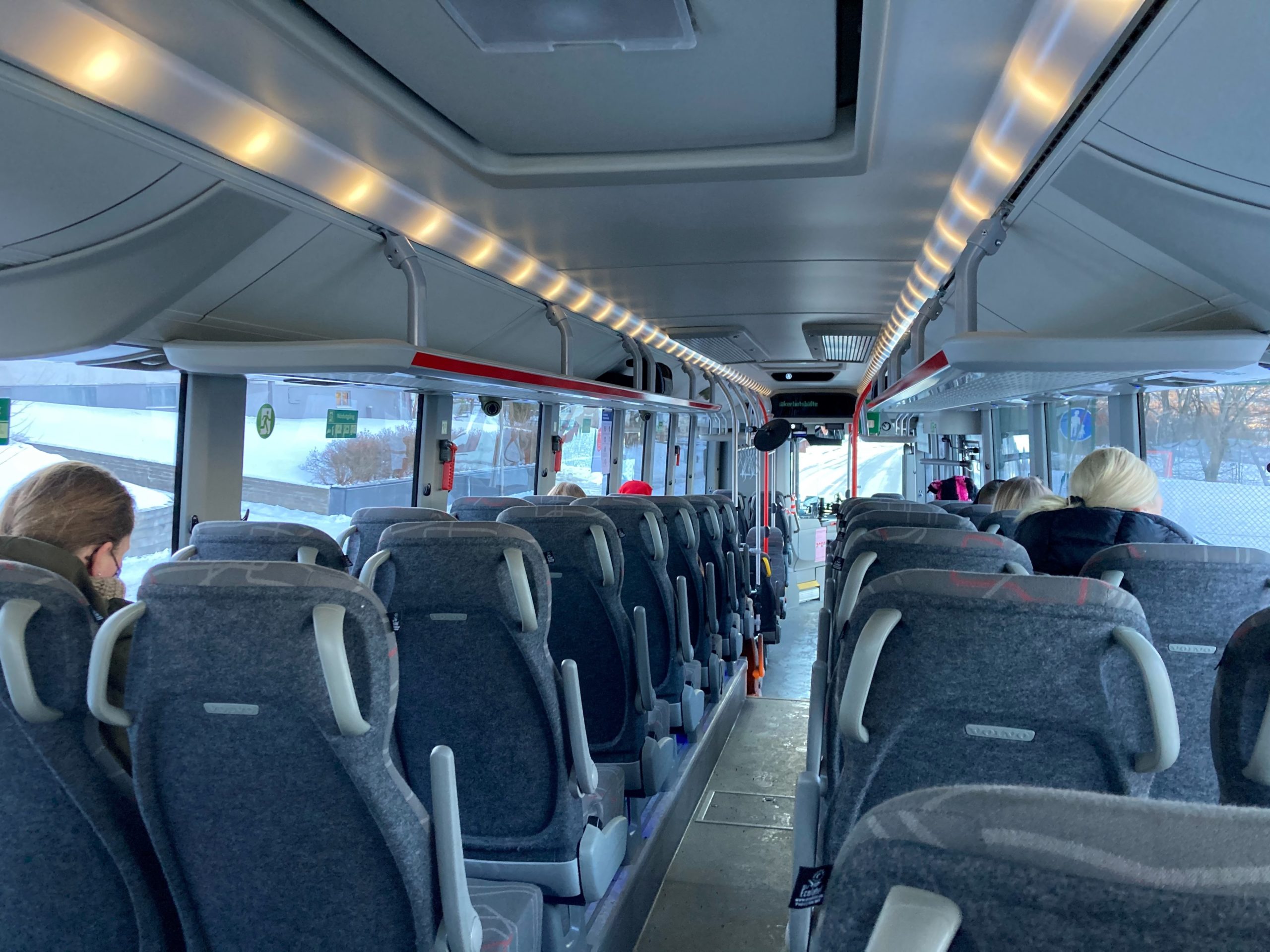
      • A must have for coming to Sweden is definingly the “Buss App” aka “journey Planner” it is a constantly updating Buss and Train monitor that can tell you all the future routes from the closest Bus stop or train station to wherever you wish to go. Other than on extreme occasions, the busses will arrive at the allotted time give-or-take 3 minutes. When you get on your buss you pay by scanning your refillable month buss pass, this is only about 20 dollars for minors.
      • The first big mistake I ever made was on my first week of school. Making the assumption that the bus station in the town I went to school in was the only bus station in all existence and the mother ship of all busses ever to roam the world. So I got on a totally random bus and simply waited for it to arrive at the bus station. However… I was soon to realize that there is a bus station in every sizable town and the buss I was on wasn’t even coming close to my town at all. The driver realizing I was a total Morton called some of his bus friends and brought me to the first bus station that had a bus going to my home town.
    • Changing busses
      • This was one of the hardest parts for me because you will often find yourself at bus stations with several stops all with the same names, you can get confused like myself as to where you should wait. Your host family probably won’t see the point in explaining the bus system because they lived with it their entire lives, so make sure to either ask questions or learn fast. In the beginning always double or triple check the stop you are waiting at and the time you should be there.
        • On my first trip to school form my new host family in a city far from the one in which I go to school, I got terribly messed up in a bus station. Usually I would take a longer bus to the nearby big city and take the train, but today was different. I got on the bus from my house and got off at a circular bus station with several stops. I knew the bus I was waiting from, but I had no idea where to wait. After about an hour I’d had three whole busses leave me as I was running after them. One of my problems being I hadn’t gotten a SIM card yet so I had no wifi to check the Buss App. Eventually I realized I would have to catch the first bus home and start all over. However! I realized that instead I could take the first buss to Jönköping and from there I would take the train like usual. I succeeded in my endeavor and will forever remember it as a win for me! … even though I got to class a hour late.
      • The Buss (and train) Police.
        • Now these guys are the real trouble… built like a cross between The Incredible Hulk and a literal Bolder, these guys com on to busses randomly, in uniform, in groups and check that everyone has paid and are following all of the rules. For an American student this means the following:
          • They approach me and ask for my Buss Card
          • Upon scanning my card they will realize I have a minors card (I don’t look 16)
          • Now they want my ID to prove I am 16…
          • Upon looking at my Drivers License they will see I am American
          • NOW I have to give them my Residency permit card to prove I’m not an illegal alien and then finally they will leave me to be.
    Catherine in front of her bus stop.

    I dramatize this of course, but I can’t stress enough how important it is to have all three cards on you at all times. Another problem that can occur with The Buss Police is refilling you bus card. This story is a rather humorous one for me, so much so that I almost forget sweating bullets during it.

    Every month your buss card will run out one day before it was purchased the previous month, so if I bought my card on the 1st (like I do) then on the 31st it will run out. But if I keep refilling it the same day it runs out then the day will keep moving back and I just like a little more structure than that. So I use my expired buss card every month on the first to go to the buss station and refill it. This is possible because (especially with COVID-19) the bus drivers don’t require you to scan every time, usually simply reaching for your card will work and they will wave you on. One day however, it occurred to me that if The Buss Police were to come on the 1st then I would kind of be in trouble. My argument “that’s ridiculous I’m sure everyone refills their card on the 1st so why would they check? Aaaaaand I’ve only ever seen The Buss Police three times since being here, it’s terribly unlikely, terribly indeed…

    Long story short — The Buss Police totally came that day but after I promised I was on my way to refill it right now they let me go!

    The front of the buss is the number and end destination, this is also the name of the buss on the buss app


    The back of the bus shows just the number .

    Watch this video below to see how Catherine books her bus ticket:


  • The Swedish School System from an Exchange Student’s Perspective

    The Swedish School System from an Exchange Student’s Perspective

    I’ve been in school here in Sweden for a little over two months! Time has gone by so quickly but I’m really enjoying the experience of going to highschool and staying with a host family. There are quite a few differences between the school systems that I noticed quite quickly! I arrived in Sweden by train from Copenhagen in the late afternoon on Saturday and met my host family for the first time. Everything was so new and a little scary, but they made me feel right at home by showing me around the house and having fika as soon as we arrived. Despite feeling more comfortable at home, I was starting school on Monday! I was nervous and I didn’t really know what to expect.

    Early Monday morning my host father Mikael walked me to the school and we met with some teachers. I am attending gymnasieskola , the Swedish equivalent of highschool. They gave me my schedule and a laptop and my media teacher, Tommy, took me upstairs to the media room, which is full of computers and cameras. The first big difference between a Swedish and American school is how you address the teachers. In Sweden, they always go by their first name and would find it strange if you address them as Mr/Ms. This takes a little getting used to as I’ve been taught since kindergarten to always use Mr/Ms when talking to my teachers, but I enjoy calling teachers by their first name. I think it makes them seem more like a friend instead of an authority figure.

    Secondly, the grades in school are a bit different from America. As I said, I’m attending gymnasieskola –– sort of like American high school. It has three grades and people are usually ages16-19 when they attend.

    Here is how it’s laid out:

    Förskola and Förskoleklass – like preschool, ranging from ages 1 through 6
    Grundskola – 9 grades, sort of like elementary and middle school + freshman year of highschool. Ages 7-15. It’s divided into 3 sections:

    • Lågstadiet (grades 1-3)
    • Mellanstadiet (grades 4-6) and
    • Högstadiet (grades 6-9) Gymnasieskola – 3 years, much like the last three years of American high school.

    Despite being 16, I’m taking 2nd and 3rd year classes so I can experience the photography and media program more. Normally, a 16 year old would be a year one student in gymnasieskola !

    My first media class had only four other students, and in my experience, many of the class sizes are small to medium depending on what you are used to. Some of my classes range from 5-10 people and some of the bigger classes like math have 15 students. In Sweden, Gymnasieskola is much more tailored to your interests and future career than American high school. My school focuses heavily on media, journalism, and digital arts. That isn’t to say that we don’t have math and language classes as well. In my application process, I was able to express my interests which helped me get into a school that was a good match for me.

    And lastly, the biggest difference! The schedule in Swedish school is basically the polar opposite of American schools. When I first received my schedule I was confused about the large empty spots between classes. I asked one of my new friends and they told me there were no classes in those spots and I could do whatever I wanted. I was shocked! In America, at least at my school, classes are back to back and you can’t leave the building freely or be in the halls while class is happening. With these large breaks in my schedule, I am allowed to leave school and do whatever I want whether it be going for a walk, going to a cafe or the store with friends, or heading to the lunchroom. This freedom reminds me a lot of what I’ve heard about a college experience and I really enjoy it. I feel much less stressed about school and I have time to do things I enjoy doing.

    Swedish schools also don’t take being late or tardy seriously, which is good and bad. On one hand, it’s nice to not be punished for being a couple of minutes late. On the other hand, sometimes students come in 20-30 minutes late and end up missing most of class. I definitely recommend trying to be timely if you’re thinking of attending a Swedish high school! You’ll get much more out of the class and it’s much nicer for the teacher. Going to high school abroad is an amazing and invaluable experience, and I hope this insight helped. Thank you for reading!

  • Managing Money Abroad as a Teen

    Managing Money Abroad as a Teen

    We all make mistakes, and when you travel across the world there are even more opportunities to mess up. One of the easiest areas to mess up is in managing your money. It is a great time to learn, but a hard one as well.

    As a 17-year-old person, I am in the first years of my life where I get to have a job and my own money. Learning how much things cost and how to save your own money is one of the toughest lessons to learn. Luckily there is a grace period when you are young when you don’t have to buy as much as adults. Although this is true when you are traveling there are some differences. There is so much more to do that is new and everything costs money. When living with a host family it is often your responsibility to pay for yourself when eating out, or tickets to things or when you are out with friends.

    Before I left on my exchange my parents were constantly worried about me having enough money, telling me how expensive things were going to be. Because they were worried, I did a lot of preparing and fundraisers. I didn’t like doing them and thought it was kind of overkill but I was very glad that I did. You want to have freedom while you are traveling and that takes money. So do some fundraising, get a summer job, and look for scholarships.

    Once you are off and to your new country you have a set amount of money. To make sure your money lasts you, the best thing I found to do is find a balance. Instead of getting coffee fours days a week, make it a special thing on Monday. There will be things to do that cost money and you want to be able to do them. But there are also free things to do, like spending time walking around just enjoying your city or town, or watching a movie at home with microwave popcorn.

    Even if you think you are doing a good job and finding a good balance you could still look at your bankcard statement at the end of the month and see that you spent way more money than you thought. Before you go, learn the currency conversion from your home currency. Although I thought I had a pretty good idea, when I did the math in my head with some rounding I often found myself spending more on something than I had calculated. I recommend a currency converter app on your phone to make sure you know how much something costs. With my bankcard, there were also some international charges, which could add up. Checking with your bank to find out what the fees are is a good idea.

    There will be things that cost money that are worth doing so on your personal budget find a balance. It’s easy to rationalize buying things or spending money sometimes when you are going through a rough time. Some weeks or months you will spend too much money, but you have to be able to notice it and do better the next time.  It’s a hard part of traveling but a great lesson to bring home with you.

    Fiona MacDonald, from Cantwell, Alaska, is a Greenheart Travel First Time Traveler Scholarship recipientLearn more about Greenheart Travel’s scholarship opportunities to help you travel for a change!

  • Make the Most of Your Travels by Getting Involved: Play Hockey in Sweden

    Make the Most of Your Travels by Getting Involved: Play Hockey in Sweden

    When I chose Sweden as a country I wanted to study in I knew I wanted to be able to play hockey. I have been playing hockey since I was about 8 years old. Growing up in Rural Alaska it brought me so many opportunities to travel and meet kids who enjoyed the sport as much as I did. Although I wanted to play hockey in Sweden I kept an open mind, as it isn’t exactly a sport you can play anywhere. But once I got to Gothenburg and got settled a little I started to think about playing hockey.

    Playing indoor beach volleyball with my class for PE.

    Unlike in the United States, sports are not a part of school.

    This means that you have to look for community leagues to play sports and can involve a little searching in a big city like Gothenburg. It also means that you probably play sports with all different kids than you go to school with which is much different than at home. Because I couldn’t use my school to find sports I turned to Google! “Recreational Hockey in Gothenburg,” I was able to find  a website for the Gothenburg Hockey Club. On the website I found a practice time for the Rec team so one Tuesday night I found my way to the hockey rink which turned about to be only 15 minutes from my house, a huge improvement from the 50 I drive for hockey at home.  Before I watched I had no idea what to expect. I didn’t know if it was kids or adults, old or young. It turned out to be mostly men and a couple of girls all gathering for a fun game.

    Enjoying the Very famous Swedish pastry Kanelbullar on Kanelbullens Dag.

    The next week I went back, now knowing more what I wanted, kind of. :))) Being here I have gotten good at not being scared to ask questions and to not beat around the bush as I know when I approach people speaking English they will be slightly caught off guard so I keep it simple. I walked up to the counter at the arena and told the lady “ I am a foreign exchange student and I want to play hockey” She said she didn’t know what I had to do to play but she took me to a guy who I again told “ I am a foreign exchange student and I want to play hockey.” With that he asked me if I had gear, I didn’t, so he found another girl who from the extra gear closet found me a whole set of gear. Once they got me the gear they invited me to play in the game that night.

    So in about 20 minutes, I went from not playing hockey to playing hockey in Sweden.

    It was a pretty crazy experience sitting on the bench in a hockey rink with a bunch of Swedish hockey players.  They were all so welcoming, but really I’m not surprised as so far in my journey as a hockey player all people who come together to play a game are. After playing in that men’s game the girl who helped me get the gear invited me to play with a women’s team the next day. That is the team I now am playing with on a regular basis. The team practices a couple times a week and has games on weekends. Playing with the women I have made many friends. At school, I found it a little hard to find people that had the same interests as me. Because school and sports are so separated and coming in not knowing anyone or speaking the language it is quite hard to find out what kids are interested in which makes it hard to find kids you even want to be friends with. Playing a sport creates a group of people that at least have one thing in common.  but all girls who play hockey get along very well. After a long day at school or frustrations at home, it is always nice to be able to go to hockey get lost in the game and enjoy the crazy locker room shenanigans.

    Most of the students studying abroad from around the world that are living in Sweden as Foreign Exchange students.

    The coach does give the directions for drills in Swedish, luckily many of the words are similar and my coach draws it on a whiteboard. I always try and understand the best I can but if I don’t understand I ask for the directions again in English or one of the girls is always willing to explain. On the team, there are two other girls who don’t speak Swedish but have been in Sweden a little longer as both go to university here so they understand more of the drills and can help me. Although some words are similar I have learned a few important hockey phrases in Swedish. For example, I learned left, vänster, and right Höger, so I know which side wing I will be when someone comes off the ice yelling it during a line change.

    I am far from home but hockey makes me feel a little closer.

    No matter where the rink is or what language the coach is speaking its still the same. I even found the coach repeats the same things like “keep your head up” something apparently every coach says a lot. Skating still gives me the same feeling and being apart of a team is still the greatest. I couldn’t be more excited to get to play the sport I love while living in Sweden!


    Fiona MacDonald, from Cantwell, Alaska, is a Greenheart Travel First Time Traveler Scholarship recipientLearn more about Greenheart Travel’s scholarship opportunities to help you travel for a change!


    Are you also a first-time traveler? Sweden may be the place to start your adventure!