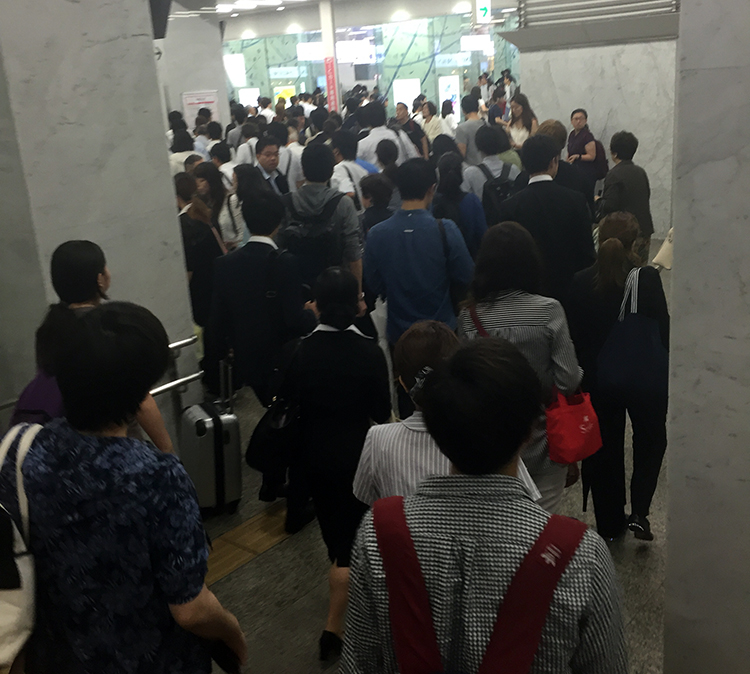
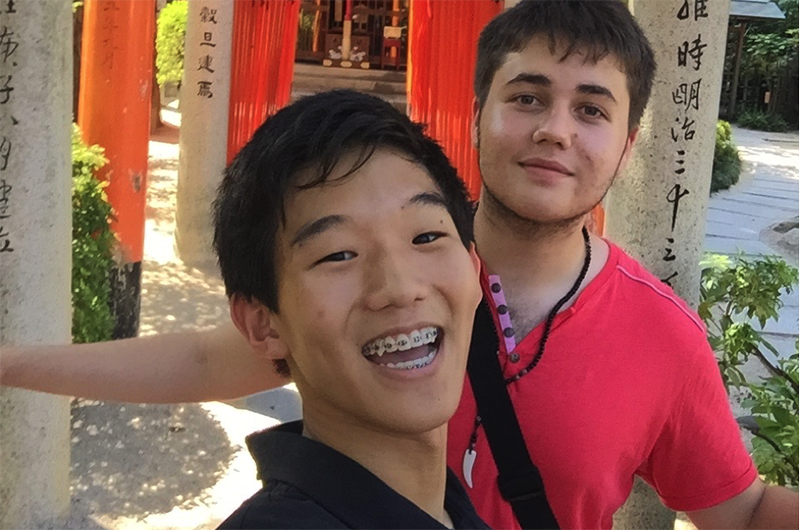
My total impression of my language camp in Fukuoka was overwhelmingly positive. I made a bunch of new friends and I lived in Japan not as a tourist, but as a normal student. Taking the train and walking among crowds of people was an experience I didn’t get on my previous trip to this country. I was really nervous on my first day, but I was alright because everyone else seemed to be nervous too. I made friends on the first day, too. It was awkward at first, but it got better from there.
Japanese Food Scene
The food scene in town was interesting too, because there were so many ramen shops. I quickly tired of ramen, and proceeded to avoid it. I liked eating the baked goods that I could find there, which were delicious. My host family also cooked a variety of things, with there always being meat or fish at the center of our meals. The dinners I had with my host family were always nice, with there being a variety of foods at hand to choose from. There were a lot of bento places as well. Even though Japanese food isn’t my favorite, I found foods that suited me.
Learning the Japanese Language
I am and was quite under-confident in my speaking skills of any foreign language (my Japanese is a little better now) and was super afraid of making mistakes, so I didn’t talk much with my hosts for the first few days. Dinner was awkward at first, since all I did was quietly listen. I built a better relationship with my hosts over time, and began growing more confident in talking with them. I think that the key is time.
Even if you are not confident in your ability, that feeling can go away with time and practice. I’m glad I stayed three weeks, and wish I could stay longer to improve more. Sometimes it is a bit lonely being more or less alone, but like I said before, time is key. You will get over those feelings of loneliness and work to understand your surrounding environments. As I’m writing this at home, I kind of wish that I was back in Japan! It is still weird being here, not having to struggle to speak a different language. I kind of miss that, because every moment was a learning experience.
Managing My Money Abroad
I also learned how to better limit how much money I spend during my time there. I had to pay for my public transportation and most of my food costs, which adds up to a lot of money. The minimum amount per day can be at least $15. I only spent 500 yen on a gift for myself, and I blew most of my money on gifts for my family. I learned more than just how to get around in a foreign city during those three weeks.
Weekend Adventures in Japan
On the weekends, I went out with my host family, and for the most part didn’t speak English during that time. One day we went to a friend’s house, and played video games and pretty much just hung out. The good thing about language barriers is that they don’t apply when playing video games. We had dinner and played card games as well. At the school that I attended we were taught formal Japanese, which is generally useful, but kind of stuffy sounding in an informal environment. I learned a lot about informal language when I was with my hosts, and Informal Japanese comes a lot easier to me than formal language.
We went to Dazaifu Tenmangu Jinja when the rain was pouring, which did end up with both me and my host sister having some very wet clothes. I tried mochi, which was the shrine’s specialty. It put most mochi I had tried so far to shame. My hosts treated me so well that I was sorry to leave without giving some sort of goodbye gift.
Language Classes at the School
School was very good. It started at either 9:30 a.m. or 10:30 a.m., and I didn’t get home until 6 p.m. Japanese classes were four hours long, and were generally useful. I began to learn about the enigma that is Japanese grammar, and about formal language as well. Japanese has several levels of formal and informal speech, which sounds a bit daunting, but is easy to understand. I usually hung out with my friends during the 50 minutes we have for lunch, buying either bento, ramen, or sweets to eat. The activity class is a class where we either do something like pottery or ikebana, or we go on a tour of sorts. It takes place either in the morning or the afternoon. It’s usually very fun; I got to spend time with my new friends, I tried new things like taiko, and I got to walk around town a bit.
When I hung out with my friends from school, we usually walked around town and in malls. We were always looking for food. My German friend always wanted ramen, even though she had it practically every day. We were an interesting group of nationalities: Turkish, German, Spanish, Canadian, American, and Taiwanese. My Turkish friend and I liked talking about geopolitical memes, an edgy subject that is full of racist and bigoted humor. There were always things to talk about. I asked my friends about their home countries, we talked about why they came to Japan, and about the state of the world. I will miss them now that I left.
I had such an eventful and fulfilling time in Fukuoka thanks to Greenheart Travel, GenkiJACS, my host family, and most of all my family for giving their support. I’d most definitely recommend this experience for anyone who wants to learn Japanese or travel to Japan.
Aden Jibril is 15 years old and lives in Oakland, California. His goal during his language program in Fukuoka, Japan is to “learn to cook at least one Japanese dish, increase my language skill, and to interact well with my host family.” Follow Aden’s adventures in Japan on his weekly blog post updates.
My daily routine in Japan is waking up at 7:30 a.m in the morning to get ready for school. During that time, I would finish any homework that I didn’t do the previous night, brush my teeth, text my friends and family, and prepare for school. By 8:15 a.m, I leave my homestay house to go to Fujisaki Station in which I take the subway to go all the way to Hakata Station. By the time I get to Hakata Station and travel to my school, it’s around 9:00 a.m in which I have 30 minutes to spare until class starts.
Check out my daily commute to the Japanese language school:
At 9:30 a.m, I have Japanese Language class all the way up to 1:10 p.m. There are 5-10 minute breaks between classes, but each class is around 1 hour long, so usually I try to bring a snack with me to eat during breaks.
At 1:10 p.m, I either go to the supermarket or a guy that I like to call “The Bento Guy” because he sells cheap bentos for only 300 yen ($3 in USD).
At 2:05 p.m., I have activity class that goes into either the culture class or the pop-culture class and we do fun activities until 3:50 p.m.
After activity class, I either go straight back to my station, or I go with my friends to a place that we want to go to such as an anime store, a CD store, or to the mall. Then I go home to meet Mahiru and Ms. Chikako to eat dinner. My favorite foods so far is chicken karaage, somen noodles, ramen, gyoza, and curry with rice and chicken katsu.
After eating, Mahiru helps me with my Japanese homework. Then it’s free time until 11:00 p.m and then I go to sleep and the day repeats. I have gotten used to commuting to school and have picked up some tips to share with future students.
Tips for Future Students
One tip that I can give for anyone who is wanting to travel abroad to learn a new language is try to prepare yourself beforehand. I know that a lot of the students who started at beginner’s level were still having a hard time even though they were just beginning. I think you should try to learn and master the basics before learning it during class, that way you have an easier time to adjust to the teacher’s pace and the classwork/homework that they give you.
Another piece of advice for anyone who wants to travel abroad to learn a new language is to speak out. I know that trying to immerse yourself into another country that speaks a different language than yours is going to be very difficult and challenging but try to communicate to the locals and other people around you. Don’t be afraid to speak whenever you feel like you need help, even though they may or may not understand you. Just don’t be shy trying to communicate in a language that you have little to no experience in speaking and just try your best to ask for help.
What I’ve Learned About Myself During My Time in Japan
I learned a lot about myself during my time abroad in Japan. I learned that I can actually handle public transportation a lot better than I expected. In Hawaii, I have never used a bus nor is there any subway stations. By going to Japan, I’ve had a great experience in using public transportation, that I probably wouldn’t have learned in Hawaii because I never use it.
I also learned that I truly enjoy making international friends from all over the world. Not only have I made friends at school and my host family’s home, I’ve been able to make friends from Japanese schools as well as some of Ms. Chikako’s friends. This has been a great and amazing experience overall and I feel like I’m going to remember this trip forever.
Duke Takeno is 16 years old and lives in Oahu, Hawaii. His goal during his language program in Fukuoka, Japan is to “learn the language, connect with the other students in the program as well as my host family, and to enjoy what Japan has to offer. I can’t wait to begin my adventure!” Follow Duke’s adventures in Japan on his weekly blog post updates.
I just finished up my third and final week of my language camp in Salamanca, and I miss it so much already. I met so many incredible people during my travels that I will remember for a lifetime. Here are a few of the people that shaped my experience.
My Spanish Host Family
My host family was extremely kind and welcoming. They always asked me how I was doing, and were able to help me with anything I needed. They made an effort to teach me new Spanish vocabulary, and helped me with my grammar when I didn’t understand. Nerea, the two year old daughter, was very cute, and she always played with me!
My International Friends
Meeting new friends was one of the best parts of traveling abroad. I met friends from every corner of the world. I was able to embrace and learn about Spanish culture, while learning about the culture of the homes of my new friends!
My Spanish Teachers
My teachers were all so wonderful. They held discussions in class everyday, and really cared about the students. Each teacher truly had a passion for their job and was excited to be at school.
Allie Larman is 15 years old and lives in Berkeley, California. Her goal during his language program in Salamanca, Spain is “to learn and try Spanish dance styles such as Flamenco while I am in Salamanca. I practice American dance at home, and I hope to broaden my dance horizons.” Follow Allie’s adventures in Spain on her weekly blog post updates.
These past few days I have been waking up late enough that I am the only one in the house. Everyone has left for their various occupations. On Saturday, this happened, though I did wake up much later than the rest of my host family, at about 10:00 a.m. My host brother came back a few minutes after I sat down in the kitchen/ dining room, but left soon after. I waited out much of the day before my host mother, host sister and I went to Kurume city to visit the grandparents.
The good thing about more rural areas in Japan is that they are really peaceful, with many rice fields and mountains in the backgrounds. It is a type of rural place that I would like to live in, as compared to the more rural places in America (just my opinion, not something to over-analyze). The clouds were white and puffy, and Thetes rivers sparkled in the evening sunlight.
The grandparents of my host family were very accommodating, and the Grandfather spoke English rather well, as he had traveled to the U.S. on numerous occasions. They took us out for Okonomiyaki, which was delicious. We ate Yakisoba as well.
Did I mention that Japanese people seem to like using a lot of mayo on things? My host father mentioned it one night when we were eating salmon, that Japanese people like mayonnaise. He had put what seemed like WAYY too much mayo on his salmon, practically smothering the fish. Anyways, most of the talking was done among the others in our group, as talking to me would be mostly one sided.
My vocabulary in Japanese was and is very limited. After arriving at their home once again, the Grandfather showed me pictures of him and his wife in the American Southwest, on their most recent trip. That day was good because I was not sad. I was worried that I would not be able to go gift shopping during the trip.
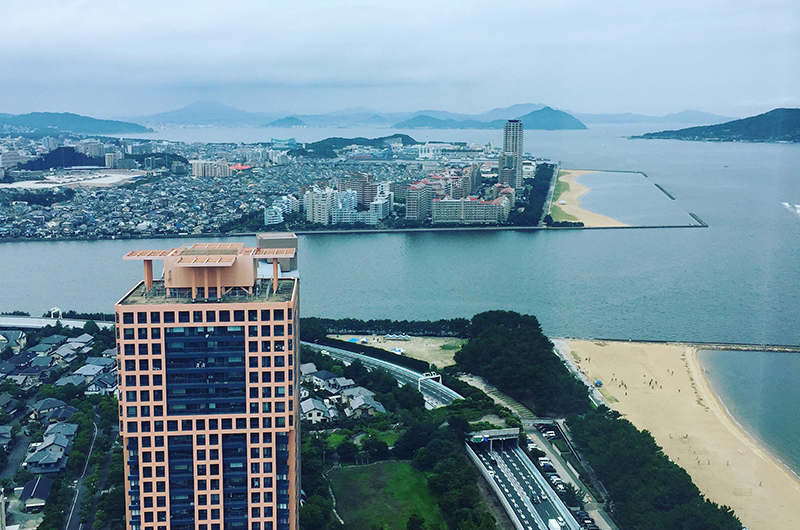
The day after, I went to Fukuoka Tower. It gave a wonderful view of the Sea, the mountains, and the outlying islands. I did not spend much time there, as one can only spend so much time staring at the view. Afterward, my host brother, his friend, and myself went window shopping in Tenjin, a commercial district in downtown Fukuoka. We spent the evening playing video games and eating karaage bento.
Any Japanese shopping center will have at least one or two stores that have products or signs in English that make no grammatical sense. It is quite off-putting, but I said nothing of it. My handwriting is almost as much as an affront to English as those places. I always find it funny when I see Japanese people walking around with nonsense english on hats or shirts, just as much as when I see Americans with nonsense katakana on their clothes.
I did not talk much that day, because I was struggling to understand what people were saying. With my vocabulary, it is a near impossible task.
On Wednesday I took a calligraphy class, which was stressful, but fun. Calligraphy is very meticulous and it is very easy to make an error. My hands kept shaking, but I managed to do well enough. We practiced using the character夢. We also made our own signature stamps, with kanji used to represent our katakana names.
After that, I went to lunch. I went around the corner to get something from the street vendor I call the “Bento Guy” because I don’t know his name. He is very popular with the students at the language school. He sells all of his items for the same price: ¥300. That is pretty cheap considering that the food is good. After lunch comes four hours of Japanese lessons, which can be pretty tedious at times, but I have learned a lot.
After class, I went to buy gifts for my family, and spent about 76 USD and am still not finished yet. They are good gifts though, so I am not worried. I did want to try the cafes and restaurants in the shopping center in which I bought the gifts, but it seems I won’t have time. There were so many other things I want to do here too.
Living in Japan is something that I realize would not be an achievable goal for a gaijin such as myself, nor is it something I particularly want to do. Visiting is great, but sadly, time goes by fast, and is soon becomes time to return home. My hosts have been welcoming and considerate of my language difficulties. I am also sad to be leaving my new friends, who came here from all over the world, and whom I probably will never see again. I am leaving my language camp tomorrow, and two days later I am leaving the country. I hope I can remember the events that happened in these past three weeks in a good light, and I am sure I will.

Aden Jibril is 15 years old and lives in Oakland, California. His goal during his language program in Fukuoka, Japan is to “learn to cook at least one Japanese dish, increase my language skill, and to interact well with my host family.” Follow Aden’s adventures in Japan on his weekly blog post updates.
Greenheart Travel is excited to send a group of amazing high school students to study abroad as part of our 2016 Travel Correspondent Scholarship awards. To help introduce our inspiring writers, we are doing a series of spotlight interviews to help you get to know a little more about who they are, where they will be headed and what inspired them to study abroad.
Read on to meet 16-year-old, Cassidy Bopp, our Greenheart Travel Correspondent from Saltsburg, Pennyslvania who’ll be traveling abroad to study in Costa Rica!
Favorite thing to do in your free time?
In my free time, I like to take pictures, go for walks, and hang out with friends.
Have you traveled abroad before?
No, I have never traveled abroad. This will be my first time!
What got you interested in learning a new language and studying abroad?
For as long as I can remember I have wanted to travel, but taking a Spanish class my first year of high school got me even more interested in learning different languages and experiencing other cultures.
What are you most excited about experiencing or seeing during your high school abroad program?
I am most excited to meet new kinds of people and expand my mindset and knowledge when it comes to other cultures.
Why do you feel it’s important to travel to a new place and experience a different culture?
To me, it is important to travel and experience different cultures in order to learn that the way your culture is, is not the only right way to live. It reduces ignorance and shows you how much is out there in the world.
What are you nervous about?
I am nervous about communicating with people in the beginning, because my Spanish is far from perfect.
How have you prepared for your time living and studying abroad?
I have prepared by spending several hours reading about the culture, food, weather, and more. I have also done a lot of Duolingo to improve my Spanish, looked at the regional dialect, and found people from my host city to follow on social media to see what it’s like.
How do you think you will change the most during your time abroad?
I think my Spanish will improve significantly, along with my stress management in certain situations and my knowledge of the culture.
Cassidy Bopp is 16 years old and lives in Saltsburg, Pennsylvania . Her goal during her study abroad program is to “gain a better understanding of the culture in Costa Rica and to see more of the world, and really take it in and appreciate it to the fullest.” Follow Cassidy’s adventure in Costa Rica on her blog post updates throughout her program.
This week has been a hurricane of emotions, from wanting to go home really badly and then crying because I have to. There is nothing quite like traveling abroad. It’s the best thing ever, but be prepared for what it does to your insides.
Poor Kevin
One of my favorite things is learning strange things about another culture. Example: One German friend explained that getting called a ‘Kevin’ in Germany is an insult, to which all the other German students nodded in agreement, muttering things like “yes, no Kevin,” and “Kevin is a bad thing,” while my friend went on to say that a close English translation for Kevin might be ‘dumb***’. And since I met more German-speaking kids than any other, I also discovered that they seem to be born Type A (in a good way).
I saw them picking up empty water bottles in the park, making lots of lists, making sure everyone else’s water glass was always full when eating or taping every receipt for everything they bought into a journal. Another weird one (to me, anyway) is that every male in Italy wears Speedos at the pool. Every single one. No matter what their body looks like. I mean, #beconfident, right? Unfortunately, there are too many more to mention (I’ve been so tired this week I can’t even remember them), but I’ll have some good conversation starters for years to come.
BFFS R GR8
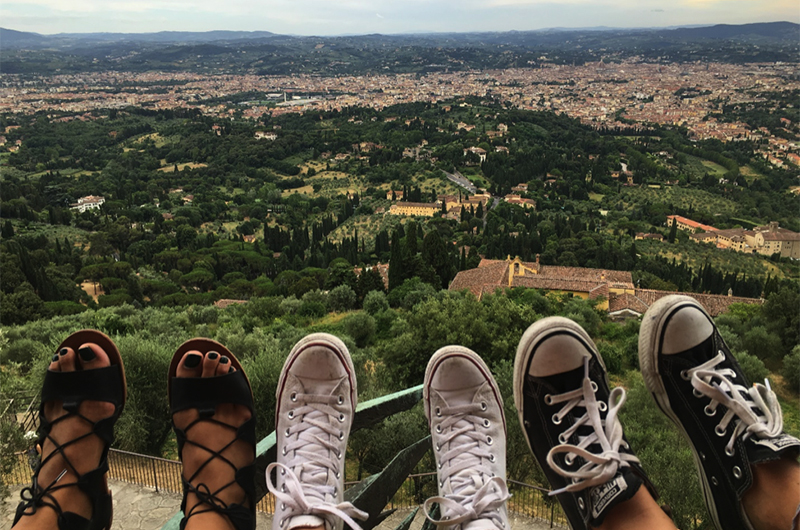
Me & The Girls Near Florence.
It is shocking how close a group of adolescent females can become in a matter of five days. I had to say goodbye yesterday, and suddenly said group of girls was blocking sidewalk traffic to partake in a massive group hug. There was a little crying involved; we don’t need to mention it. What I’m saying is, you will make some of the best friends you’ve ever had. You will share the same experiences, the same adventures, and even the same challenges.
From trying to force our tongues to make new sounds, to playing slightly inappropriate games of water bottle toss in the street, to pigging out at the design-your-own-ice-cream-bar Magnum Store every single day, not to mention Karaoke, late night walks, and shopping too long, these were the best two weeks of my life.
My new friends at getting ice cream.Ice cream from the Magnum Store.
Pokemon Go and #TaylorSwiftisoverclub
Something inevitable about traveling abroad (and probably beneficial) is that I haven’t been able to keep up with the Kardashians, or anything else. I am just now finding out about Pokemon Go and Taylor Swift vs. Everyone. Stuff like that doesn’t really matter when you’re busy soaking up a whole other culture. Other inevitable things: so much walking, not nearly enough sleep, and occasional frustration.
But there are things on the other end of the spectrum as well, including: so many friends, so much knowledge, and so many sights to see. You’ll find that there are lots of things that can’t be helped, but if you can roll with the punches, it will all be worth it.
Relaxing on the pier at the Italian Riviera, Cinque Terre.
Daily Excursions
Attending a Greenheart Travel language camp in Florence means that I get to go on fun excursions every day, including visits to museums, landmarks, and even the weird pool (Speedos, see paragraph no. 2). These excursions give you the chance to become even closer to your new friends while seeing all kinds of interesting new things.
Botticelli’s Birth of Venus in the Uffizi Art Gallery.Ceiling at the Piazza della Signoria.
I do have one crucial piece of advice for you though; keep track of your personal belongings at all times. You don’t want to lose your money or passport, much less an expensive pair of Ray-Bans. Yeah, I had my sunglasses clipped to the outside of my book bag for, like, five seconds and they got stolen (maybe don’t bring expensive sunglasses), but that isn’t my point here.
What I’m talking about is that I have amazing activities planned for me every day! And during the weekend, there is always a day trip planned for both Saturday and Sunday. I was lucky enough to be there the weekend that a Cinque Terre trip was scheduled and have never seen a more beautiful place. I took some awesome pictures like the professional photographer I think I am, even though I was on the hardest hike I can remember.
View from my hike along the Cinque Terre.New friend near Cinque Terre.
I’ve said it before and I’ll say it again: these two weeks have honestly been the best of my life, and it will be bittersweet to get on the plane to go home. My advice is to never be scared of what’s out there, and if there’s ever a chance to do something like this, then absolutely, positively, take that chance.
Libby Crecco is 14 years old and lives in Clarkson, Nebraska. Her goal during her language program in Florence, Italy is to “learn as much about Italian culture as I hope to learn about the language.” Follow Libby’s adventure in Italy on her weekly blog post updates.
Over the past two weeks, I’ve had the opportunity to learn Spanish in an immersive teen summer language camp in Costa Rica. During my time here, I have improved my language skills greatly and learned a lot about the best ways to learn a new or previously studied language. I have also had a lot of fun doing so, and I’ll include some photos of my favorite activities so you can partake in my trip!
Before I dive into what I’ve learned, I’ll give you a briefing on the Spanish background I had before going into my time in Costa Rica. In the States, I have taken 4 years of classes at my school, and during those years I had accumulated a lot of knowledge. I could write a decent paper, get a good grade on a test, and carry a somewhat staged conversion.
My speaking ability going into these two weeks was minimal, and I lacked a lot of crucial vocab to carry a conversation. That was my Spanish foundation going into this program, but my first piece of advice is to not let your current language background prevent you from stepping out and further learning a language. We all start somewhere, and now is always the best time to further your language skills.
Me “jumping” right in to a new culture and language while on a zip-lining excursion in Costa Rica.
With that, I have three pieces of advice to improving your language skills:
Immerse Yourself in the Language
The best way to learn a language is to surround yourself with an atmosphere of which promotes learning your language. The most natural way to do this is to go abroad and surround yourself with another culture and people that forces you to use the language you’re trying to learn in daily communication.
I have found that my time in Costa Rica has rapidly improved my speaking abilities, much faster and easier than four years of Spanish classes did. These classes provided me with crucial knowledge of how to conjugate verbs, form sentences, and a plethora of other knowledge that had helped me greatly, but immersing myself with a culture of learning and Spanish helped me turn that knowledge into experience.
It helped me to turn what I knew about the language into something I could use to communicate with people I would never had been able to talk to before and to partake in a different culture. The process was also a lot more natural than learning a language in a classroom in the United States, as it wasn’t done out of a desire simply to learn, but to communicate. That’s why my time in Costa Rica has improved my language abilities so drastically, as I was able to put into practice in a practical sense what I had learned in school.
Learning Spanish in my language class.
Don’t Be a Thought Translator!
When I first arrived in Costa Rica, the woman who runs the transportation service for my program told me that a piece of advice that helped her learn English was to create a box in her mind and keep everything regarding English there. That way, when she needed to speak English she could pull whatever she needed from that box. This is a very practical way to help you begin to think in the language you’re trying to learn.
Thinking in the language you’re trying to learn is an important skill because it takes a lot less time to communicate, this is particularly beneficial in verbal communication, and because it will allow for a more natural expression of ideas. This is because instead of thinking in your current language and then translating your idea to another language, which will probably be different in form and structure, you can simply express your raw thoughts in your new language.
My friends and I at the Universidad de San Jose.
Poco a Poco
Poco a poco is a saying in Costa Rica that I have heard many times in the two weeks I have been here. It means little by little, and it is a saying commonly used when people are learning something new, especially a language. This is because learning something as complicated and complex as a language is going to take time, and you’ll learn it little by little, bit by bit. Just have some patience, and you’ll find that you’ll slowly begin to understand and speak more and more. Patience and time are the essential ingredients for learning anything new, and learning a language is no exception.
I hope that these tips are of some help for you in your adventurous task of learning a new language, and I wish you the best of luck!
Speaking of adventures, it’s not just about learning a language but getting to experience new things while traveling. Like me petting a baby crocodile.
Owen Arnall is 17 years old and lives in Springfield, Missouri. His goal during his language program in San Jose, Costa Rica is to “embrace the pura vida of life so that I can be completely submerged into the culture and build meaningful relationships with the Ticos!” Follow Owen’s adventure in Costa Rica on his weekly blog post updates.
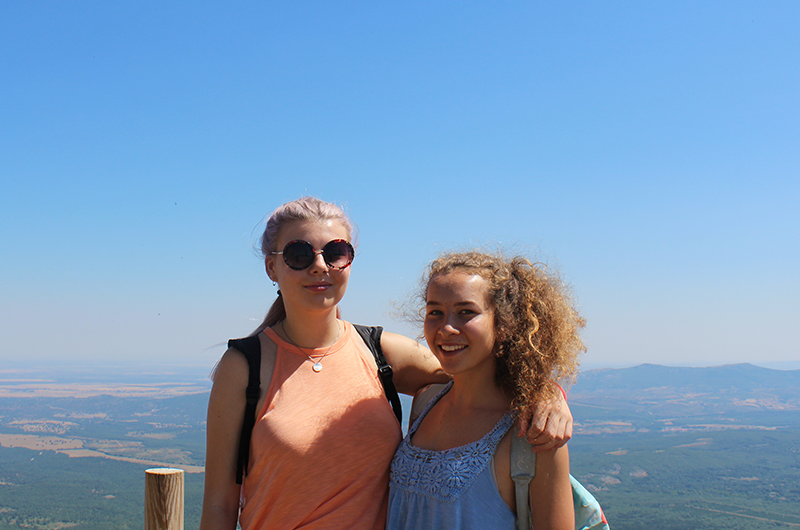
My past two weeks in Salamanca have been truly life changing. Last weekend, I visited La Pena de Francia, a little pueblo (village), with breathtaking views. I have developed an amazing group of friends who I absolutely love. Unfortunately, the majority of them are leaving tomorrow, so we are all going out to dinner tonight to wish them farewell.
My Spanish speaking skills have greatly improved, and I find myself speaking with ease in conversations with the locals and in class. I have learned innumerable things in the past in the past couple weeks here, that have helped me have the best language camp experience possible.
My top 4 language camp tips:
1. Don’t shy away from conversation in class
Speak as much as possible in class, and participate in class discussions. It is often easier to sit in the back of class, zoning out, but personally, I find class conversations one of the most helpful parts of my time here. It is extremely helpful to practice your Spanish in a safe, judgement-free, environment and get personalized feedback.
2. Try to make a variety of friends
The language camp is a very international school. Almost all of the friends I have made here are from different countries, (ex. Ireland, Bulgaria, France, Italy, Singapore). I have learned about so many different cultures, while also embracing Spanish culture. It is an amazing feeling to know you have friends all over the world, and you have someone to show you around their countries. It also forces you to practice more Spanish, as many of your friends may not speak English.
3. Get out and see the sights
While a 3 hour siesta (nap) is occasionally necessary, try to get out of the house and explore as much as possible! Salamanca is full of things to see and do.
4. Be prepared to fall in love with Salamanca
Salamanca is a truly incredible city, the people are incredible, the architecture is unparalleled, and is simply an amazing place. I am completely in love with the city, and wish I could stay forever. The thought of leaving seems like an impossible task. You may never want to leave!
Allie Larman is 15 years old and lives in Berkeley, California. Her goal during his language program in Salamanca, Spain is “to learn and try Spanish dance styles such as Flamenco while I am in Salamanca. I practice American dance at home, and I hope to broaden my dance horizons.” Follow Allie’s adventures in Spain on her weekly blog post updates.
This was my final week in Japan for my language camp program. Read on to learn more about my experiences these last few days and check out my video highlights below.
Day 14 in Fukuoka:
Today, I went to Fukuoka Tower with Kat. During the subway ride, I was talking on the phone with one of my friends and an old man was staring at me weirdly. I didn’t think about it too much and I continued to talk to my friend. When I arrived at Meinohama Station, the old man grabbed me by the arm and started talking to me in Japanese. I didn’t really understand what he was saying, so I told him in Japanese that I don’t understand.
He pulled me towards a sign that said, “When crowded, turn off your cell phone near the priority seats.” I still didn’t understand because it was neither crowded nor was I in the priority seats. So I told him I don’t understand, but I’m sorry in Japanese. He then asked if I was from China or Portugal. I kept trying to tell him America, but he still didn’t understand and started saying something that I couldn’t understand in Japanese. I knew that there was no way I could communicate any further, so I said I’m sorry, and he finally left.
I was told later on that Japan has etiquettes that they follow all the time and I was breaking one of them. I now know to never call someone on the subway (even though I saw five other people who were Japanese doing it.)
After the traumatic incident in the subway, I met Kat and we walked to Fukuoka Tower to buy our tickets to go up to the top. There was actually an English tour guide who told us the facts and history of Fukuoka Tower, which was very cool to see that they were considerate of international people. We went up to the highest floor possible and got to see a stunning view of Fukuoka Tower. We spotted our own homestay houses as well as the places where we’ve been to and it was just an amazing sight to see.
We then went to the place where they sold crepes. It was very delicious and after eating we walked to see the city lights. It was amazing.
Day 15 in Fukuoka:
Today I had to say goodbye to Kat. It was sad seeing her leave because we only got to spend two weeks in Japan, but it was cool hanging out with her. I was able to say goodbye to her at the airport as she was about to go home. It was nice being able to talk to her one last time before I had to see her leave.
I didn’t really feel safe when I went outside of the apartment this morning because there was a lot of bad omen signs that just appeared out of nowhere. For example, I saw a tons of black crows on top of a dead tree with black cats lying around it. I usually don’t care about the supernatural stuff and all those ridiculous rumors about how bad omens could bring an end to you, but it just seemed so out of place. Luckily my host family and I were going to Dazaifu Shrine, so I thought that if this is a bad omen, hopefully the shrine will take care of it.
We parked outside of the shrine and we walked up towards the shrine. There were a huge variety of shops from food vendors and ice cream shops, to samurai toys and anime goodies. We went to the shrine to pray as well as look around the shrine. It was huge because there was a museum as well as a theme park. Sadly, we weren’t able to go to both of them because it was such a far walk, but we got to enjoy the sightseeing, as well as being able to buy some cool things from the shops.
Day 16 in Fukuoka:
Today there was going to be a new batch of students who were coming to the language camp. We had three new people in my class; Candace, Joshua, and Aden (I’m sorry if I spelt your name wrong). Aden and Candace are both Greenheart Travel students and Aden is a scholarship student which is the same as me! We sadly didn’t have enough time to talk, but at least we got to know that we were all Greenheart Travel students.
My friends and I went to a bookstore after class. We decided to go to a bookstore which was near Hakata Station. There we got to see a lot of cool things that we could buy. There were Yugioh cards, books, CDs, DVDs, guitars, pianos, etc. I would’ve bought something for myself or my family and friends, but sadly I forgot to bring my money, so I could only buy a book. But it was interesting to see all these things in one store which was cool. After going to the bookstore, we decided to call it a day and went back home.
Day 17 in Fukuoka:
Today I went on an anime/otaku map tour. We were going to go to different places where we could buy anime goodies. We first went to Mandarake, and it was a huge anime store. It had everything that you would want! It had action figures, posters, CDs, DVDs, cards, manga, light novels, etc. There was just a huge amount of anime stuff which was so cool to see!
We then went to a GEE! Store which actually had an event for one of me and my friends favorite anime. It was sad because we couldn’t believe that we missed an event for one of our favorite anime shows, but we didn’t let that spoil our fun when we were looking around the GEE! Store.
After going to all those stores, I decided to stay at school to work on my homework with my friend and then back to my homestay. After eating dinner at my homestay, I went for a walk to the beach, which was only a five minute walk, and I got to see something that I wasn’t expecting…Fireworks. I guess you could say that this was my very late Fourth of July Fireworks celebration.
Day 18 in Fukuoka:
Today, I went to Kushida Shrine after my Japanese language classes were over. We went before a festival, so we got to see all the preparations. My friends and I paid some money for a fortune teller (luckily there was an English version). My friend, Deha, got moderately lucky which apparently was the second best for fortune tellings. When I looked at mine, I got very lucky which was the number one for fortune tellings. I did a small fist pump in the air and quietly said “YES” because I got one of the best fortune tellings. My friend and I hung the fortune tellings and we went to pray to Buddha for good luck.
After going through the temple with all the shrines, as well as some shrine priests and priestess in their uniform, we went to Kawabata Shotengai. It was like a mall but it had a long walkway with different shops at each corner. We even found an Owl Cafe which was one of the things my Japanese language teacher in Hawaii told me about. After finding the end of the mall, we reached Canal City Mall in which we knew our way back to Hakata Station and we left to go back to our homestay.
Day 19 in Fukuoka:
Today I did a cosplay class and we learned the history of cosplay as well as our sensei’s cosplay past. It was so interesting learning the history of cosplay. In the past, cosplay wasn’t accepted in Japan due to a horrible incident. It was the 1989 incident of Tsutomu Miyazaki which had a huge impact on people’s views of anime, cosplay, or manga. After learning the history of cosplay, our class got to do our own cosplay. I cosplayed as the Prince of Tennis, but then I noticed that I looked exactly the same in real life because I always wear collared shirts that are sporty as well as long pants.
After class, I went to Makiko’s house to visit her one more time before I had to leave Japan in a few more days. I got to meet Daiki again and we got to play chess together. After playing chess, we ate dinner which was pork cutlet and it was absolutely delicious. After eating dinner, Ms. Makiko wanted me to try calligraphy, so she taught me how to write “Happiness” in Japanese and after a long, stressful, difficult time, I was finally able to do it. After learning how to write calligraphy, it was time for me to leave and go back to my homestay to meet two Japanese students who were going to America during the winter. Ms. Chikako wanted me to talk to them in English to help them with their English language. It was cool meeting Japanese students even though they were older than me (they were both 18 years old).
Day 20 in Fukuoka:
Today was the last day that I had to go to school at my language camp. It was sad to say goodbye to all the new friends that I made from when I first started school. My friends and I agreed to hang out after class to have somewhat of a party for the people who were leaving. I finished up class and I went to the ceremony. It turns out that I was the first person to give my speech. I started to get nervous because I was the first person to speak in a language that I’m still a beginner. There were times that I messed up, but I believe I delivered my speech in a way people could understand. After getting my certificate, I got lunch with my friend Deha and we waited for the people who were coming bowling with us to arrive.
Apparently, I forgot that sometimes students have different classes, some are in the morning and some are in the afternoon. My friends who were going bowling with us had classes during the afternoon, and it would take us 2-3 hours of waiting in the lounge before we could go anywhere. So my friends and I decided that we would go somewhere else besides bowling. We went to the station where our sensei recommended us to go and we had trouble right when we got there. We didn’t know what the bus looked like and none of us knew Kanji or that much katakana. We asked an old lady for help and she told us to wait for a while and the bus would come to get us. We waited and finally the bus that looked like the one our sensei described came and we went on. We waved goodbye to the old lady and she made a X with her hands and I started to freak out.
Luckily though, we were on the right bus and we went to the onsen safe and sound. We got to go inside and take a nice hot bath as well as style our hair. We went to eat dinner and dessert where I finally found shave ice after two weeks of searching.
Day 21 in Fukuoka:
Today I had to start cleaning up my room so that the next student who is coming tomorrow would have a nice clean room. It took me a while, but I’m used to cleaning my room because my mom wants me to clean the house every Friday.
I finished, and I started to get hungry, but I knew I wanted to go to Tenjin to look around the area. I told Mahiru about my plan and he said sure. After eating I looked at my phone to find if there was anything near me that peaked my interests and sure enough there was. There was a Tower Records store only ½ a mile away. I remembered that my dad used to talk about how Hawaii had a Tower Records store before, but then they closed down, so I decided to go there first.
I went there and to my surprise it was pretty packed with people from my age to my dad’s age. It was so cool to see all the music CDS and everything in one place. I got some goods to bring back to my dad and went to Medarake to buy something for myself.
I then went back to my homestay family to be greeted with another part of Ms. Chikako’s family; her daughter, Chiharu who just came back from Singapore. We talked for a little while and we ate dinner together and just talked about anything that came to our minds. After a while we knew we were all tired so we went to our rooms and slept.
Day 22 in Fukuoka:
Sunday was the day I was leaving Japan. I asked Mahiru where I could go to get snacks for my trip back home and he took me to a convenience store that sold pretty much anything; from clothes and suitcases all the way to snacks and electrical appliances. We walked all the way there to get the things we needed and we went back to our home. Then I waited for a little while before it was time for me to go. It was very sad to say goodbye to my host family, but I had a feeling I was going to meet them again one day. Ms. Chikako drove me to the airport and we said our final goodbyes.
After nine hours of watching movies and eating snacks, I arrived in Hawaii! When I landed though, it looked so unfamiliar to the point where I didn’t know if I actually went on the right plane. I followed the people in front of me until we reached customs in which I found out that it was Hawaii because there was a sign that said “Aloha!” I went through customs easily and grabbed my bags and headed outside to wait for my parents. My mom greeted me with a warm smile and a huge hug saying, “Welcome back son!” I was so happy to see my mom again and couldn’t wait to tell her all my experiences in Japan. We drove back home after getting me something to eat because I was starving and then I was greeted with a huge surprise.
My parents redecorated my whole entire room and it was amazing. I couldn’t believe my eyes when I saw my room because it looked so brand new and cool that I was just speechless. I thanked my parents for everything and said I’m finally home! After unpacking and sleeping for six hours, we had a welcome home party with all my friends and family asking all about my trip in which I showed them the videos that I made and they loved it! I was sad leaving Japan, but thanks to my amazing loving parents, family and friends, they made me happy that I came back to Hawaii!
Get more insights into my final week in Japan and check out my video below!
Duke Takeno is 16 years old and lives in Oahu, Hawaii. His goal during his language program in Fukuoka, Japan is to “learn the language, connect with the other students in the program as well as my host family, and to enjoy what Japan has to offer. I can’t wait to begin my adventure!” Follow Duke’s adventures in Japan on his weekly blog post updates.
After just one week in Salamanca at my Spanish language camp, my daily routine has become easy, fun, and predictable.
In the morning my alarm goes off at 7:20 a.m. and I attempt to get out of bed. Once I manage to get up, I make my bed and get ready for classes. Then, around 8:15 a.m. my roommate and I have breakfast.
A typical breakfast in Spain consists of chocolate milk or coffee, little cookies, and toast. After breakfast, I walk to school with my roommate.
Classes start at 9 a.m. and go until 12:30 p.m.. From 9 to 10:30 a.m. I have a grammar class, then from 11 to 12:30 I have a conversation class where you put to use the grammar you just learned. In between the two classes we have a 30 minute break where my friends and I get a snack.
After class, I walk home with my friends through the Plaza Mayor and busy streets. When I get home it’s time for lunch. After lunch, I shower and complete the homework assigned that day. Usually the homework only takes 10 minutes, but it’s good review on what we did that day.
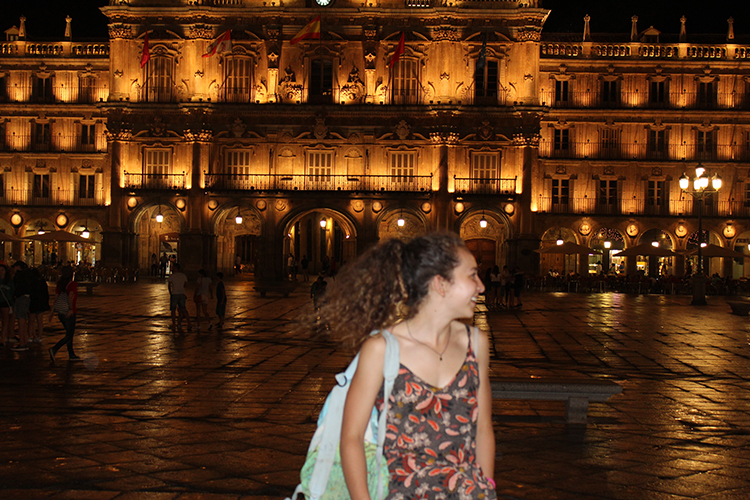
Later, I meet my friends in the plaza mayor and we hang out around Salamanca. On hot days we get ice cream or lemonade from one of the many ice cream stores throughout the plaza.
Around 5:45 p.m. there is an activity focusing on culture. We have visited the cathedral, a park, and did a treasure hunt. The cultural aspect of the school is my favorite. Hearing about the past of Salamanca helps me understand why it is the way it is today.
After the cultural activity, I head home with my friends. There, I relax for an hour before dinner. For dinner we have a main dish, usually a meat or pasta, a salad, bread, and fruit for dessert. During dinner, my host mom asks us questions about our day, which not only is good for building a relationship, but also great practice for speaking Spanish.
Around 10 p.m., I meet my friends at the plaza mayor, where the majority of people are during the night. In Salamanca, children stay up until around 12am. Later, I head home and get sleep before the next day of classes.
Clara Bekeny is 15 years old and lives in San Francisco, California. Her goal during her language program in Salamanca, Spain is to “to broaden my understanding of the Spanish culture and to make new friends during my trip to Salamanca. Additionally, I hope to improve my Spanish language skills.” Follow Clara’s adventure in Spain on her weekly blog post updates.