Author: Terianne Marsh

  • Creating the Young Leaders Camp with the Global Impact Grant

    Creating the Young Leaders Camp with the Global Impact Grant

    Global Impact Grants are funds awarded to Greenheart Travel participants and alumni to create, improve, or maintain an impactful, community-focused project abroad or at home. Read about how Greenheart Travel Alum, Kirin Taylor, used her GIG to organize a youth service project in the United States. 

    Originally, we thought and planned our Young Leaders Peace Camp to be: “an opportunity for young teenagers (12-14) from a variety of cultures, communities, and backgrounds to come together to experience peace, build character, learn about divisive issues in our society, and brainstorm solutions to these real-world problems.”

    We were able to do all of this, as well as allow participants to experience direct service with the homeless and younger children. This camp was considerably special, and needed by everyone who participated and our communities. We had seven 12-14 year olds, five volunteers over 18, and other groups of people who partnered with us throughout the week.

    What happened in just a couple of days was remarkable. The participants’ self-esteem and self-worth grew, assumptions and stereotypes were questioned, and unlikely friendships were made. This camp was newly developed by myself and Little Friends for Peace’s Program Director, Shoa Philpotts. It could only have been done with the help of the Greenheart Grant.

    In a regular peace camp, this age group would be considered “Counselors in Training”; meaning, they would remain in a group with younger children in order to develop leadership skills and eventually become a counselor. Instead of doing this, our daily activities utilized critical thinking, sharing, and empowerment.  We also encouraged the evaluation of personal talents, thereafter prompting them to apply their talents to problem-solving. At one point, each participant had to identify a passion of theirs, a possible way to channel it, and three career interests relative to both. This made them think about how their current passions, if channeled correctly, can define their futures.

    An example of one Young Leader’s responses is:

    1. Passion: Poetry
    2. Channel: Motivate people with it
    3. Career interests: Therapist, poet, start my own movement. Ex: LFFP

    Our volunteers had to do the same, which demonstrated how difficult self-assessment and reflection can be; this encouragement of intergenerational exchange, thoroughly contributed to the success of the camp overall. The knowledge that every age group struggles to be and do their best is significant when evaluating oneself, as we asked everyone to do.

    We also used LFFP’s “Wellness Wheel” to help the Young Leaders identify which areas of their lives require growth and which areas are thriving. In this way, everyone saw the good parts of themselves while being motivated to do better in others. Younger participants could look up to the older ones and draw inspiration, and the older participants were touched by this. Later in the week, smaller groups made action plans to help the homeless, by combining all of their talents.

    An example of this was: Utilizing the groups’ talents of playing football, cooking, and organizing/social justice pursuits to create a Charity Football Game and Banquet, where the homeless could participate and share about their experiences. ‘

    In addition to intergenerational exchange, this camp was cultural exchange. We had a group of people from Cyprus visit us all of Wednesday. They shared about the physical division of the North and South of their country, and their participation in the Cyprus Friendship Program. This program allows a teenager from the North and South to be paired, in order for them to learn about each other and bridge the divide. This day there was a lesson about race, class, and implicit bias in the United States, which allowed the visitors to see our society has huge flaws, comparable in some ways to Cyprus.

    The direct service we did included meeting and serving lunch to the homeless on one occasion, and making lunch and delivering it to them on another. In 100 degree heat, the kids walked around D.C. in search of people to interact with and politely offer a meal to. This was not originally scheduled into our week, but because they were so touched by their experience Tuesday that unanimously, the kids chose to spend their “Celebration Day” (Friday) doing this service.

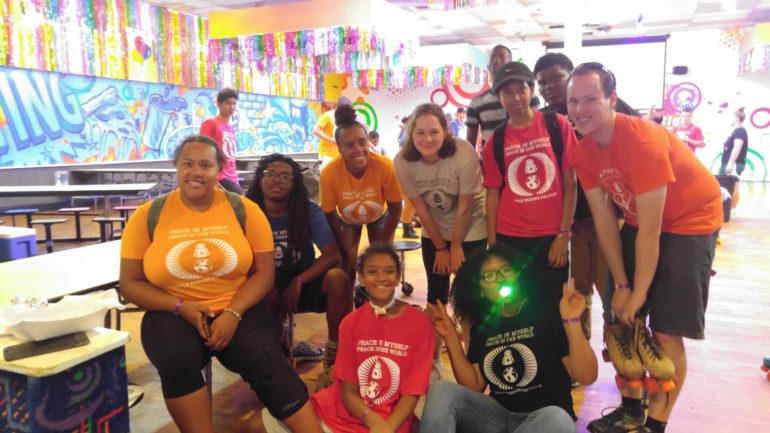
    On Thursday when we went to a skating rink in lieu of going to the Smithsonian due to a heat warning, each young leader had to watch out for at least one younger kid throughout the time. As demonstrated in the photos, they really lived up to the task – taking responsibility for multiple kids’ safety and enjoyment.

    Now that LFFP has seen this camp work, and bring people of different backgrounds, classes, and cultures together, there are implications. This camp can combine with other peace camps to offer those less interested in working with younger children a way to participate in peace building and leadership. The safe space we provided, along with the interactive learning experiences, check-ins, songs, story-sharing, games, and service projects, empowered participants and encouragingly guided them to leadership.

    To learn more about Little Friends for Peace, please visit lffp.org

  • Looking to a Peaceful Future with the Help of a Greenheart Grant

    Looking to a Peaceful Future with the Help of a Greenheart Grant

    After studying abroad in Austria my senior year of high school, I was very excited to return to Europe for a study abroad semester, and this time to Rome, Italy! At my university, St. John’s, I am very proud to be a part of the social justice program known as the Ozanam Scholars; this program emphasizes global citizenship, Vincentian Leadership, and service. Through it, I complete service each week.

    I really wanted to do meaningful service while abroad, and even wanted to create something, which is how a Greenheart Grant came into play. I work at Little Friends for Peace’s (LFFP’s) Summer Peace Camps in an administrative position, and decided to go through both the social justice program and LFFP to develop a site in Rome with the help of the Greenheart Grant. I was able to use the funds from the grant to put together activities, and to get the supplies and materials needed for them.

    Some students and a teacher reading together outdoors.
    Kirin reading to children outside.

    Summer Peace Camps

    LFFP began Peace Camps 35 summers ago, and from there the organization went on to establish many other programs, including peace clubs. The point of the programming is to teach both kids and adults to answer violence with skills for peace. The club aims to teach the concept of peace and these skills to children, and help them to practice in a safe and fun environment.

    At peace clubs, safe environments are created so that friendships are fostered, and also so that the children feel they can show their talents and be themselves. It is an ideal learning environment, as they are able to engage in dialogues about service and nonviolence, and are shown examples of actions towards peace.

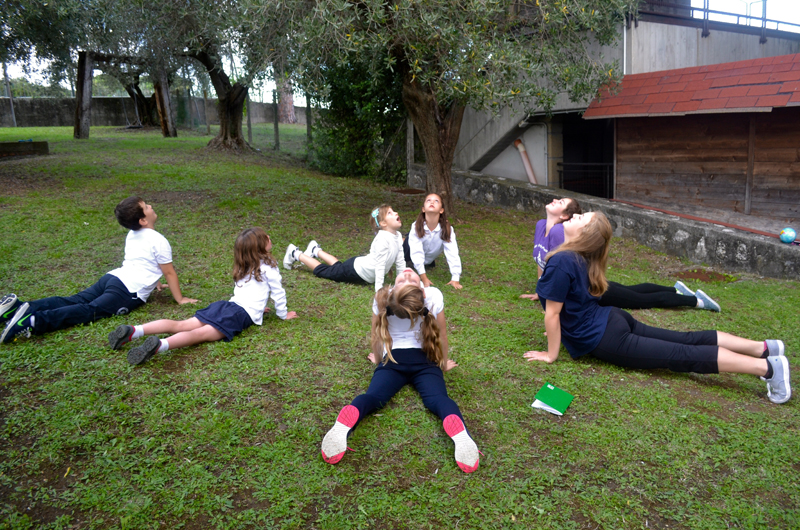
    The activities we did varied each week, but always included a mixture of: cooperative games, stories, social justice lessons, yoga, meditation, peaceful art projects, or sharing talents such as music to teach and live peace. The club helped children to express themselves, make friends, and learn conflict resolution and skills for peace.

    Kids passing a globe outside.
    Students passing a globe around outdoors.

    Peace Circles

    At the beginning of each club we would do a peace circle. This is a practice utilized a lot by LFFP, which helps to create community. We would all sit in a circle and pass around the peace globe which would define who would speak. Each person would share about what brought them peace that day, and what broke their peace. This helped us all get to know each other and to become comfortable, and the lessons would be better understood by all as a result.

    When something came up that myself or the other volunteers were able to give advice or guidance on, we would do so. We would also use this opportunity to present lessons on peacemakers, or to create a dialogue on what peace is and how we can spread it. We would end the circle by reciting the LFFP Peace Pledge and doing a song that required stretching. These rituals got the children into the mindset of peace club, and taught skills like respecting those who were talking, and how to participate in a dialogue.

    Kids doing a pledge in a classroom.
    Children doing the Peacebuilding Pledge as part of the summer peace camp.

    The Peacebuilding Pledge

    The Peacebuilding Pledge is one tool we used to ensure the children were aware of their role in creating peace.

    The pledge is:

    “I am a peace builder. I pledge:
    to talk to others with respect,
    to treat people with care,
    to make peace not break peace,
    to build peace
    at home,
    at school,
    and in my neighborhood
    each day”

    Kids coloring on the floor of a classroom.
    Kids coloring on the floor of a classroom.

    How the Peace Club Made an Impact

    All of our activities and lessons aimed to help the children value themselves, and learn how to interact with others in ways that their talents and good hearts are shown. By the end of our eight sessions, the kids were all extremely kind to each other, and sharing stories of how they taught something from the club to their friends or families.

    We heard back from two parents who worked at the school that they were already seeing changes in their children, and that they were really enjoying the club. The school’s teachers, activities coordinator, and administration all expressed how grateful they were to have such a positive program available to their students.

    A boy shows his artwork.
    A boy holds up his artwork.

    The other volunteers and I saw these children shine throughout peace club, and are filled with stories and memories of their progress. One girl was so proud of a shirt she had with peace signs on it that she brought it to the club and changed from her uniform shirt into it for the rest of the day. Another girl brought a book in Italian that she thought contained peacemaking, and translated it to all of us during a peace circle. And students that were in the same class seemed to strengthen their friendship because of the club.

    A group of students in a classroom in Italy.
    Kirin with some peace club students in a classroom in Italy.

    Looking to a Peaceful Future

    Needless to say, the volunteers and I, LFFP, and the school were all extremely pleased with the outcome of the sessions! The club is approved to continue for the spring semester, as well as in the future, should we continue to provide the same quality programming.

    The site helps volunteers to have a peaceful learning experience almost as much as the kids, and requires them to be very active in planning, responsible for leading the children in activities, helping them to learn, and ensuring they are safe. Doing service can really enhance a study-abroad experience, and volunteering at Peace Club will surely help students to perpetuate their skills and peace within themselves.

    As part of my involvement with both the program and LFFP, I will make sure the new runners of the site know our mission, our procedures, and our peace philosophy, so that it can remain successful!


    Learn how you can travel for a change with the help of a Greenheart Grant!

  • Alumni Spotlight on Kirin Taylor, High School Student in Austria

    This week, Greenheart Travel interviewed High School Abroad participant Kirin Taylor, who has been studying abroad in Austria since last September. In this interview, Kirin shares with us her desire to learn German, her inspiration for studying abroad, and advice she has for future participants!

    Q: What inspired you to study abroad and specifically in Austria?

    I was inspired to study abroad by my interests in international relations, diplomacy, communication, and peace studies, and my love for travel. I predicted that spending time in another country would give me a first-hand experience in the exchanging of cultures, ideas, and values, which turned out to be completely true.

    One reason I chose Austria, which is also a primary reason why I wanted to study abroad, was to learn German. Austria also has beautiful and unique landscapes, a central location in Europe, and a rich culture.

    Q: What have you discovered about Austrian culture and life since living there?

    I have discovered that it is completely and utterly unique. Many people don’t know that Germany and Austria are so different, but here there is traditional music, celebrations, foods, schools, and customs. By travelling within Austria, one could see lakes, forests, mountains, large cities, small villages, and more, despite its relative smallness. The people here are very willing to help, and almost everyone knows some English!

    kirin-visiting-Italy

    Q: What are some reasons to learn German?

    German can be very useful in business, and in international and diplomatic work, and happens to be less commonly learned in America than Spanish, French, and Chinese.

    Learning a new language opens you up to so many new people, places, and experiences.

    Additionally, By learning German it is possible to see the connections between a lot of German and English words, as English is Germanic. I’ve found that really interesting. Knowing German could make it easier to study languages like Dutch in the future.

    Q: What’s it like to learn a language through immersion?

    Learning languages in high school was always very difficult for me, because there wasn’t enough time to practice, and it wasn’t being applied. Immersion gives you no option, but to try and learn the language of that country, and there are definitely better and quicker results from this method. Having not studied German before, I was barely able to speak at first, and it took time before the language came to me. After 3 months of living here, I was able to start understanding German, and with that, speaking, reading, and writing have come fairly quickly. It is amazing that learning a language with immersion is possible, and happens so quickly, even for someone who has not been previously exposed to the language, or is particularly gifted in this field.  Learning through immersion also takes determination, as you must be willing to practice, and remain open minded.

    Q: Do you have any tips for how students can make the most of their study abroad experience?

    I would advise students to really take advantage of the opportunities offered to you while studying abroad. Learn the language, meet as many people as you can, build good relationships with your host family and new friends, experience the country’s culture, and when possible, travel!

    Kirin-and-host-sister-at-christmas-market

    Q: Did someone inspire you to study abroad or to travel (ex. A teacher, friend, role model)?

    I work and volunteer for a peace organization based out of Washington DC, called Little Friends for Peace. My involvement with them really inspired me to try to create good relationships and connections internationally, and hopefully my actions will influence others to do the same as well.

    Q: If you were talking with a friend who was unsure about studying abroad in high school, what would you say to persuade them to go for it?

    I would tell them that gaining these experiences and skills while in high school could be more important and rewarding than anything else they could possibly do with their time. No matter where you’d choose to go, your experience would be completely unique and life changing, making you reevaluate how you live your life, what you enjoy, and what’s important to you.

    Q: What are your plans for after the program and how have your travels inspired these goals?

    After I leave Austria in July, I am home for the summer and then headed to college! I am not sure which one yet, as I don’t have to decide until the beginning of May. My travelling has influenced what I will be studying, as I will continue to learn German, and will explore global and cultural studies. My exchange year has reinforced my love of travelling, and I am sure I will return to this country, as well as explore new ones in my future.

    Q: Any other additional thoughts or tips you have for anyone wanting to travel for a change?

    Travelling, whether it’s for an exchange or not, really does create change in the world. People could change their views of your country, just by one interaction with you. That’s a very scary and wonderful thought.

    Program-blog-button

  • Busy Days in Austria

    I have now been studying abroad in Austria for slightly over two weeks, and two weeks is enough to do a lot! My host family and I have kept very busy, and it doesn’t look like that will stop for a while! It is great to be so productive, but also exhausting. Here’s an idea of my week’s adventures!

    Day 1:

    • I arrived in Wien (Vienna) at around 8 a.m. on the 29th, this is only 2 a.m. eastern standard time. Despite being exhausted I jumped right into my day, which started with Kaffe at a Cafe in the airport with my Area Rep, Ira, my Local coordinator, and several other adult employees of the program.
    • Ira and I then took a bus, and then a train, to get to our hometown Knittelfeld. After eating some delicious Austrian food, and resting, I finally got to meet my host family!
    • It was the day before my host sister’s birthday, so I went out with her and her friends to celebrate!

    meeting friends in Austria

    Day 2:

    • To celebrate My host sister’s birthday, we went out to lunch, and I tried traditional Austrian Schnitzel.

    Day 3:

    • I went grocery shopping with my 7-year-old host sister and host mother. I learned many German words by going through the products.
    • My host sisters and I had fun writing German words on sticky notes to place on objects around the house.
    • We then had dinner together, talking for several hours, and becoming acquainted with one another.

    Day 4:

    • I ran errands with my host father, and the older host sister, including getting an OBB (the train system) card, and going shopping for a desk for my room.
    • Yet again, we enjoyed a meal together, spending hours to eat and talk. This is only possible during weekends or holidays, but is great whenever it happens.
    • I helped my host sister pack for her trip to Hungary!

    Day 5:

    • I attempted to go shopping by myself, although I never ended up getting what I needed, I succeeded in learning a few new words.
    • I played with my younger host sister, including a German board game.
    • My host parents took me out alone, first to see my school, explore the church there, and talk with the headmaster, and then to see the Red Bull ring in Spielberg. It was great to talk with them alone, and to see the beautiful view.
    • My host mother gave me a tour of the family’s large garden and backyard, something that it had been too rainy to do up until this point.

    day 5.2

    Day 6:

    • I went to downtown Knittelfeld with my younger host sister, and host mother. We bought the things I was unable to get alone, went to a bakery, a book store, and took a walk.
    • I got to meet and spend time with 2 friends of my host sister (she was still in Hungary).
    • I watched “Mamma Mia” in German!

    Day 7:

    • I walked with my younger host sister and host mother to the dentist office where both my host parents work, and which they created.
    • We went to an Italian restaurant, and I had the closest thing to a real Italian pizza I had ever had.
    • My younger host sister and I swam in our cold, cold pool.
    • We had dinner with family friends, and my host sister returned from Hungary!

    day 7 day 7.2

    Day 8:

    •  My lovely Area Rep met with our family.
    • Many people from school (like 30!) came to sleepover at our house, to celebrate the end of summer.

    Day 9:

    • Our family ate lunch at a local restaurant, and afterwards got Italian gelato.

    food in Austria

    Day 10:

    • We walked my younger host sister to her first day of school, all of the kids and their families were walking on the first day, which was very nice to be apart of.
    • I ate breakfast out with my host parents, and host sister.
    • We attended mass & orientation at our school.
    • We had dinner and dessert out at the restaurant above the Red Bull Track in Spielberg!

    day 10

    As for the rest of my days here, most are filled with school, which I will save for a later post!

    Coming up I have my program orientation with all of the exchange students in Austria, a weekend in ITALY, and a trip to VIENNA! I am so grateful for how fun my time here has been, and how fun and beneficial it will continue to be. I really owe it all to my wonderful and generous host family. Endless thank you’s and love!

    Program-blog-button

  • Preparing for the Opportunity of a Lifetime

    Hallo & Guten tag!

    My name is Kirin. I am 17 years old, and am about to have the opportunity of a lifetime. I’m spending the entirety of my senior year, and then some, in Austria studying abroad. I am leaving for 10 months! I will be living in a small  town called Knittelfeld, in the state Styria. There I will be living with my Gastfamilie (host family), consisting of a host mother and father, and 16 and 7-year-old host sisters.

    I figured I would answer a couple questions about my trip, the program, and myself that I am being asked a lot lately.

    Do you speak German?

    I do not speak German, but will (at least more than now) by the end of 10 months. I will be fully immersed in the culture, and language. I have been teaching myself, using an app called Duolingo, flashcards, workbooks, textbooks, and audiotapes.  At school all my classes will be in German, and I will be expected to try to communicate using English as little as possible. I will take German classes with a woman in my neighborhood as well. The one-on-one instruction will be very helpful.

    What will your school be like?

    Each day I will take the bus to school with my host sister. It is a catholic school, and completely in German. I am not receiving grades, but am attending classes in order to learn the language, make friends, and experience different methods of education.

    Will you be traveling?

    I hope to go on trips with my host family, school, and Greenheart. I will have more opportunities to do so, as Austria is fairly small, and many countries border it. The bordering countries are Germany, the Czech Republic, Switzerland, Italy, Slovenia, Hungary, and Slovakia. I am also in close proximity to Austria’s capital, the famous Vienna (with about a 2 hour drive). My flight is straight there, so I will at least be visiting there once, if not many times.

    Will you be graduating high school?

    Yes. I have one credit left, which happens to be English 12. Fortunately, I will be able to take AP Literature online, although this may distract me from the immersion. I also plan on applying to colleges while there, and maybe (if completely necessary) taking the SAT a second time.

    How did you discover this program?

    I was prompted to look for study abroad programs because I knew I had alternatives to a normal senior year. I could’ve graduated over the summer and started community college, etc, but looked into this and chose this, and could not be more excited! A simple google search showed me Greenheart Travel, and with more information and consideration, I chose it!

    Why Austria?

    I have not had good luck learning languages in school, both Spanish and French were extremely hard for me in a classroom setting, and immersion was a way to get around this problem. I chose to do an exchange for that reason, but chose Austria for many reasons. Because it is beautiful and in a great location.  Because German is less common, and more needed in the work field. Because I was told the people there are extremely gracious, and welcoming, and the country is far too overlooked. And believe it or not, The Sound of Music was not relevant to this decision.

    Program-blog-button