

Tag: austria

  • “Yes, and…”: One High School Abroad Austria Student on How Exchange is a lot like Improv

    “Yes, and…”: One High School Abroad Austria Student on How Exchange is a lot like Improv

    By Mollie Block

    A semester abroad is kind of like one long improv class. No, I’ve never taken an improv class before (unless you count the exercises I did in my 3rd grade after school drama club) but granted I’ve never been on a semester abroad before either. A bit of a bold statement, I’m aware, but don’t discount it until you hear me out. If you have taken an improv class before, and even if you haven’t, you know the one main rule of improv. “Yes, and …” For those of you who don’t know, and those that need a refresher, allow me to try and explain (sorry real improv students for how I’m going to mess this up!) what this means: Whenever a person is improving a scene and is asked a question the appropriate response is always “Yes, and …”. This opens up multiple paths for a scene to take and ensures there is always more to be acted. 

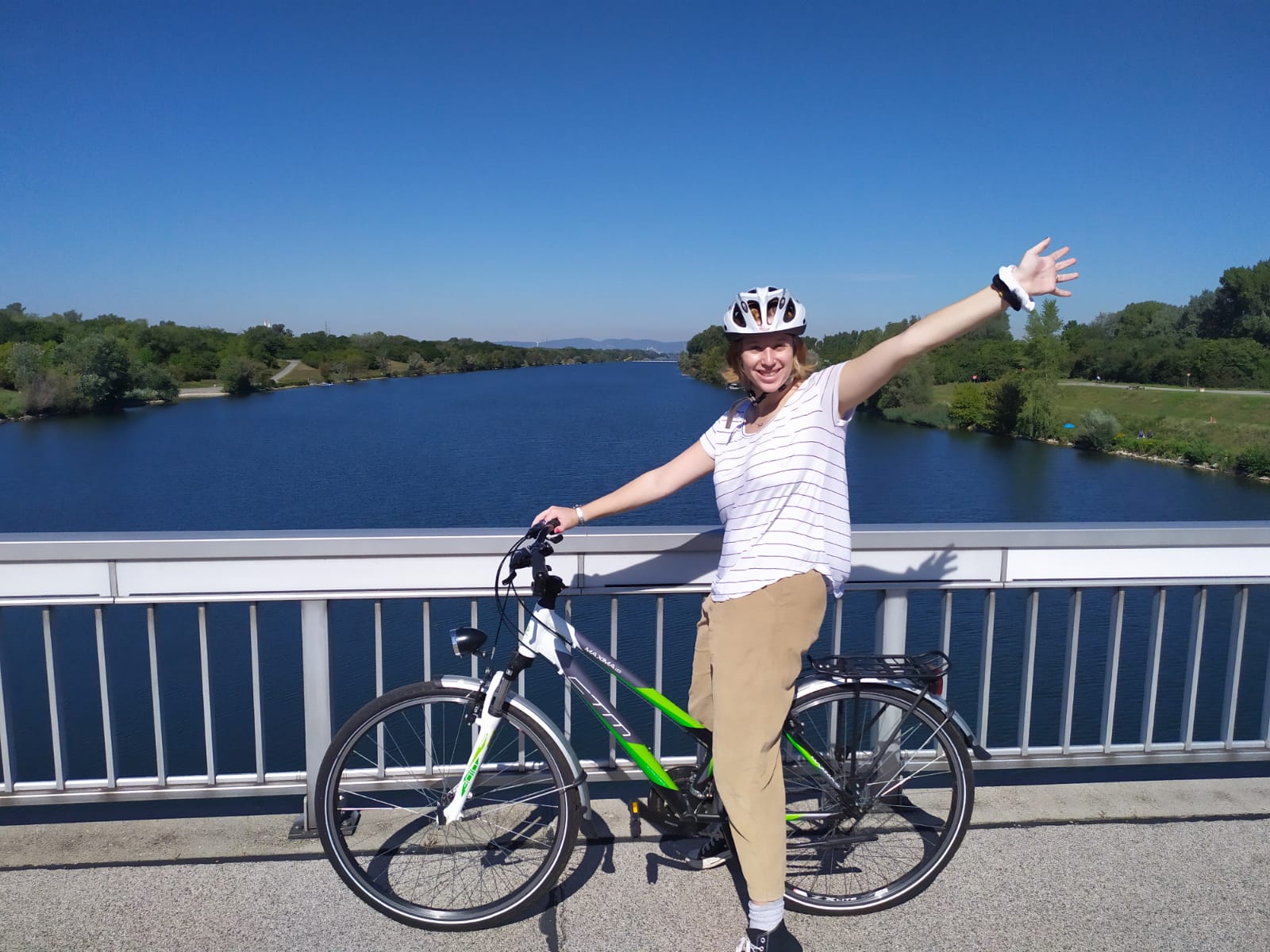
    Mollie in Vienna, enjoying the city in a Coronavirus safe way.

    I’ve only been abroad for about three months and yet I can say with confidence that the number one rule for improv happens to be the same number one rule for being an exchange student. I’ve found that the only way I’m going to get the most out of this journey is by opening myself up to new experiences, even if I’m scared or hesitant. 

    Maybe you’re still not on board, my comparison doesn’t make a lot of sense in the abstract, so let me give an example. One of my first days here, my host dad asked me if I wanted to go on a bike ride after we dropped off my host sister at her practice. Now I know what you’re thinking; this is a pretty insignificant thing to mention, what’s the big deal about a bike ride? I never really liked biking that much, downhills are scary and uphills are taxing, but the summer before my 8th grade I got into a bike crash. It wasn’t terrible, nothing broken and no scars, but I did have to go to the ER and I haven’t been on a bike since. Until coming here. I felt bad turning down my host dads offer, I had only been here a few days and I wanted to show my host family how eager I was to become a part of their life, so I said sure. I expected to maybe walk my bike for a little and stop somewhere on the path. However, I ended up riding my bike for a couple hours. 

    Yes, it was flat and yes, we were going slow but if you had asked me to go on a bike ride any time before I left (which people did, often) I would’ve (and I did) said no. I ended up having a really fun time biking (I can almost hear my sister saying “I told you so”) and while I haven’t been on a ride since, I know I will again and I’m already excited. 

    “My point is, people don’t come into study abroad programs having everything figured out.”

    The “Yes, and… ” rule isn’t the only way a study abroad and an improv class are alike. The whole point of improv is that the actors have no idea what they’re doing until they do it. A bit like the whole “fake it till you make it” mindset. In my experience, this is the same when you’re an exchange student. I came to Vienna with basically no German, not a whole lot of knowledge about the city and a ton of excitement. I had no idea what to expect. I’ve been here three months and I’m still getting surprised by this place everyday. My point is, people don’t come into study abroad programs having everything figured out. Most of us aren’t fluent in the language, I could barely introduce myself in German!, and we’re equal parts scared out of our minds and unbelievably excited for the amazing journey ahead of us (at least in my experience, I can’t talk for all exchange students). Just like in an improv scene, you learn as you go. 

    Mollie’s host sister walking her host dog.

    There is no way to make a plan for or accurately anticipate your time abroad. Of course, I know my semester abroad looks even more different from other years because of the Coronavirus and everything it entails (online school, lockdown, restaurants and cafes are closed, etc.), but even without a worldwide pandemic, everybody’s experiences look different. 

    “…Even without a worldwide pandemic, everybody’s experiences look different”

    If this analogy, of an exchange program being like an improv class, made sense to you, I’m glad. And if it didn’t, whether you’re a fellow exchange student, an interested parent, a prospective traveler or anything in between, that’s also ok. For me, thinking about my experience in this way has been interesting. It helps me to remember everything is part of the experience. Just like improv, there’s no right or wrong way to do an exchange program.  

    Mollie Block is a high school student from Maryland currently studying abroad in Vienna, Austria with Greenheart Travel. 

  • Holidays Abroad: Celebrating Outside of My Comfort Zone in Austria

    Holidays Abroad: Celebrating Outside of My Comfort Zone in Austria

    The holidays are typically about staying in your comfort zone. Though my family celebrates Christmas and Hanukkah, the big hype is usually Hanukkah. Every year we invite at least 20-40 of our closest friends, eat endless amounts of latkes and bagels, say the Hanukkah prayer and enjoy each other’s company for hours.

    This year is slightly different since I’m studying in Austria. Well, it’s actually more than slightly different. For one, it’s the first Christmas I’m not with my family. It’s also my first time not celebrating Hanukkah unless you count my family and I lighting the menorah over Skype a Hanukkah celebration. This was my first holiday season outside of my comfort zone.

    From Santa Claus to Christkind

    Every country has their own customs. Growing up, I thought Santa Claus was a universal thing and that everyone shared the myth of him and his reindeer. However, in Austria, there is no fat, old man in a red suit who stuffs himself down your chimney. Instead they have Christkind. Christkind is an almost angelic figure who comes through the window to deliver your gifts.

    The best word in German to describe an Austrian Christmas is “gemütlichkeit.” This phrase is a very well known here and basically translates to coziness, relaxing or just anything to do with being comfortable.

    How Christmas Day is Celebrated in Austria

    We woke up bright and early on the 24th, which is Christmas day here. For breakfast we ate bread with cheese and meat. Bread is a pretty huge part of the culture. At breakfast, lunch and dinner, you can expect lots of bread.

    Around 11 or so we arrived at the town square (Hauptplatz) where the crowds warmed up on punsch. This warmed juice with alcohol is a Christmas custom. Punsch comes in many flavors, but marillen (apricot) is the more traditional one.

    The streets are closed off at this point and a bunch of men on horses come trotting down to the middle of the block. A wagon pulls up with a very talented elderly man and a woman who start singing the infamous Christmas carol “Stille Nacht” (Silent Night). A candle lighting ceremony (“Light of Peace from Bethlehem”) begins shortly after. We carry our lit candles back home.

    Every year children reenact the story of Mary and Joseph at the local church. It’s the one day of the year the majority of Korneuburg goes and watches the show for half an hour or so. It was one of my first times being in a church for some kind of religious ceremony. I admit, I was a tad clueless about the story of Mary and Joseph myself, so it was nice to finally see it in person.

    We returned home and my host sisters and I all waited in the younger one’s bedroom for twenty minutes. The sound of a bell was our cue to come to the living room. The Christmas tree (christbaum) was decked out with lit candles, süßigkeiten (candy) and ornaments. Handmade weihnachtskekse (cookies) lay on the table, my host mom played her flute and we sang German Christmas carols together as a family for half an hour.

    New Year’s Day and the Days of the Three Kings

    The rest of my holidays went by fast. Sylvester (New Years) is a pretty big event as well. Every year on New Year’s Day there is a huge concert in Vienna that lasts for three hours and is the highlight of the day. You supposedly have to buy the tickets five years in advance and the “cheapest” ticket is 1,000 euro (1,051 USD). But, no need to fret or empty your wallets. There is a live TV version, as well.

    January 3rd through 5th are the days of the three kings. Children of each town dress up as Caspar, Melchior, and Balthazar (the three Wise Men). It surprised me that the children dressed as Balthazar — a biblical king from Africa — had their faces painted black. I realize this ancient tradition isn’t intended to mock Africans, but it did make me uncomfortable. As someone who stands with the Black Lives Matter community, it felt strange seeing “blackface” in person.

    Though it isn’t a practice I personally agree with, I reminded myself I am living in and learning about a different culture. These were innocent kids and to them, this holiday is an old tradition of playing dress up and collecting money for charity.  

    Winter break of 2016 has been different, but a good experience. I learned new ways to celebrate the holidays while reflecting on my own traditions as well. So far, 2017 has started on a pretty good note and I’m hoping it’ll keep going up from here.

    Frohe Weihnachten!

    Have you ever wondered what it would be like to celebrate the holidays in another country? 

  • Want to Experience a European City as a Teen? 10 Reasons Choose Vienna in 2021

    Want to Experience a European City as a Teen? 10 Reasons Choose Vienna in 2021

    Across all Greenheart Travel High School Abroad destinations we prioritize placing students in small town or at biggest regional medium-sized cities. Why? Smaller areas general safer. You’ll get to know members of your community and there will be people looking after you. You’re also less likely to encounter a strong expat community whose common language is English. Smaller areas mean more opportunity for you to strengthen your language skills and make the most out of your time abroad. It also generally means less commute time and a lower cost of living. Win, win!

    On our High School Abroad Austria program, students are placed throughout the country, often in stunning mountainside villages, near rolling hills, or charming small cities. But in this country, we make exception to our smaller-area-as-a-preference rule: Vienna, Austria.

    As an applicant, you can request to be placed in Vienna for an additional fee. Here’s why:

    1.Vienna’s public transportation system is one of the best in the world

    For most U.S. teens, trying to get around means relying on older friends with driver’s licenses or constantly asking your parents to take you somewhere. In Vienna, you won’t asking your host family for a ride every time you want to leave the house. Vienna has four different ways for you to explore the city: a subway (U-Bahn), local trains (Schnellbahn or S-Bahn), trams (Straßenbahn), and bus (Autobus). Buy a monthly pass for €51.00 – academic year students might even consider buying an annual pass that costs €1 a day! As long as you communicate well with your host family about where you are and who you’re with, you’ll have lots of freedom to transit wherever you’d like.

    (Tip: Don’t forget to download the app Scotty to easily access timetables and train lines.)

    2. Compared to other European cities, Vienna is affordable

    Greenheart Travel recommends students bring at least $300/month spending money for items like public transportation, shopping, entertainment, and whatever else isn’t covered by your program fee. So if you’ve dreamed of living in a European city – with all it’s perks (see point #1) but cringe at the thought of  paying $23 for a big mac (we’re just using McDonald’s as a comparison – please don’t make that your go-to meal abroad!), Vienna is a great option. With money going further, you can do and see more.

    3. Vienna was nominated as one of the cities with the highest quality of life in the world

    For ten years in a row! Attention aspiring urban planners – this is for you! It’s known for its “green spaces, cheap and efficient public transport, and a low crime rate.” Who wouldn’t want to live in a city like that?! If you’ve already tried to convince your parents to let you study abroad you’ll know: safety is one of their biggest concerns. With Vienna’s impressive stats on safety, it won’t be hard to prove it’s a great place for you to study.

    High school abroad students eat together.

    4. You can easily find German courses for foreigners

    There’s no language requirement to apply study in Austria, but you’ll need to put in a lot of effort to learn once you arrive. Luckily, Vienna is full of German courses for foreigners to catch up to speed and excel in school. Need help? Your host family and local coordinator are there to point you in the right direction.

    As one student Ximena explains it, coming to Vienna is a great idea because “You get to learn German, a language that is very important and that will help you in your future. I recommend 100%!”

    5. Students placed in Vienna have the most options for after schools sports or activities

    Being placed in a city means there are a variety of options for afterschool activities. You can find your passion and get involved in what activity you’re dreaming about! (Or in the case of our alum Sarah, you could take German on Mondays and Wednesdays, bass lessons on Tuesdays, and orchestra and circus on Thursdays.)  Sports? Photography? Skiing? Cycling? Rowing?

    Attention music lovers: if you’re placed just outside Vienna, you’d be able to reap the benefits of living near the city and also play in a village orchestra.

    Students at Burgruine Modling excursion

    6. You’ll have a jam-packed schedule of excursions and trips 

    With easy access to Austria’s bordering nations (Germany, Lichtenstein, Switzerland, Slovenia, Hungary, and Czech Republic), there’s no shortage of possible opportunities to travel. Some students travel with their host families, but if your host family doesn’t travel, our in-country staff have plenty of plans for you. Students can join trips for an additional cost to places like Venice and London, and you’ll also be able to partake in the Welcome Party-Orientation Meeting, a snowboard weekend, yodeling course, and farewell party.

    Just last weekend our students traveled with local staff to visit Burgruine Modling, a historic castle. As one student says, “The landscapes are beautiful! Going hiking was a really cool activity because the views from the mountain were so pretty!”

    Students at Burgruine Modling excursion

    Additional trips not in your budget? Each local coordinator organizes meet ups throughout the year so you and other exchange students can reconnect and experience another aspect of Austrian culture. We hope it includes all of these delicious foods!

    7. Have a special academic interest? You can request a specialized school

    While we could go on and on about all of the incredible exploring you’ll do in Vienna, we can’t forget to mention school. That’s one of the main reasons you’re studying abroad! Most exchange students take the same compulsory subjects like German, English, Math, Biology, History, etc., but Austria also has specialized schools you can request. There are schools focused on things like sports, music, science, economics, tourism, handicrafts, and agriculture. Meeting fellow students who share your interests is a great way to jumpstart friendships and find commonalities.

    8. Students won’t stop gushing over it 

    We think Vienna is pretty awesome, but don’t just take our word for it! “Vienna has become my favorite city ever. It is soooo pretty, it feels so safe, it’s a great place to hang out with your friends, it is so easy to get there, the museums are amazing, it is really a beautiful city!” says Ximena.

    Well, count us in! What about you?

  • Take 5: High School in Austria with Bree McCarthy

    Take 5: High School in Austria with Bree McCarthy

    Bree McCarthy chose to spend a trimester of high school in Austria, a country with both natural and urban beauty. We asked her five quick questions for this week’s Take 5. Kick back and grab some “Gusto” to snack on while you read about her experience!

    1. When is the first time you feel like you made a friend?

    The first day of school. I didn’t know this then, but the entire class knew my name, and this girl named Sarah walked in and sat down and started asking me all these questions, she was really enthusiastic about American culture and wanted to know everything. I mean EVERYTHING! So I told her everything I could and we wound up going to the mall later that day and spending a lot of time just talking and laughing. It’s a really good memory.

    2. Biggest German (language) miscommunication?

    When my host sister would speak fast and I just couldn’t follow the conversation. I needed to be spoken to slowly and I needed to speak slowly to them. To communicate efficiently, you also don’t have to always speak correctly. Instead of saying, “My book “Mocking Jay” is exquisite” you can always just point to your book and say “Good” or “Gut’ or “Bien” or whatever their home language is, to express what your feeling.  But talk, just keep talking to everyone. Ask them questions, and let them ask questions. The best way to get involved with everything is to just jump in. If you feel excluded from something, then just get involved somewhere else. There are always different things you can do.

    3. Best mentor(s) abroad?

    My host mother-like person. I didn’t have a host mother, but my host father had a girlfriend and another really close friend. I connected a lot with both of these people, not only because they were around a lot, but also because they knew when I was upset or mad, and they would comfort me or confront me, or give me whatever I needed. And I would listen to their advice and their stories and it was just really good.

    4. Favorite Austrian junk food?

    Gusto. They are these yellow sponge-like chip things. I LOVED THEM. I miss them. They’re kinda salty, but not, I don’t know, but they were GOOD!


    5. Advice for others going abroad?

    You can’t prepare for the emotional-ness of it all. I mean, Greenheart Travel tries really hard to prepare you, but you just have to jump in and relax. The happiness and the sadness I felt there was so much bigger than at home. Which is such a good thing, because now I have more perspective. My advice is to just try. What’s the best thing that could happen?

    Does Austria sound right for you? Click the link below for more details about High School Abroad: