Tag: holidays abroad

  • Celebrating Loy Krathong in Thailand

    Celebrating Loy Krathong in Thailand

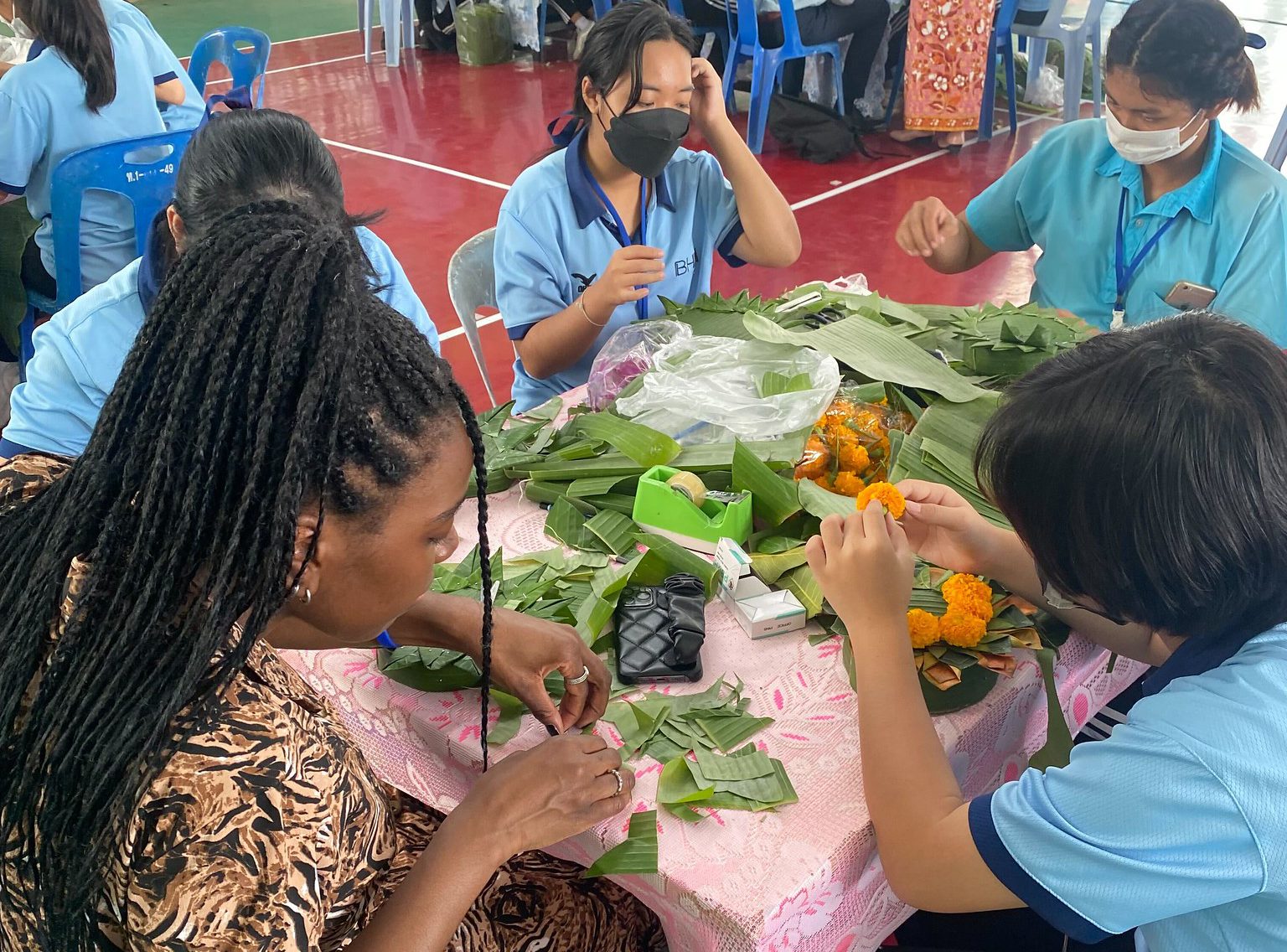
    Every now and then, our well-traveled staff tells us about an experience they’ve had that we just have to share with our travelers. Recently, we received some photos of travelers preparing for Loy Krathong, a holiday in Thailand. Here is a little bit about Loy Krathong from Ian, one of Greenheart Travel’s Team.

    In Thailand a very culturally-important holiday comes around in November. The tradition of crafting beautiful and unique baskets and setting them afloat in open water is said to have dated back to the 14th century. It is a tradition that any traveler should make a point to see and take part in should they get the chance… This is Loy Krathong.

    Loy Krathong festival is celebrated annually in Thailand and marks the end of the rainy season during the twelfth lunar month. The name, translated, means “to float a basket”, because all across the country Thai people release thousands of “krathongs” (lotus shaped rafts decorated with candles, incense, and flowers) onto the water of lakes, rivers, and canals as an act to thank the Water Goddess for a year’s worth of her generous supply during the harvest season. Some believe that this is also the time to symbolically start anew and “float away” any anger, grudges, and negative feelings. If your candle stays lit until your Krathong disappears out of sight, it means a year of good luck! Many cities hosting Loy Krathong festivals are extremely welcome to foreigners participating! Even hostels and hotels often host basket decorating events for their guests.

    My first Loy Krathong happened when I was traveling in Chiang Mai, the second largest city in Thailand and the epicenter of Lanna (northern Thai) culture. While one can take part in Loy Krathong anywhere in the country, I highly suggest making the trek up north at least once; many Thai people also make it a point to visit Chiang Mai during this time as well, especially if their cultural heritage is northern. It truly is a spectacle seeing families send out their baskets afloat one after another. If you are interested in heading up to Chiang Mai, I highly suggest purchasing your ticket (and booking your accommodation) as early as possible, as they get booked out quickly. Getting to the northern city is doable by plane, train, or bus.

    Wherever you find yourself in Thailand, you absolutely should try to join in on the festivities. Part of traveling is learning about and absorbing the local culture, and participating in Loy Krathong with friends or strangers is an absolute highlight for anyone traveling or living in Thailand.

    Thanks Ian for sharing more about this holiday!  If you’re interested in visiting Thailand, check out our Teach Abroad Thailand programs. Travel for a change with Greenheart Travel!

  • Holidays Abroad: Celebrating Outside of My Comfort Zone in Austria

    Holidays Abroad: Celebrating Outside of My Comfort Zone in Austria

    The holidays are typically about staying in your comfort zone. Though my family celebrates Christmas and Hanukkah, the big hype is usually Hanukkah. Every year we invite at least 20-40 of our closest friends, eat endless amounts of latkes and bagels, say the Hanukkah prayer and enjoy each other’s company for hours.

    This year is slightly different since I’m studying in Austria. Well, it’s actually more than slightly different. For one, it’s the first Christmas I’m not with my family. It’s also my first time not celebrating Hanukkah unless you count my family and I lighting the menorah over Skype a Hanukkah celebration. This was my first holiday season outside of my comfort zone.

    From Santa Claus to Christkind

    Every country has their own customs. Growing up, I thought Santa Claus was a universal thing and that everyone shared the myth of him and his reindeer. However, in Austria, there is no fat, old man in a red suit who stuffs himself down your chimney. Instead they have Christkind. Christkind is an almost angelic figure who comes through the window to deliver your gifts.

    The best word in German to describe an Austrian Christmas is “gemütlichkeit.” This phrase is a very well known here and basically translates to coziness, relaxing or just anything to do with being comfortable.

    How Christmas Day is Celebrated in Austria

    We woke up bright and early on the 24th, which is Christmas day here. For breakfast we ate bread with cheese and meat. Bread is a pretty huge part of the culture. At breakfast, lunch and dinner, you can expect lots of bread.

    Around 11 or so we arrived at the town square (Hauptplatz) where the crowds warmed up on punsch. This warmed juice with alcohol is a Christmas custom. Punsch comes in many flavors, but marillen (apricot) is the more traditional one.

    The streets are closed off at this point and a bunch of men on horses come trotting down to the middle of the block. A wagon pulls up with a very talented elderly man and a woman who start singing the infamous Christmas carol “Stille Nacht” (Silent Night). A candle lighting ceremony (“Light of Peace from Bethlehem”) begins shortly after. We carry our lit candles back home.

    Every year children reenact the story of Mary and Joseph at the local church. It’s the one day of the year the majority of Korneuburg goes and watches the show for half an hour or so. It was one of my first times being in a church for some kind of religious ceremony. I admit, I was a tad clueless about the story of Mary and Joseph myself, so it was nice to finally see it in person.

    We returned home and my host sisters and I all waited in the younger one’s bedroom for twenty minutes. The sound of a bell was our cue to come to the living room. The Christmas tree (christbaum) was decked out with lit candles, süßigkeiten (candy) and ornaments. Handmade weihnachtskekse (cookies) lay on the table, my host mom played her flute and we sang German Christmas carols together as a family for half an hour.

    New Year’s Day and the Days of the Three Kings

    The rest of my holidays went by fast. Sylvester (New Years) is a pretty big event as well. Every year on New Year’s Day there is a huge concert in Vienna that lasts for three hours and is the highlight of the day. You supposedly have to buy the tickets five years in advance and the “cheapest” ticket is 1,000 euro (1,051 USD). But, no need to fret or empty your wallets. There is a live TV version, as well.

    January 3rd through 5th are the days of the three kings. Children of each town dress up as Caspar, Melchior, and Balthazar (the three Wise Men). It surprised me that the children dressed as Balthazar — a biblical king from Africa — had their faces painted black. I realize this ancient tradition isn’t intended to mock Africans, but it did make me uncomfortable. As someone who stands with the Black Lives Matter community, it felt strange seeing “blackface” in person.

    Though it isn’t a practice I personally agree with, I reminded myself I am living in and learning about a different culture. These were innocent kids and to them, this holiday is an old tradition of playing dress up and collecting money for charity.  

    Winter break of 2016 has been different, but a good experience. I learned new ways to celebrate the holidays while reflecting on my own traditions as well. So far, 2017 has started on a pretty good note and I’m hoping it’ll keep going up from here.

    Frohe Weihnachten!

    Have you ever wondered what it would be like to celebrate the holidays in another country? 

  • Reflecting on a Holiday in Japan

    Reflecting on a Holiday in Japan

    During my study abroad program in Japan, I found the main difference between Christmas in The United States and in Japan is the food. My real family back in the States were kind enough to send me packages with various Christmas sweets inside, much to my delight. But I was surprised when sharing these sweets with my friends and host family in Japan.

    Mint is not a commonly-liked flavor here, and it is certainly not considered a Christmassy one. Although I was a little shocked, I was not complaining, because that leave more candy for me. The big difference between Christmas food in The U.S.A and in Japan is the main course.

    In The United States it is typical for a family to have a main course of ham, or beef, or turkey. But in Japan it is usually chicken. Kentucky Fried Chicken, to be exact. Kentucky Fried Chicken has managed to convince the entire country of Japan that their food is what westerners eat on Christmas.

    I am not joking.

    Although it is certainly a lie, I was more than happy to eat fried chicken on Christmas, even if it isn’t what I was used to. It most definitely helped that my family’s Christmas fried chicken was homemade, and therefore extremely delicious.

    Read more of Eve’s experience celebrating Christmas in Japan in her latest article.

    Program-blog-button