Category: High School – Switzerland

  • 5 Reasons Studying Abroad in High School Will Change Your Life

    5 Reasons Studying Abroad in High School Will Change Your Life

    You are googling high school abroad. You are scrolling through Instagram to see all the inspiring travel photos. You are preparing a powerpoint to easily present this crazy idea to your parents – they may even have said “Yes!!”. You’ve watched all the Youtubers you can and you are ready to go!!  What is stopping you?  In case you need even more inspiration to take that leap – here is a helpful list of the ways you will be forever changed if you do decide to go on a high school abroad program.

    Be part of a select group.

    Did you know only about 1,200 students go on a high school abroad program every year? That is for the entire United States! You will be one of the select few students who actually becomes an exchange student in high school.

    Develop practical language skills.

    There is NO better way to gain fluency in another language. I get asked all the time if it would be better to study abroad in college and don’t get me wrong that is wonderful BUT the problem is you don’t usually get the same level of language and cultural immersion. How you can settle in and learn about the daily life of your host country and how can you have any hope of gaining fluency in the language if you are with international students and speaking English all day.

    Have roots on the other side of the world

    The host family you stay with will be your family for your whole life! How beautiful is that? You essentially become their son/daughter, you do life with them and that is a bond that lasts. Ask anyone who was an exchange student in high school and they will tell you that even into adulthood, they stay in touch with and visit their Host family. Don’t miss out on this opportunity for a sincere connection with a family abroad. Not to mention your local friends.

    Experience being independent

    If you study abroad in High school, there is nothing that will intimidate you. If you can leave your comfort zone and spend three months, a semester, or (eek!) a year of high school abroad. You will become SO much more confident, independent, and mature. It’s amazing and you are learning a million things that you could never learn if you stay home.

    Prepare for the future

    You’ll get much more out of your college years if you study abroad in high school. So many students go to college and have no idea what they want to do. I sure didn’t! Living in another country and seeing another part of the world really helps you understand yourself better and move into your college years with more confidence and clarity.

    I hope this list was helpful. If you are still unsure, I’d be happy to talk discuss the options with you or your parents or you can reach out to past and current participants in our Facebook group. Here is my calendar, find a time that works for you and we’ll talk soon!

  • Next Step After Teen Summer Language Camp: High School Abroad

    Next Step After Teen Summer Language Camp: High School Abroad

    So you just finished your Teen Summer Language Camp. You’ve embraced life with a host family, sampled your new favorite foods, accelerated your language skills and met other teens from all over the world. But the summer is coming to a close, and you wish you could do it all over again, or at least stay abroad a little longer. 

    And you can! By being an exchange student on a High School Abroad program

    Now, let’s not get confused. Teen Summer Language Camp is NOT just a short version of High School Abroad. The two programs are totally different but go hand in hand. 

    Here are some of the similarities and differences broken down:


    High School Abroad 

    Teen Summer Language Camp 

    School   Local high school  Language school  
    Accommodation         Host family  Host family or residence hall 
    Length Summer (1-2 months), trimester, semester, or academic year  2-6 weeks  
    When  Summer, Fall, Spring  Summer  

    Both Teen Summer Language Camp and High School abroad offer full language and cultural immersion, but the lengths and experiences are vastly different.  

    After successfully completing a Teen Summer Language Camp, you’re ready for the new experiences, joys and challenges that come with studying abroad in a local high school for a longer period.  

    Greenheart Traveler Alexander Obenchain always knew he wanted to study abroad in high school in Japan. In Summer 2018, a Teen Summer Language Camp in Tokyo was the first step to help him prepare for his academic year high school study abroad in 2019. Easing into the language and culture of Japan in Summer 2018 allowed Alexander to hit the ground running when he landed in Japan for his high school program.  

    “Coming for a smaller amount of time helped me prepare for the difference in atmosphere between here and the states,” he explains. “It was certainly a good thing to have studied the language a little bit more in-depth beforehand. I can also compare my skills from now to then.”  

    And navigating the Japanese train system? He figured that out a long time ago!  

    But you don’t have to return to the same country you went to for your Language Camp. Maybe you went to Salamanca, Spain in the summer, and now that you know you can handle being far from home, want to explore Sweden!

    So is studying abroad in a local high school right for you? With improved language skills, you’ll be ready to learn subjects like math, science, and drama in another language. After living with a host family for a few weeks, you can anticipate how much you can learn about a country and its culture through observing (and living) day-to-day life abroad. You’ve proven to your parents that you’re independent, capable and problem-solving.  

    You’ve gotten a taste, now it’s time to thrive.  

  • 8 Ways to Support Your Child While Abroad

    8 Ways to Support Your Child While Abroad

    When you’re a parent sending your child abroad, you know there’s a lot they must prepare for: culture shock, homesickness, and language barriers. But your children aren’t the only ones experiencing a life change 

    “This was definitely a learning experience for the parents as well!” says Lisa Hall, mother of high school in Sweden alum Matilda. “It was very hard to not be there to help when things were tough.” 

    So what can you do? Miles away from your children, how can you still support them? We asked parents of Greenheart Travel alumni share their insight on how you can best support your child while they’re abroad. Here are their tips.  

    Before they go abroad, talk about life when they return  

    “Prior to him leaving for the 6 months, we did discuss what he wanted to do at his school in the US during his junior year.  He decided he would try to run for student council office while he was overseas.  And unbeknownst to his dad and I – he did run, campaigned via Instagram and won the vice president spot for the upcoming junior class here in the US.  The lesson to learn…. make goals with your child and then let your child be the captain of that ship while he is away.” -Bonnie Green, mother of high school in New Zealand alum Graham.

    Agree on a weekly time to talk – and stick with it  

    Schedule a time and way to communicate in advance, that way you are both on the same page. For example, decide that they need to check-in on Sundays around 7:00 pm their time via WhatsApp. This way, you don’t need to send them texts throughout the day because you’ll already have a set time to catch up. 

    Mary Scott, mother of language camp in Spain alum Emmy, explains why it’s so important to give space. “While she was abroad, we made sure we weren’t constantly bombarding her with texts and skype calls which at first was difficult. However, we knew she would have a more enriching experience if she wasn’t having to think about us back in Michigan the whole time. We wanted her to be able to completely devote herself to speaking Spanish and learning about her new environment.”

    For Hall, being far from her daughter was “hard in a different way when she was having so much fun, there was hardly any contact! But that was the best kind of growth for us all.” 

    Olivia McCollum at her high school while studying abroad in Japan

    Recognize that YOUR life is going to change  

    Your life at home is undoubtedly going to change. For Bonnie Green, she and her husband experienced being empty nesters for the first time.

    Her advice? Take this opportunity and focus on you.  

    “Make a list of things YOU want to do while your child is away. My husband and I took dance lessons, had adult only (no children) dinner parties, accomplished house updates, traveled to visit our children who were away at college, visited aging parents, put in extra time at work and started hiking more.”  

    And that leads us to our next point… 

    Don’t say how much you miss them or how much you want them home

    Your child will most likely be homesick at some point, and it can be really hard to go through that while hearing pleads to come home. Being asked to come back and hearing about what they are missing at home can make a hard day so much worse. 

    Instead, tell them that you are so excited to hear about their adventures when they are back.   

    Jacob Dane Chilton with host family in Spain

    Encourage them to reach out to local staff and take initiative  

    Part of why going abroad builds confidence and leadership skills is because travelers are expected to speak up and handle themselves. Instead of telling your teen what to do, or doing things on their behalf, allow them the opportunity to be independent. This is especially important when handling the pre-departure logistics so that they don’t feel totally lost when stepping foot in the airport. “When a problem comes up, discuss the different ways it can be solved instead of jumping in and telling them what to do.” says Scott.

    The best thing you can do for your teen is to let them practice communicating with adults and learning how to manage themselves. It can be hard to trust your child to do everything right but giving them that space to grow will make them better prepared for their program (and life).  

    I think it is vital that while your child is aboard that he/she become a part of their new community,” says Green. “While he did stay in touch with friends in the states, he made friends in NZ.  The small town even had a send-off for him and took him to the airport.” 

    Read about their country and take interest when they share new knowledge 

    A great way to get involved in their experience is by learning more about the culture in the country in which they’re going. As  you learn about your child’s new home, take note of what your child is excited about. “I was sure to listen to all the positive details, no matter how small!” says Hall. 

    You could practice making a tortilla española or start listening to the music of traditional Austrian brass band and surprise them with your newfound knowledge.  

    Greenheart staff member Allison Yates’s mom started learning Spanish when she studied abroad in Argentina. “She knew that Spanish was a huge part of my life, so it meant so much that she wanted to learn it too! It helped her feel like she understood my experience more,” says Yates.  

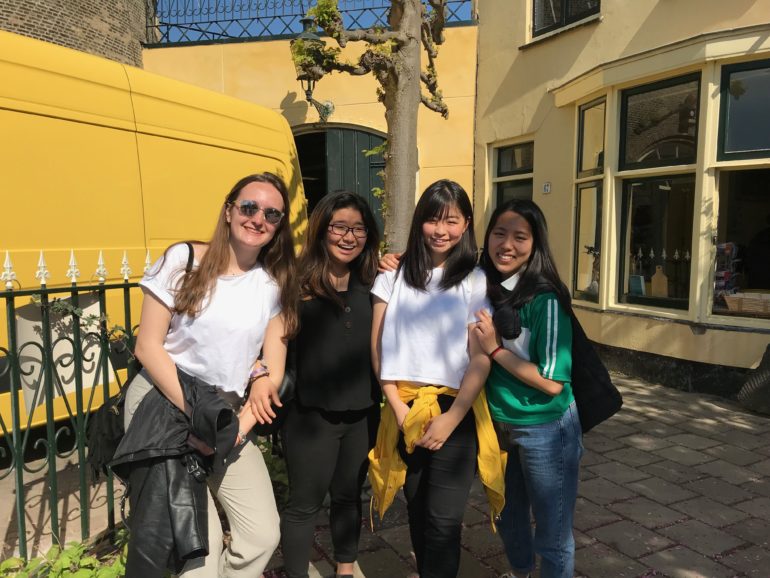
    Students attending high school abroad in the Netherlands

    Educate yourself on what they might be feeling – and how you can help from afar

    A great way to get a sense of the mental and emotional experience of studying abroad is by completing the Greenheart Travel Atlas along with your child. This is tool for before, during, and after the cultural exchange experience that includes personal and professional development, cultural understanding and environmental awareness. 

    For example, if your normally independent child calls you multiple times a day when they first arrive in the country, you’ll remember it’s likely initial culture shock.  You can remind them to follow the Greenheart Travel Atlas tools to overcome this stage and focus on meeting new people and spending time with their host family.  

    Halls says she supported Matilda by “making sure she knew I was there to talk about things, whether they were positive or negative. I tried to give her as much time as I could, but not to have it be open-ended or all the time.”  

    While your first instinct might be to check in more frequently, increased contact with friends and family back home only exacerbates culture shock. 

    Rest easy – they’re in good hands 

    We had to give up our control and trust in the goodness and professionalism of others. We did our research, chose a great partner in Greenheart, and raised a strong daughter,” says Laura Foster, mother of high school abroad Costa Rica alum, Eleanor.  

    As parents and former exchange students, Greenheart and our in-country partners know what it’s like to be far from your family, and we work to equip students with the tools they need to succeed.  

  • The Student Visa Process Broken Down Step-By-Step

    The Student Visa Process Broken Down Step-By-Step

    If you’ve ever gone abroad before you have most likely had to fill out some sort of international documents and paperwork. It’s a drag. Who wants to fill out what seems like form after form when you could be creating a travel itinerary of all of the places you are dreaming of going! However, this paperwork plays an important part in keeping you safe and accounted for while traveling abroad. More often than not, your duration and reason for travel determine how much paperwork and planning you have to do.

    This blog will serve as a guide to my experience with obtaining a Student Visa at the Spanish Consulate in Chicago. Currently, I am nearing the end of the process of applying for a Spanish Student Visa. I will be studying at the Universidad de Sevilla in Seville, Spain next year for nine months and couldn’t be more thrilled!

    Don’t know what a visa is? Click here.

    To be honest, I’ve never really minded filling out paperwork, especially when it came to cultural exchange; I knew it meant that I was one step closer to getting off that plane and interacting with locals. However, I’m going to be frank and say that this application was no walk in the park. Because I will be studying in Spain for over 90 days, I needed to apply for a student visa, and because I would be staying over 6 months, there were additional documents I needed to obtain. 

    Before I could even start on all of this paperwork, I needed to figure out where my closest Spanish Consulate was and make an appointment no sooner than three months before the start of my university classes. Since I live in Michigan, the closest consulate was in Chicago, a place where I luckily know quite a few people (Greenheart Travel 💚). With my appointment date set, I got to work on the long list of things I needed to acquire. 

    National Visa Application 

    I got this from off of the consulate’s website and filled it out with some help from my program coordinator. This form needs to be completed in capital letters and with DD/MM/YYYY format. Once it was filled out, I glued one of my passport photos to it and made a copy.

    Money Order

    For the Chicago Spanish Consulate, the current fee for a student visa was $160. They do not accept cash or check so I went to my post office to get a money order. I paperclipped this to my application form. 

    Prepaid/ Pre-addressed USPS Priority Express Envelope and Disclaimer Form

    This envelope is a bit pricey ($30 ish) but guarantees that your documents will be delivered quickly and safely. I put the consulate’s address on the “From” and my home address on “To.” The disclaimer form is found on the instructions form from the consulate and states that you are allowing the consulate to mail your passport with the visa back to you. 

    Original Passport and ID

    A passport was something I luckily had already so there was no extra paperwork there. Keep in mind that generally, a valid passport is one that will not expire for at least six months after the date you leave the foreign country. I photocopied my passport as well as my university student ID, and my driver’s license. Be sure to bring your actual passport and cards to the appointment as well.

    Two Passport Photos

    I got these taken at the study abroad office on my university’s campus for $3, but you can get these taken at a lot of places like the post office or Walgreens.

    Original Hardcopy Acceptance Letter, Evidence of Funds, and Proof of Health Insurance

    Since I am going through a study abroad provider, this was all taken care of and sent to me. 

    All three of these needed to be in Spanish or have a translation. The acceptance letter was to prove I was enrolled as a full-time student, the evidence of funds was to assure that I would be able to pay for my program, and the proof of health insurance was to cover any medical fees I might obtain during my stay. I made a copy of each of these forms. 

    Medical Certificate (For stays over 180 days)

    On the consulate’s website, this is one of two additional forms to print out for stays over 180 days. I just made a normal appointment for a physical and brought in the paper. This form states that you are in good physical and mental health and do not have pre-existing conditions. There was a little confusion at my appointment as the form had a Spanish translation of what it said in English that needed to be stamped and signed as well. Because there wasn’t a translator in my doctor’s office that day they wouldn’t stamp it (surprising for a town that has a significant Hispanic population), so I had to come back the next week when the translator was in. I made a copy of this form. 

    FBI Background Check with an Apostille (For stays over 180 days)

    This document was definitely the most frustrating and tiring of them all. It began by going through a service called Accurate Biometrics (there are a few to choose from) to get my fingerprints scanned and sent to the FBI to run the background check. This was relatively easy as I made an appointment online then went into a FedEx office for the scan. It cost about $40 and took just about ten minutes. My results were sent to me the next day through my email.

    This is when it became difficult. I needed to get an Apostille of the Hague Convention (this is a kind of “stamp” that makes the document internationally recognized) issued by the US Department of State in Washington DC. I hadn’t received any direction on what this was or how to get it so I emailed my program coordinator and went on the government website. Since I had a little over a month until my appointment at the consulate, I decided not to go through an expensive apostille service and just send it to the Office of Authentications myself. In my envelope, I needed to include my FBI background check, an apostille request form (called a DS-4194), a check for $8 (that was the fee for my document), and a pre-paid addressed USPS envelope for them to send me my document back.

    I had read that this would take about 10 or 12 days. When it got to be around that point, I called the office to check my document status. After waiting about 20 minutes on hold, they told me that I was not in the system and that it must be in their mail room still being sorted. I knew I should’ve gotten tracking for this envelope… I called back multiple times over the next couple days and got the same response every time. I started to panic a little as my visa appointment quickly approached. With an urge from my study abroad coordinator, I swallowed my pride and contacted an apostille service. Because I didn’t have much time left before my appointment I was forced to get the “rush” service which was about $300 altogether. 

    With $300 drained from my bank account, but a bit more peace of mind, I waited for my last document to arrive. It came by mail with 3 days before my appointment. Because this also had to be translated into Spanish, I went through the company One Hour Translation. With my FBI background check and the Apostille, it was around $45 and was sent back to me within 50 minutes. After I received these last forms, I compiled everything into an envelope and waited for my appointment. 

    But you’ll never guess what showed up in the mail the day before my appointment…

    My ORIGINAL FBI background check with Apostille. Yes, the one I DIDN’T have to pay $300 for… My only advice is – buy tracking for your envelopes. 

    The Appointment

    On the day of my appointment, I woke up pretty early to catch a train from Michigan City, IN to Chicago. I got to the consulate a bit early; because there wasn’t a sign in sheet, I sat down and waited to be called. Once called up to the window, I handed over all of my documents and passport. The official checked them all and handed back the originals (to be used while in Spain) and kept the copies. All that was left to do was give him my envelope and disclaimer form. This appointment took no more than 5 minutes. He even thanked me for being so organized and following the instructions! 

    To be honest, this process was probably one of the hardest and most mentally taxing things I’ve ever had to do. However, I know I truly am one step closer to experiencing new changes; changes that will introduce new people, insights, and ideas to my life.

    This post is an example of a student’s perspective of applying for a student visa. This is not a step-by-step guide for applying for student visas. Each country (and each consulate) has different requirements. While Greenheart cannot apply for your visa for you, we provide detailed application instructions and support during the application process.

  • VIDEO: High School Exchange Students Interview Each Other

    VIDEO: High School Exchange Students Interview Each Other

    When deciding whether or not to study abroad as a high school student your mind is likely full of questions like “Will I make friends!?” or “What if I’m lonely?” While we are here to can support you as much as possible through things like the Greenheart Travel Atlas, nothing can beat hearing first-hand from two Greenheart high school study abroad students about their experience.

    Ian is an American who studied abroad in France with Greenheart Travel. Paula is a Spaniard who studied abroad in the USA with Greenheart Exchange. How are their stories the same/similar? Watch to find out!