

Category: Teach Abroad Programs

  • Teaching Tips Tuesday: How to Balance Work and Play while Teaching English Abroad

    Teaching Tips Tuesday: How to Balance Work and Play while Teaching English Abroad

    Deciding to teach abroad in Myanmar eight months ago was one of the best decisions I ever made. Teaching English seemed like a fun and achievable way for me to foster my travel bug and I wasn’t wrong! Since leaving home, I’ve been able to travel around Asia, meet incredible people, and eat some delicious food. It really has been quite the adventure. 

    That being said, there have definitely been moments here when I felt frustrated with my job or uneasy being so far away from home. I’ve found that to help cope with these feelings, it’s imperative to have a fulfilling work/life balance. Teaching is of course a huge part of your journey living abroad, but it’s equally important to fill your time with adventure and things you loved to do at home.

    Below is a list of six ways to create a healthy balance of your work life and your free time so that you can make the most of your teaching abroad experience:

    Be flexible, in and out of the classroom

    One very important thing I’ve learned living between Myanmar and Vietnam for seven months is that things change all the time. Classes will get canceled, you’ll be asked to cover someone else’s class last minute, people will send you the wrong schedule, locations change, kids won’t respond well to your lesson plan… The list goes on.

    Simply put, you have to be ready to adapt.

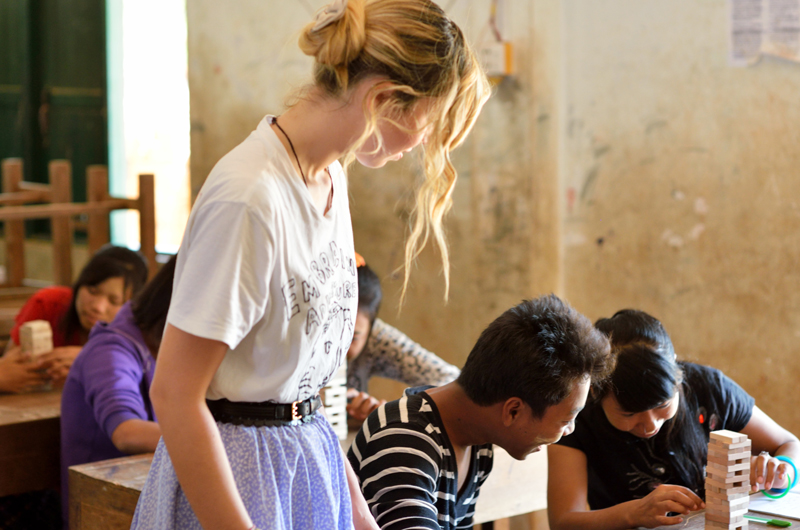
    Ali Haymes teaching English to novice nuns in Myanmar.

    I’ve learned the hard way that trying to control all these situations just leads to more stress and anxiety. It can definitely be frustrating when things don’t go as planned or you don’t feel prepared, but this is all part of the charm of living in Asia.

    Once I learned to accept that things constantly change and that nothing is ever as organized as you may hope it will be, teaching here became much more enjoyable. If you’re flexible in your schedule and in your mindset (and always have extra games to play in class), you’ll be able to lead a much happier life abroad.

    An empty classroom in Vietnam.

    Take a break

    Being a teacher abroad you will quickly find that there is an abundance of teaching positions available. You’ll constantly be offered new jobs and cover classes. This can be a great source of additional income! But, you can always say, “No.”

    It’s great to have the option to fill your time with more classes, especially if you’re hoping to save up some money. But, I’ve found it equally as important to remember that you aren’t solely here to teach. You aren’t obligated to teach on your day off or to pick up that early morning class on Sundays. You can take a break. Giving myself this freedom has really allowed me to enjoy the time that I do teach even more.

    A scenic view of Vietnam.

    Find your spot

    One thing I think can be helpful in a positive work/life balance is finding different spaces for these two worlds. Hanoi in particular has an incredible coffee culture, there’s a cafe almost every other store front. Finding a place where you can only lesson plan and do work can be very beneficial.

    I’ve found a couple cafes where I often go and sit with my laptop for a few hours, lesson plan, blog, and get brunch. I’ve also found some cafes where I go to just enjoy being outside and have some fresh juice, maybe read a book. Having these spaces outside of home is very helpful to ease your mind and create a healthy balance of how much you work each day.

    I can go to a cafe knowing that I will work for a little bit and then I can be done and enjoy the rest of the day, or I can go to the place knowing that I’m taking a break from work. Whether I’m going for work or to relax, setting aside this time has been a great benefit to organizing my free time.

    At a cafe in Hanoi, Vietnam.

    Connect with other teachers

    Connecting with other teachers is not only a great way to ease yourself into life abroad, but it can also help you balance and blend your work and free time. While it’s great to have separate spaces for where you work and where you relax as mentioned above, in some cases, mixing the two can also help you feel more at home while living abroad. It’s quite easy to connect with other teachers in Myanmar and Vietnam, and I’m sure equally as simple on any Greenheart Travel program!

    You will be surrounded by lots of other people having very similar experiences to you and this can be used to your advantage. Fellow teachers will likely become your dear, dear friends while living abroad. These can be people you go to if you have a difficult student in your class, or people you go to if you are feeling homesick. You can talk to your fellow teachers about what games work and don’t work in your classes, or you can plan weekend trips together.

    Living and interacting with other teachers outside of work has been greatly rewarding for me in this sense. Being able to have a great connection to so many teachers has helped me through tough times at work, and also been a great emotional support while I’ve been here.

    A group of teachers exercising together in Yangon, Myanmar.

    Make time for your passions

    This is one of the most crucial things you can do while living abroad. Create a perfect balance of work and play. While teaching can be fun and it’s an excellent way to contribute to a society while also supporting yourself in another country, it may not be everyone’s passion. As such, it’s important to also fill your time with things you would enjoy doing at home.

    For example, I’ve found a yoga studio in my neighborhood that also offers aerial classes, something I did growing up in Chicago. It has been so wonderful to be able to take an aerial class in the morning before my lessons in the evening. This helps me relax before class and not get too stressed about lesson planning. It has also helped me meet more expats and teachers to connect with! If you work evenings and weekends as many people in Vietnam do, it’s especially easy to fill your days with your hobbies and then work in the evenings, creating a nice mix of working and relaxing.

    Ali doing aerial yoga in Hanoi, Vietnam.

    Get out of the city

    My last recommendation to have a full life teaching English abroad is to get out of the city you’re placed in. Living in Yangon, Hanoi, or somewhere equally as busy can get a bit overwhelming. It’s wonderful to have so many amenities around you, but the crazy traffic, crowded streets, and pollution can take a toll on your well being. And sometimes this can have a negative effect on your teaching ability and how you feel in the classroom.

    Taking a day or two to get away from it all can be rejuvenating and make you feel ready to take on teaching with a whole new attitude. Luckily, there are incredible mountains and gorgeous landscapes to explore only a few hours outside of Hanoi, and many other cities in Southeast Asia. Especially if you are feeling overwhelmed in the city, taking a short trip can be a perfect way to gain some perspective and feel ready to jump back into the classroom.

    A vibrant street view in Yangon, Myanmar.


    Greenheart Travler, Ali Haymes, taught English in Myanmar through Greenheart Travel for three months, before venturing off on her own to find a teaching position in Vietnam. Follow along on her Southeast Asian adventures!

    Looking for more advice? Head to our teaching tips page!

  • How Teaching in China Changed My Life

    How Teaching in China Changed My Life

    I made one of the biggest decisions of my life because my college professor decided that she didn’t “feel” like doing the whole teaching thing one day and cancelled class.  Faced with an extra 4 hours, I had an epiphany.  I did not know what I was going to do with those extra hours and I also had no idea what I was going to do with the rest of my life.  This reality was a bit jarring, so I decided to kill 2 birds with one stone. I went directly to the computer lab and used my new found freedom to determine the path for my post-college life…or at least the year following college.

    After scouring the internet for a couple of hours, I realized that:

    a) I wanted to live abroad again
    b) I wanted to live in a non-western country, where I would also feel safe
    c) I wanted to work, not continue my studies, and
    d) a little spending cash wouldn’t hurt.

    So what does that spell? T-E-A-C-H-I-N-G  I-N  C-H-I-N-A!!! or at least it did for me.

    As soon as the idea hit me, it was like a weight had been lifted.  I’ve never been as sure as anything in my life and that certainty was liberating.

    By April, I was officially accepted to teach English in Hunan Province and mentally I was ready to go immediately.  Unfortunately for my impatient self, I had to wait until August to leave.   This was a great first lesson in flexibility.  When you are living abroad (specifically in China) you have control and power over nothing. Once you give into that notion, you stop thinking about how things should be, and just start enjoying the way things are.

    While I was eating the most delicious food in the world amongst rice paddies, my friends back at home were struggling to be hired at entry-level jobs they didn’t even like.  Their choice to stay at home was more comfortable, but I was living a “choose your own adventure” book.  Every morning, I thought to myself, “what crazy Chinese shenanigans, will I get into today? And every night I wasn’t disappointed.

    The experiences I was allowed and the people I met were so enriching that 7 years later they continue to have an incredible impact on my daily life.  I taught over 800 Chinese kiddos how to sing “you are my sunshine”. I considered snake to be a staple at meals. I traveled.  I had conversations in Mandarin. I eavesdropped on other people having conversations in Mandarin. I slept in a dining car for an 18 hour train journey…and liked it.  I connected a history class at my Alma mater high school with one of my English classes, so they could be pen pals.  I judged karaoke competitions.  I played ping-pong.  I made friendships with some of the most fascinating, caring, engaging, and coolest people I’ve ever had the pleasure of knowing.

    It’s more than experiencing a different culture.  It’s about connecting with people whom you initially didn’t understand… on any level.  But once you break through those communication barriers, it’s difficult to come up with a feeling more satisfying.

    The rewards of teaching in China didn’t end when I left.  Every one of my employers mentioned that my stint in China made me stand out among the other applicants.  Their reasons varied, but the outcome was the same. I was hired.

    If I had to do it all over again, I would do everything the same way.  Teaching abroad was absolutely life-changing.  It made me attractive to employers, allowed me opportunities to travel, and gave insight into an amazing world I would otherwise have thought of as just another place on the map.  China gave me the gift of never again seeing places as the “other”, but instead seeing them as other cool areas to discover.

  • 6 Tips to Learning Thai, and Other Languages, While Teaching Abroad

    6 Tips to Learning Thai, and Other Languages, While Teaching Abroad

    So you have been teaching in Thailand, and have picked up enough phrases to order that delicious pad Thai up the street, find a bathroom easily by asking, and haggle your way through any tuk tuk/taxi conversation. But the moment someone asks you a question that doesn’t illicit a ‘yes’ or ‘no’ answer, you fumble with your words. Your brain freezes up, and you can’t think of what to say. What do you do now?

    The answer is simple: Study more and study hard.

    A statue of Buddha in Thailand.
    A statue of Buddha in Thailand.

    A Plateau in Language Learning

    You have tried so hard to learn what you have, yet you feel like studying isn’t taking you anywhere. What can you do?

    Don’t worry, I have been where you are before, and I have struggled with learning Thai. I am nowhere near fluent yet, but I have passed the beginner stages. This “brain freeze” you are experiencing isn’t a headache from a Slurpee at 7-Eleven, but a plateau.

    A plateau in language learning, or any skill in life for that matter, is the glass ceiling you get to after putting in so many hours of practice and work into learning a skill, such as learning Thai, and you suddenly find yourself not progressing at the expedient rate at which you were before.

    This article will hopefully provide you with the tools (more specifically a sledgehammer) to help you break through that glass ceiling, and to keep progressing in your language learning. Are you ready?

    People visiting a temple in Thailand.
    People visiting a temple in Thailand.

    Here are six tips to help you learn Thai, or another language, while teaching and traveling abroad:

    1. Speak as much as you can, and make mistakes.

    This is number one for a reason. If you want to get better at a skill, then you need to practice it as much as possible. Not only that, but you cannot be afraid to make mistakes. Once you have a fear of making mistakes, your confidence will diminish, along with your motivation for learning the language.

    Remember that motto you heard all your life: Learn from your mistakes.

    If you don’t make mistakes, then you will not learn. So go out there, start talking, and find out the hard way. Get your elbows dirty and your tongue twisted. If you find yourself struggling and making mistakes, or finding it difficult to locate a phrase or word in your lexicon, then laugh it off. Odds are, the Thai person already is.

    Thai salad on a table.
    Thai food on a table.

    2. Learn relevant language for everyday use.

    What do I mean by this, you ask?

    Well, it is simple. Start by learning phrases that you can use everyday. Granted at this point you’ve already learned phrases like, “How much is this?” and “Is this spicy?”

    • Now’s the time to learn the words for places you frequent like ‘restaurant’, ‘train station’, ‘bank’, ‘school’.
    • Learn simple descriptive words such as colors and common adjectives.
    • Work on your numbers past the hundreds.
    • Learn how to ask where someone has been, and where they are going.
    • Figure out how to say expressions such as, “How was your day?” and “What food do you like?”

    If you are struggling to think of what to learn at first, think of simple phrases you say in English daily, and then make a list out of them. Odds are it will be extensive.

    The back of a truck that says Thailand.
    The back of a truck in Thailand.

    3. Learn in sentences (phrases).

    There was a famous linguist that said words by themselves have no meaning. Try it. What does ‘couch’ mean? You can tell me it is something you sit on, sure, but the only reason this word has that meaning is from the context of other words describing what it does.

    What I am getting at is that if you focus on learning individual words all time, you won’t understand the context, and you won’t commit them to memory. For example, if you know how to ask, “Where is the bathroom?”, you can now ask, “Where is the bank?”

    If you know how to say the phrase, and use it daily, it will be much easier to learn and remember the new vocabulary you are studying. This strategy is called sentence mining; literally mining a sentence for new vocabulary. Google it, it is extremely effective.

    Thai long boats on a beach.
    Long boats on a beach in Thailand.

    4. Do not let grammar rules and translations in your native tongue influence your target language.

    I learned from a hyperpolyglot named Stuart J. Raj (Google him too, he will blow your mind), about how to think in meanings. I can’t say I do this all the time, but I try to whenever I speak Thai.

    For example, take the word“ไป” (pronounced ‘bpai’) in Thai. It means “to go” in English. But, think about what ‘to go’ actually means. For a Thai person, ‘bpai’ is more along the lines of to move away from the point in space where you are right now, while the word “มา” (pronounced ‘ma’) means coming towards where you are now from a point where you were before.

    So, instead of attaching a single word, such as “go” or “come” to a Thai word’s translation, try to think on a deeper level. It will help you in the long run. It sounds difficult, but so is learning a foreign language.

    5. Create an immersion environment that will stimulate your learning.

    This one is important. What I mean by this is even though you live in Thailand and are surrounded by spoken Thai everyday, you can do so much more to learn.

    For starters:

    • Listen to Thai talk radio
    • Learn some Thai music
    • Read Thai children’s books
    • Watch T.V. shows in Thai
    • Speak out loud when you are alone in Thai

    Pretty much what I am saying here is that anytime you think of doing something in English, do it in Thai. You will thank me later.

    Young students in a classroom in Thailand.
    Young students in a classroom in Thailand.

    6. Don’t Speak English unless you absolutely have to, or don’t use it at all.

    This is the Mother of all the tips, and also the most difficult. If you are reading this you are most likely an English Teacher in a Thai school, just like me, so you speak English for a living. But, when you are not teaching, challenge yourself to speak only in Thai.

    • When you go to the market, speak in Thai.
    • When you talk to your Thai friends, even if they speak English fluently, respond in Thai.
    • Try to use the language as much as possible, or even promise yourself not to use your mother tongue.

    Not falling back on your mother tongue does a lot for your learning process. It allows you to work around words you don’t know when you hear them. If you fall back on English when you are in a conversation, you are limiting your ability to listen, hear, and speak the language. Also, if you fall back on English frequently, you aren’t really trying anymore. I know it’s not possible to do it at a beginners level all the time, but maybe set aside 30 minutes to an hour a day where you pledge to only speak Thai, and increase the amount of time the better you get.

    Thai culture books on a shelf.
    Thai culture books on a shelf.

    Try, and Try Hard

    I know what you are thinking: “But, Max, this is so much to do!”

    Guess what, it is.

    Learning a foreign language is no simple task, and not for the faint of heart. Plus, it takes hours of time, effort, and requires intense dedication. Trust me, if you don’t put in the time and effort to actually sit down and study an hour or two a day, you will not become fluent. You will also likely not “pick up” the language just by living in Thailand. If you want to learn Thai, or any foreign language for that matter, you have to try, and try hard.

    Ask anyone you know who speaks a foreign language that isn’t a native speaker. They will tell you they studied; I guarantee it. I am not trying to sound mean, that is just how it is.

    Hopefully my tips point you in the right direction to further your language learning process! Remember, learning languages is fun and a wonderful experience, so embrace it head on!


    Do you have any language learning tips? Share them below!

  • Teaching Tips Tuesday: Add Some Summer Fun to Your English Lessons

    Teaching Tips Tuesday: Add Some Summer Fun to Your English Lessons

    While teaching English in places such as South Korea and Thailand, it’s common to be responsible for facilitating “English Camps” when school’s out. The ideas below are perfect for a summer themed camp, or for teachers looking to add some summertime sun and fun into their English lessons by practicing vocabulary and expressions associated with summer plans and common summery things.

    Here are five ways to add some summer fun to your English lessons:

    Bags of ice in a freezer.
    Bags of ice in the freezer to make ice cream.

    Shake Things Up with Homemade Ice Cream

    Making homemade ice cream gets students up and moving around the classroom, and helps them practice action words associated with a recipe such as add, mix, shake.

    Materials (per group of four students):

    • One small plastic bag
    • One large plastic bag
    • Newspaper for padding
    • Spoons
    • Cups or dishes

    Ingredients (four servings):

    • One bag (or two trays) of ice
    • Six spoonfuls of salt
    • Two spoonfuls of sugar
    • 1/2 cup of milk
    Students added ingredients to a bag of ice.
    Students adding ingredients to a bag of ice to make ice cream.

    How to Make Ice Cream:

    • Mix milk and sugar in the small plastic bag.
    • Add ice and salt in the large bag.
    • Put the small bag inside the larger one.
    • Wrap the bags within newspaper for insulation (and so hands don’t get too cold).
    • Have students take turns shaking the bags for a total of ten minutes.
    • Open up the bag and serve your homemade ice cream!
    A group of students running in a schoolyard.
    Students running to look for clues during a schoolyard hunt.

    All Around the School Hunt

    Having students hunt for clues all around the school gets them out of the classroom, and hopefully outside to soak up some sun. A school-wide hunt works well for lessons focusing on prepositions of place, and/or vocabulary words associated with items around a school.

    Recommendation: Have the clues lead to some type of snack, prize, or reward at the end for an added incentive.

    Notes: Give yourself plenty of time to plan your course(s) ahead of time, and ensure you have all clues hidden around the school beforehand.

    A clue for a scavenger hunt taped to a wall.
    A clue for a school scavenger hunt taped to the side of a wall.

    Some More S’mores, Please

    If you or your students have never tasted s’mores before, you’re in for a real treat. S’mores are a popular snack that go hand-in-hand with summer. In the United States, for example, s’mores are most often eaten while camping, or really any time there’s a fire to roast marshmallows. Why are they called s’mores? Because when you eat one s’more, you almost always want “some more”!

    Making s’mores during a lesson provides an opportunity for students to practice using some more when asking and answering questions. S’mores also go along with units on camping, or just cultural summertime activities in general.

    Materials:

    • Candles (or a portable electric/gas burner)
    • Chopsticks
    • Plates or tissues

    Ingredients (per s’more):

    • One or two marshmallows
    • Two graham crackers*
    • Chocolate

    *You can substitute various sweet crackers, or even chocolate-covered biscuits for both the chocolate and graham crackers.

    Ingredients to make S'mores.
    Making s’mores in the classroom with different ingredients.

    How to Make S’mores:

    • Stick the marshmallow(s) on the end of a chopstick and roast them over a flame.
    • Put the chocolate on one half of the graham cracker.
    • Place the roasted marshmallow(s) on top of the chocolate.
    • Set the other graham cracker half on top of the roasted marshmallow.
    • Lightly press down to sandwich together the s’more.
    • Enjoy the yummy, sticky mess!

    Recommendation: Metal chopsticks (or other utensils) are safer than wooden ones.

    Notes:

    • Ask your school/colleagues for permission to make s’mores prior to building a “campfire” in the classroom.
    • Closely supervise younger learners so as to not burn the building down.
    Roasting marshmallows over small candles.
    Students roasting marshmallows over small candles in the classroom.

    Jiggly, Giggly Water Balloon Fun

    On a particularly hot summer day, or perhaps the last day of your summer fun English Camp, throw in some water balloons to help cool off. There are many ways to incorporate the use of water balloons into an English lesson. Below are two ideas to help students practice target vocabulary and language while competing in a friendly team competition.

    Materials: 

    • Two buckets or large bowls (per team)
    • Many water balloons (at least 12 per team for each initiative)
    Students toss a water balloon.
    Students toss a water balloon during a class activity in the summer.

    Water Balloon Toss

    How to Play:

    • Divide your class into teams of five or six students.
    • Have two teams stand in a straight line with at least five feet of space in between each student.
    • Set two buckets or bowls at the beginning and end of both lines.
    • The first student in each line picks up a water balloon and tosses it to the next.
    • This continues from student to student until it makes it to the end of a line.
    • If a water balloon falls and/or breaks, the team must start over with a new one.
    • Once a balloon reaches the end if a line, the last student must place it in the container and ask or answer a question with a teacher.
    • If he or she is correct, they can turn around and run to the beginning of the line to pick up the next water balloon.
    • All students move up one place in line so that everyone will eventually practice the English vocabulary and expressions for the summer lesson.
    • Whichever team has the most amount of balloons in the bucket or bowl at the end of a certain amount of time wins!
    Two girls stand back-to-back in a water balloon relay.
    Two students carry a water balloon back-to-back during a team relay race.

    Back-to-Back Water Balloon Relay

    How to Play:

    • Divide your class into larger teams (of eight to ten students).
    • Have two teams stand in a straight line behind a bowl or bucket on one end, and set the other container to collect the balloons on the other end of the play area.
    • The first two students must stand back-to-back and link arms (as seen above).
    • A student behind them on their team places a water balloon between their backs.
    • When it’s time to start, the two students quickly try to reach the other end where they must carefully drop the water balloon into the container.
    • If the balloon pops or falls, they must run to the beginning and start over.
    • Once a balloon is safely dropped into a container on the opposite end of the start line, the pair of students then turns to face each other to practice the target language for the lesson before returning to the start line.
    • The next two students in line may begin only after the two before them have returned.
    • Whichever team has the most balloons in their container when time runs out wins!

    Recommendations: 

    • Fill up the water balloons before class, and have everything set up in a designated area outside.
    • Have your students bring a change of clothes or at least towel to dry off.
    • Depending on time and the size of your class, try doing both the water balloon toss and back-to-back relay as a tournament. The winning team for each round goes onto the next and competes with a new team until there’s only one winner.

    Note: Having no more than two teams compete against each other at once helps ensure students are correctly practicing their English!

    A student bites watermelon in the summer.
    A student eats watermelon in a classroom.

    A Bite of Summer Sweetness

    Watermelon is the perfect snack to slice up and share with your students when temps heat up. It could also be utilized in a summer-themed English lesson in various ways.

    • Try doing a seed-spitting contest
    • Have your students create a silly story about what happens if a person eats a watermelon seed
    • See which team can make the most creative watermelon carving

    Watermelon also serves as a way to practice summertime fruit vocabulary. And the best part is, it’s refreshing after spending time outdoors!

    A bucket full of water balloons.
    A bucket full of water balloons for summer activities.

    Who’s excited for some summer fun!? Your students will most definitely be, especially if they have to attend a summer English Camp, summer lessons, or are just antsy to start their summer holiday a few days too soon.

    The more time you put into preparing these summery activities for your students the more effective they’ll be! Keep in mind most of them are better suited for younger learners, but all could be adapted to fit a variety of ages and levels. Although the activities featured in this teaching tips blog post call for a minimal amount of materials, you might not be able to find everything you need where you’re teaching English overseas. Be resourceful and check out these other teaching tips for more ideas!


    What favorite summertime activity would you use in the classroom? Share below!

  • Teaching Tips Tuesday: Simple Ways to Relieve Stress While Teaching Abroad

    Teaching Tips Tuesday: Simple Ways to Relieve Stress While Teaching Abroad

    Teaching English abroad can be a very rewarding and transformative experience. Many of our Greenheart Travelers continue teaching overseas much longer than they planned, and others even end up redefining their career path or finding their calling as an educator.

    Teaching abroad can also be quite stressful and frustrating at times. There are cultural differences and language barriers to deal with. And it involves a lot of learning as you go, especially if you haven’t had a chance to gain a TEFL certification before you go.

    Here are a few tips to help you get through the tough days:

    A teacher hiding under a desk.

    1. Overcome your nervousness.

    Sometimes the last thing you’re going to want to do is face your students. Perhaps it’s your first time in front of a class, maybe you haven’t fully prepared for a lesson, or you’re just not feeling well from something you ate the night before.

    Inhale.

    Exhale.

    Find a moment to collect yourself, and begin your class by facilitating a centering activity.

    It’s always a good idea to start with an active warm up. Chances are your students will also feel nervous about practicing English. When anxiousness abounds, overcome it through laughter and movement.

    A teacher resting on a couch after school.

    2. Seek out a community to be part of, and do fun activities together.

    Some days it’s probably going to take a friend or two to pull you off the couch and out your door. Teaching can be exhausting, especially if you’ve had a particularly rough day. Thankfully, you’ll likely be placed in a city with other English teachers from all over the world, and one of the perks of teaching overseas is making life-long, international friends.

    Seek out a community of locals and other foreigners to be part of, and do fun things together such as. Spending time with others is a huge stress reliever and a great way to boost morale.

    A teacher feeling angry and journaling.

    3. Blog about the good days and the bad days.

    Dealing with cultural differences or trying to communicate through a language barrier is going to get to you. In fact, you may even feel downright angry about everything when it happens. Keeping a journal has been known to be an effective stress management tool for many.

    • Jot down some of your thoughts on paper
    • Ponder what’s causing you to feel how you feel in that moment
    • Acknowledge the negatives, but focus on the positives
    • Come up with proactive ways to respond what’s stressing you out
    • Then consider blogging about it

    Blogging gives you the opportunity to be transparent about your overall experience, the good and the bad, and invites others to relate to and help you through the hard stuff.

    Let us know if you want to blog about your teaching abroad experience while on one of our programs!

    A teacher looking sad.

    4. Stock up on motivational activities to keep your students engaged.

    Avoid boring your students to sleep during lessons by keeping them entertained while improving their English skills. The more ideas you have up your sleeves, the better. Trying to think of activities on the spot can be highly stressful, and repeating games too many times (unless requested by your students) makes them less appealing.

    We know it takes a long time to build a stash of exciting motivators, so here are lots of teaching tips to help you start stocking up!

    A teacher excited for a long weekend.

    5. Make the most of your time off. But, also rest.

    Long weekends are the best, aren’t they? You’ll get three-day weekends in other countries, too. Likely for holidays you haven’t even heard of before. Making the most of extra time off doesn’t necessarily mean trekking all over the place, and then rolling into your first lesson right after hoping off an overnight bus.

    Give yourself some cushion. Travel for two days, and leave the third one open to relax and prepare for the week ahead. Seems like common sense, right? But, when your time abroad seems limited, you’re going to want to see and do as much as possible.

    Be intentional about getting enough rest.

    “A challenge I hadn’t anticipated was dealing with burnout and not taking good care of myself mentally. For the first two months, I was bringing work home almost every night and traveling most weekends, so I never really gave myself a break or time to relax.” – Kara Menini, Greenheart Travel Program Manager and Teacher in Thailand

    A teacher looking and feeling stressed.

    Teaching abroad is the journey of a lifetime, complete with all sorts of ups and downs along the way. You’re going to feel stressed and frustrated every now and then, but you’re definitely not going to be alone in riding these emotions. We’ve been there. Our Greenheart Travel teachers and alumni have been there. Take a breath. Seek out friends to spend time with. Let your thoughts out. Always come prepared for class. And rest.


    Do you have other tips for reducing stress while teaching abroad? Share below! 

  • Teaching Tips Tuesday: How to Prepare for Your Teach Abroad Experience Before You Go

    Teaching Tips Tuesday: How to Prepare for Your Teach Abroad Experience Before You Go

    Perhaps you’re just starting to consider teaching overseas. Maybe you’ve already applied and are anxiously waiting to hear if you’ll be tutoring in a homestay in Chile. Or, you’re going to teach in China, but you’ve got a few months to prepare before departure. Getting ready to move to another country with a Greenheart Travel teach abroad program is thrilling, but there’s so much to do!

    Don’t worry! We’ve got you covered.

    Take a breath. Realize you’re making an awesome life decision. Share your intentions on social media so everyone can be excited for you, and most importantly, prepare for teaching English overseas by hitting the books, gaining more experience, seeking advice, and grabbing a few items you may need in the classroom.

    Here are some proactive ways to prepare for your teach abroad experience before you go:

    Give Online Tutoring a Try

    Online tutoring is becoming more and more popular, and this is a great means to gain real teaching experience—while getting paid—before you go abroad. Lots of online tutoring providers offer training and teaching materials to boot. Another plus side of doing online tutoring is you can do so from nearly anywhere with a decent Internet connection.

    Volunteer as an ESL Tutor with a Local Organization or School

    A child in a Thai classroom.
    A young student in a classroom in Thailand.

    There are so many volunteer opportunities out there to help you gain actual in-person English tutoring experience, and the best part is you get to give back while doing so. Several of our Greenheart Travelers have volunteered at refugee centers, alongside working adults who speak English as a second language, or within special programs at underserved inner-city public schools.

    Try doing a quick Internet search to find reputable organizations in your area offering volunteer ESL tutoring hours. Many are one-on-one instructing gigs, but if given a choice we’d recommend working with a classroom of students; if possible, as oftentimes while teaching English in another country, you might find yourself in front of a room of 30+ students.

    Brush Up on the English Language

    ABC stencil letters of a world map.

    Sometimes you just know something, but you don’t really know how you know it. You know? This is likely a common situation for several of our English teachers overseas. At least it was for me. Countless times my students asked me a question about grammar, and I simply couldn’t put into words why I knew what I knew. I just knew.

    “Because it just is…” only works so many times.

    Basically, I’ve had to relearn how I learned English in order to be a more effective teacher over the years.

    It seems when you naturally acquire a language you don’t always know what many of the terms are for what you’ve been doing right (or possibly even wrong) all along (even if you paid attention during English classes in school). What are conditionals? Would you confidently know the correct past perfect form of all verbs? Could you help your students practice future progressive sentences? Brush up on your English!

    Get TEFL/TESOL Certified

    Kara studying for the Online TEFL certification course.

    Even if you it isn’t required for you to get TEFL certified to teach English abroad, it’s a very good idea to do so. Having a TEFL (TESOL) certification makes you a more competitive applicant, increases the chance you’ll have a higher starting salary, and indicates you know a thing or two about teaching English as a second or other language.

    In addition, not only do you gain classroom teaching experience, even while taking our online TEFL certification course, you learn necessary management techniques, the basics of lesson planning, and you become part of a larger community of people just as passionate as you are about traveling for a change by teaching English overseas.

    “As an already licensed teacher, I wasn’t sure if this certification would be strongly beneficial to me or not. I was applying to teach English in Thailand, and since Greenheart Travel’s program offers the certification course in Thailand, I decided to go for it. I’m very glad that I did because there were many new and useful techniques I learned throughout the certification.”

    – Lindsey Gall, Greenheart Travel teacher in Thailand and Colombia

    Raid the Dollar Section at Your Retail Store of Choice

    A teacher with kids in Thailand.
    Greenheart Travel alumna, Lindsey Gall, with her students in Thailand.

    You know how discount retailers such as Target have specific sections where everything is under a few bucks? It’s that stuff that usually lines your walk to the checkout counters with things you suddenly, absolutely need to purchase. Well, believe it or not, many of these last-minute ‘toss ins’ are perfect to take with you to use in the classroom! You never know when you’re going to need those little mind puzzles, the animal flashcards, or that mini dry-erase board. So, look out!

    About any little gadget can be made into a teaching tool, and nearly every activity can transform into an educational game. Even if you have no idea what you’d use some of these small items for when you’re impulse buying them, most would make great prizes for incentives, and can often go along with a theme or a topic of a future lesson.

    “Come with some supplies or simple games… The dollar store is a great place to go to find things like stickers with English words on them. …Additionally, there are many great flashcards and card games that are fun to bring along, as well, such as ‘Spot It’. I used these often when I tutored students after school.”

    – Lindsey Gall, Greenheart Travel Teach Abroad alumna

    Connect with Others Who’ve Done It

    A teacher with students in a Thai classroom.
    A Greenheart Travel teacher abroad.

    What better way to prepare for teaching abroad than to reach out to others who’ve gone before you, or are currently doing a teach abroad program. Connect with other Greenheart Travelers to get answers before you head out! We have a large number of teachers who’ve blogged for us, or are just a Facebook post, comment or message away.

    Our Teach in Thailand, Teach in Colombia, and Teach in Korea Facebook pages are quite active. It’s especially helpful to engage with Greenheart Travel alumni to understand what some of your future students might be interested in.

    “I think one of the biggest things that helped me prepare, was reading all of the blogs posted by current/previous teachers on Greenheart Travel’s website talking about their experiences and tips that helped them.”

    – Lisa Dershowitz, Greenheart Travel Teach in Thailand alumna

    Ask Your Friends, Family, or Even Past Teachers for Advice

    One of the most meaningful moments I had during my first years of teaching overseas was when it dawned on me how much I had gained from a particular teacher who helped me learn how to read when I fell behind my peers in elementary school. It had been years since I had even seen this teacher, but I reached out to her nonetheless to not only thank her for teaching me how to read, but to also ask her more about the curriculum she used to get me to where I needed to be in regards to comprehension.

    Ask your friends, your family members, and connect with your past educators for advice on their teaching and/or learning experience. Your personal network of connections is an absolute wealth of knowledge and resources, and it’ll mean a lot to those you know to get to be part of your overseas teaching adventure in this way. Later on you could even ask them to correspond with your students!


    We share teaching tips every Tuesday on our blog and Facebook page to help you feel as ready and as excited as possible to step right into your classroom abroad. Whether it’ll be your first class ever, or you’ve lost count of how many students you’ve taught, we hope the guidance of our Greenheart Travel community is useful. Do you have any other ideas for ways to be proactive about preparing to teach in another country? Tell us in the comments below!

    How does getting TEFL certified abroad sound?

  • Teaching Tips Tuesday: Connecting Your Classroom to the World

    Teaching Tips Tuesday: Connecting Your Classroom to the World

    Photo above: An image of my parents greeting my students that I’ve included in introductory presentations.

    Teaching English in another country is exciting, and it’s fun to share about your experience every click, snap, and recording along the way. While numerous social media outlets provide the perfect chance to document your life abroad, it’s important to come up with ways to not only share, but to also connect your overseas teaching experience with your loved ones at home, wherever that ‘home’ may be.

    By doing so, you facilitate cross-cultural exchange, a greater understanding of the world at large, and it’s a wonderful opportunity to help others feel like they have a seat in your classroom or spot on your family’s couch.

    Below are some tips to help you connect your students with the bigger picture of your life, and the global community in which we all live:

    Skype with Friends/Family During a Class

    If you happen to have a computer, projector, and strong enough Internet connection in your classroom, have your friends or family connect with your students via software such as Skype. Not only is this an interactive way to change up the pace of your usual lesson content, it’s also one of the best ways to invite your friends and family to be more a part of your overseas teaching adventure.

    Suggestion: If you don’t have access to a computer or a projector, a smartphone works just as well (depending on the size of your class).

    A teacher abroad's sister and niece greetings his students.
    My sister and niece holding a sign to connect with my students.

    Create a Presentation for Your First Lesson

    Have you received your teaching placement? Are you getting ready to go? You’ll most likely have an introductory lesson with all of your students on your first day of teaching, one in which you’ll get to immediately connect your class(es) to the frame of your life—where you come from, who you are and so on. This is something you could start putting together even before heading to another country!

    Go beyond just a photo slideshow. Make it engaging. Record some of your family members saying “hello” to your new students.

    A few things to consider including:

    • Quick clips of your friends
    • Shots of what your home looks like
    • Videos of your animals being cute
    • Even a fun quiz at the end

    Then you can take these fun bits of information and put it all together in a PowerPoint or Prezi presentation.

    Suggestion: Bring maps and print photos in case you aren’t able to show a presentation, and play prerecorded clips from your phone or other small devices instead.

    A greetings from Chicago postcard.
    A postcard from Chicago, USA.

    Facilitate a Pen Pal or Postcard Exchange

    Chances are you have a friend or a family member who works as a teacher somewhere. See if they’d like to participate in a pen pal or postcard exchange program with your students. If you don’t know of any teachers, reach out to us! We’d love to help find you a classroom of eager students to connect with your class abroad. This is especially fun for younger learners.

    Suggestion: You could design your own postcards during a lesson!

    Make a Class Video

    No matter the age of your students, video projects are a hit. Make a video with your students to showcase the culture in which you’re living and working. Be creative! Share it everywhere so others can learn more about what you’re up to. But, in order to form a more personal connection, team up with a classroom of students elsewhere, or even with your family and friends. The hope would be for your students to also have a video to watch about other people, places, and cultures!

    Check out Stephanie Warren’s video, Greenheart Travel teacher in Thailand and Myanmar, for a fantastic example:

    Bring Your Visitor to Work Day

    The more you post to your social media feeds, the greater the chance you might have visitors it seems. Living in an exotic locale is appealing! If someone comes to see you, pull them into a lesson if your school allows. Have them be a special guest for your students. They could help instruct, they could come bearing little cultural gifts or trinkets, and/or they could answer any questions your students might have.

    Suggestion: Tell your visitor to be prepared to possibly be asked very personal questions, though.

    Friends teaching together in a classroom in Myanmar.
    Teaching in Myanmar with my friend!

    There are many ways to make your lessons feel global for your students. Technology brings all of us to new cultures and to far away places and faces. Being intentional about forming more personal connections through activities such as the examples above really helps connect your students to at least your small part of the bigger picture of life. Looking for more ideas? We’ve got loads of other teaching tips just for you! 

    We love to get to be part of your journey! Please feel free to send Greenheart Travel a postcard, a Snap (@greenhearttravl), a video, or tag us on Instagram (@greenheart_travel) to let us in on your experience teaching abroad. We’ll be sure keep in touch with you and connect with your students, too!


    Do you have other ideas for connecting students to the world outside of a classroom setting? Share them below!

  • Teaching Tips Tuesday: Travel, Teaching, and Adjusting to Life in a Homestay Setting

    Teaching Tips Tuesday: Travel, Teaching, and Adjusting to Life in a Homestay Setting

    Joyce Angio, an experienced ESL teacher from Canada, recently finished teaching English in a homestay in Italy with Greenheart Travel. Read on for her advice about living with a host family, insight on balancing time for teaching and exploring, as well as ways to make the transition abroad smooth.

    What are some tips for living with a host family?

    “I know this is going to sound trite, but bring an open mind, the ability to adapt, and the desire to learn.”

    Keep your eyes and ears open, watch what is being done around you, and take your cues from what you see. For example, I apparently transgressed a cultural rule that says an invitation to dinner is accepted no matter if we want to go or not.

    Another example of a balancing act is translation: once it became known that I was an English teacher back home, friends and neighbors of my host family seemed to take it for granted that I’d be their de facto translator, homework corrector, resumé writer, and grammar teacher.

    How did you find a balance between your teaching and living schedules?

    In general, it was easy for me to find a balance between the two schedules. My host mother was a single mom raising her 16-year-old daughter on the outskirts of Rome. She left the house very early to go to work, and my host sister left for school soon after. That’s when I could take off to explore Rome.

    Since my host mother, Asia, made my host sister, Feirouz, do her “important” homework right after school, I didn’t need to get back to our neighborhood until late in the afternoon.

    Our English lesson was supposed to come once all her other homework was done, and that usually meant after dinner. But, honestly, by 9:30 at night, we were both too tired to begin our three hours of “instruction”. So, we renegotiated the requirements.

    Feirouz and I agreed to speak only in English, including text messages during the day and on weekends when I was gone. One year later, I often have my morning coffee while texting with Feirouz since she’s getting home from school as I’m getting up. In fact, in a few weeks, I’ll be going back to stay with them for a few days!

    A woman out to dinner in Italy.
    The best of Italy on Joyce’s plate.

    One aspect I wasn’t prepared for was playing the role of referee. My homestay mother admitted that when she and her daughter were choosing candidates for the program, they had to choose between a young woman and myself.

    She chose my profile for two reasons: she wouldn’t have the potential discipline issues she foresaw with a 21-year-old girl in her house. And she thought a woman “my age” would be a “grandmotherly” figure for her daughter. To her surprise, though, Feirouz and I hit it off immediately. Let’s just say I can easily channel my inner 16-year-old.

    Feirouz started calling me her “sister” within a week of my arrival. She would knock on the door of my room before going to bed. We’d sit and chat about her day, what happened at school, which friend betrayed another, which boy’s girlfriend got mad at her because she was laughing with him in the hall between classes, etc.

    I could give her the advice of a girl who’d already been there as well as the point of view of a mother who was looking at the situation with a different pair of eyes now. I could understand her often lackadaisical attitude towards school, yet warn her of the fast-approaching consequences of not putting her studies first.

    What advice do you have for first time teachers?

    As a career ESL teacher with lots of traveling experience behind me, the teaching aspect of the program wasn’t the challenging part. But, had I been a young, inexperienced teacher, I might have felt overwhelmed by the task at hand.

    I’d tell new teachers to break down the language learning aspects into their smaller parts: work a little on pronunciation, intonation, vocabulary, sentence structure, and then texts of whatever length is appropriate for their host family’s level of mastery. We’re incredibly lucky to have the Internet at our fingertips because everything we need is just a click away.

    Italian musicians playing outside.
    Musicians play near the Forum in Rome, Italy.

    How do you prepare for moving abroad?

    “The idea of leaving your friends and home behind to live in another country with “strangers” is daunting. But, if we take it a day at a time, our adaptation skills should kick in by the end of the first week.”

    Just as I mentioned above with respect to teaching a second or foreign language, by “breaking down” the homestay experience into its smaller parts, we can pretty much handle anything. Baby steps.

    Despite lots of travel experience, I’m a terrible “transitioner”. I still have to constantly balance my need for change and adventure with my need to have a comfort zone. To combat the anxiety created by leaving everything that’s familiar behind, I do the following:

    • Google walk my destination before arrival
    • Study the transportation system of where I’ll be going
    • Look out for articles, blogs and Facebook pages on the location I plan to live
    • Generally just scope out the place – anything to give me a greater sense of familiarity and offset the shock of being transplanted into unfamiliar territory

    I also try to include in my budget an “emergency” stash so I can check into a nice hotel once in awhile when I’m feeling overwhelmed and need to recuperate!

    ” Is a homestay stressful? Yep. Anything new and unfamiliar is. Is it worthwhile?. Definitely. I’m already planning the next stay!”


    Are you looking for more ideas for teaching English in a homestay? Check out our other teaching tips!

  • Teaching Tips Tuesday: Advice for Co-Teaching in the English Classroom

    Teaching Tips Tuesday: Advice for Co-Teaching in the English Classroom

    Co-teaching can be an incredibly fulfilling experience for our Greenheart Travel English teachers overseas. It can also present certain challenges and frustrations when learning how to navigate your role and responsibilities.

    Ideally, in our teach abroad programs such as South Korea and Colombia, Greenheart Travelers equally collaborate with local teachers in and out of the classroom to effectively instruct their students. However, what your role as an English Teacher will be, and what role(s) your co-teacher(s) will play could vary greatly from school to school and individual teacher to teacher.

    Below is advice from some of our current teachers, as well as alumni, for a successful co-teaching role in the English classroom.


    Gina DiBenedetto – EPIK English Teacher in South Korea

    What was your role in the English classroom?

    Teaching with a co-teacher can be either a rewarding or stressful situation. In my case, I experienced both over the course of my year in Seoul. When I arrived, my initial co-teacher allowed me to ease into the role. I would teach the vocabulary/key expressions and she would lead the games and activities. It was a match made in heaven. But, soon after I began, she moved.

    Once she left, I took over as the main teacher in the classroom, with my new co-teacher assisting with translations and classroom management. At first it was a hard adjustment, but I came to enjoy being the lead teacher in the room.

    However, after a few months, we really started to clash and it made work very tense. All of our problems were due to a lack of communication and a language barrier. I ended that semester feeling really down about work and not looking forward to the next.

    An English teacher in the classroom with students in South Korea.
    Gina in a classroom with her Korean students.

    What advice do you have for working with co-teachers?

    My biggest piece of advice is to make sure you communicate openly with your co-teachers, and to not be afraid to suggest some ideas that may be out of the norm for them. In my second semester, I was determined to have open communication with my new co-teachers, so we set up weekly meetings to plan what we would teach, and who would take each part of the lesson. It worked out well because we were always organized and proactive about planning lessons.

    As I had no formal teaching experience outside of my TEFL course, I really learned a lot from both of my co-teachers about how to structure a productive class. And I was able to provide a fresh perspective and suggest new and exciting activities to try. The second semester went extremely well because I was no longer stressed and walking on eggshells around my colleagues.

    Teachers and students wearing Halloween costumes in Korea.
    Gina with her co-teacher and students in South Korea.

    What was your overall co-teaching experience like?

    My co-teachers were my lifelines while trying to figure out this strange and exciting new country. By the time I left Korea, I had very fond memories of my times spent both in the classroom and out with my co-teachers. Working as a team definitely led our students to be more respectful of us, and to have more fun learning English.

    “Teaching with a co-teacher can be great, horrible, or anywhere in between, but having an open mind and a willingness to listen and learn will allow you to make the most of any situation!”

    Grant Bouwer – Hagwon English Teacher in South Korea

    What was your role in the English classroom?

    My co-teacher experience was a little unique in the English academy (hagwon) I worked at. I shared the same students as my co-teacher, but we never taught at the same time and my co-teacher was never in the classroom with me. My responsibilities were to teach the reading, writing and listening workbooks while my Korean co-teacher would teach English grammar and vocabulary.

    I saw myself as more than just an English teacher while in Korea. My personal goal each day was to make sure my students were enjoying life while learning English. I knew my main responsibility was to ensure the students were continually learning English, but I also wanted to make sure my classroom was more than just memorizing words. I wanted my students to laugh, feel comfortable, and have fun while gaining the language skills.

    What advice do you have for working with co-teachers?

    My advice would be to always keep the lines of communication between you and your co-teachers open. Your Korean co-teachers are extremely helpful when dealing with situations within the classroom, whether it’s a troublesome student or a student that may be falling behind. I was always able to speak with my co-teachers about students who were having difficulty. Their knowledge, advice and constant communication with the students’ parents were of great help.

    A group of hagwon teachers in South Korea.
    Grant with fellow teachers at his hagwon in Korea.

    Katie Splean – EPIK English Teacher in South Korea

    What is your role in the English classroom?

    I have taught in smaller, rural schools, which for the most part give me complete control over my classes. Initially, it was a bit overwhelming, as I was expecting to have my hand held and be introduced to the deep end a little more gradually. But, I quickly figured out how to swim and ended up loving having the freedom to conduct my classes as I wished!

    What advice do you have for working with co-teachers?

    My biggest tip on working with co-teachers is the oft-repeated “communication”. It’s important to meet with each individual teacher because within the same school, if you teach alongside different people, you may have very different roles with each class.

    Inside an English classroom in South Korea.
    An inside look at an English classroom in Korea.

    When I ran into difficulty engaging a particular class, for which my co-teacher was often absent and rarely active in the class when present, I devised a special project that required me to meet with the co-teacher outside of class. It ended up strengthening our relationship, and the pivot away from the textbook brought about a change. So, the second semester with that class went a lot better than the first.

    • If something being requested of you makes you uncomfortable, you can find a tactful way to try and explain a compromise that would appease both you and your co-teacher. At the end of the day; however, as long as they’re not violating the contract, you should do what your co-teacher wants.
    • If frustrations arise throughout the course of your experience, try and stay on good terms with your co-teachers so that you can feel more comfortable and get better results from discussing issues with them.
    • If you have any really strong issues, talk with your district or regional coordinator. They should be able to give you further insight about cultural differences which may be causing the issue(s).

    Chase Chisholm – English Teacher in South Korea and Myanmar

    What was your role in the English classroom?

    I generally took the lead during the lessons I instructed, but my co-teachers were always by my side, very helpful and interactive – especially with translation, explanation, and classroom discipline. My responsibility was quite clear. I focused mostly on speaking and listening activities, but I also saw myself as a cultural ambassador of sorts. Bringing bits and pieces of traditions from the United States into each of my lessons, English camps, and after school programs all the while immersing myself in these cultural aspects of Korea and Myanmar was really neat.

    An EPIK teacher with co-teachers in South Korea.
    Chase with his Korean co-teachers.

    I see the role of a and English teacher abroad as very versatile, and not necessarily as the expert of the language. Chances are your coworkers may actually know English even better than you, at least how to describe and teach it to students more effectively. A native English speaker is a link to more natural communication, and a way to bridge a gap between language barriers and facilitate cross-cultural exchange.

    What was your overall co-teaching experience like?

    I absolutely loved my experience teaching English overseas, and I particularly found collaborating with co-teachers in and out of the classroom to be quite satisfying. It’s imperative that mutual respect between you and your local colleagues be maintained in order to have a successful time teaching abroad.

    Ami Wright – EPIK English Teacher in South Korea

    What is your role in the English classroom?

    I teach four different grades, and I have a different co-teacher for each. My co-teachers meet with me once a week to discuss the next lesson, and they tell me which parts of the lesson I need to plan for. Two of my teachers have me plan only the game portions of the lessons every week. My other two co-teachers have me go back and forth between leading the entire lesson one week, and managing classroom behaviors the next.

    In every lesson my co-teachers rely on me to introduce new phrases and sounds so the students are able to hear the correct pronunciation. I feel that the amount of work I do (such as creating games, making presentations, and writing lesson plans) is split pretty evenly with my co-teachers.

    A Guest English Teacher with her Korean students.
    Ami with a group of her students in South Korea.

    What advice do you have for working with co-teachers?

    Some of us have co-teachers that only want us to show up to class and say a few phrases when needed, while others have co-teachers that expect us to plan and teach the entire lesson every day. Therefore, I would say that your time in the classroom is what you make of it.

    You may not have the teacher role you imagined, but you can set a goal and do your best to achieve it.

    For example: My biggest goal as a teacher here is to help my students become more confident in speaking English.

    • If you have a stronger role as a teacher in the classroom, you can accomplish this by giving your students plenty of opportunities to practice speaking English through fun games and activities.
    • If you have a more restricted role in the classroom, you can make an effort to have conversations with your students in the hallways.

    What was your overall co-teaching experience like?

    Because I have taught in my own classroom in the United States, it was difficult for me at first to share the teacher role. Once I got used to each of my co-teachers’ styles; however, I was able to appreciate working with another teacher.

    My advice for someone else would be to be very patient and understand that good things take time. The language barrier makes it quite difficult to create a strong connection with your students and coworkers at first. I got very down during my first few months here because I felt like I was never going to connect with my students the way I connected with my students in the USA. I realized that I needed to stop complaining about this lack of connection and do something to change it. That’s when I started to make the effort to get to know my students and fellow teachers more.


    Keep in mind your co-teachers are not only going to be there to help guide you, but also to learn about exciting activities, different instructional approaches, and new teaching methodologies from you. And in the end, you will undoubtedly gain an abundance of classroom best practices from them as well. Be realistic with your expectations of what your role as a co-teacher will be, and respect the knowledge and experience of your colleagues just as they will highly regard yours.


    Have you co-taught before? What advice would you give for working alongside co-teachers in the English classroom? 

  • Teaching Tips Tuesday: How to Structure a Basic ESL Lesson Plan

    Teaching Tips Tuesday: How to Structure a Basic ESL Lesson Plan

    Lesson planning is one of the most crucial aspects of teaching English abroad, but it’s also one of the most time-consuming and tedious. Many plans even include exactly what the teacher should say during a class, and the anticipated response from students. While this may be necessary at times, the more comfortable you get in the classroom, the less of a structured plan you’ll need to follow.

    There are many effective ways to structure ESL lesson plans depending on which TEFL certification course you take. The lesson plan below highlights student-centered activities for speaking and listening, as most Native English teachers abroad seem to focus on these aspects of language acquisition. But, the template structure could easily be adapted for reading and writing as well.

    This basic English lesson plan will help get you started whether you, the teacher, will be instructing in a classroom, in a home setting, or in another type of learning environment abroad. It’s especially helpful for our Greenheart Travelers planning to teach English in Colombia.

    Important Items to Include in Every English Lesson Plan

    Learning Objectives

    Highlight the learning objectives in your lesson plan, but don’t stress too much about this portion. The general objective is for students to grasp what you’re trying to teach them.

    An antique clock from Myanmar.Timing

    Lesson plans usually include an allocated amount of time per part. Timing is important, but don’t worry so much if you don’t follow the timing of your plans to the second. Oftentimes activities run shorter or longer than anticipated. Go with the flow as you’ll likely be dealing with differing cultural concepts of time and a language barrier to boot.

    Materials

    Having a list of necessary materials in your lesson plan is essential, but even more so is making sure to prepare and bring the items you want to use – and/or triple check the classroom space ahead of time to ensure everything you need is properly working and/or available.

    The Basic Structure of an ESL Lesson Plan

    The basic structure of an English lesson plan usually includes the following parts:

    • Warmer
    • Presentation
    • Practice
    • Production
    • Review

    Small balls with faces.

    Warmer

    A “warmer” begins a lesson with energy and gets students excited to learn. Oftentimes warmers are a review of previously learned material, or they introduce what’s going to be covered in the lesson. Warmers should be short and motivational.

    Suggestion for a warmer activity: Something like “Pass the Ball” is a great way to begin an English lesson for any age group.

    Recommended time: 5 minutes (out of a 45-60 minute lesson)

    Presentation

    The “presentation” of an ESL lesson generally introduces the topic, grammar points, vocabulary, and/or key expressions to be taught. This segment of the plan is where the teacher takes on the lead role, and has students listen to and repeat phrases.

    Suggestions for presentation activities: A quick video, sound bite, or another type of visual works well here to pull students in. Asking lots of questions to get students engaged with the new material works great, too.

    Recommended time: 5 minutes (out of a 45-60 minute lesson)

    Role of the teacher: Leader

    Teaching visuals for the practice portion of an ESL lesson.

    Practice

    Here students begin to practice with the target language. This is a guided section of the class, one in which the role of the teacher is to give examples and monitor student responses.

    Suggestion for a practice activity: Pairing English expressions in question and answer form, sometimes referred to as ‘couplets’, is helpful for younger beginners, particularly.

    How to incorporate couplets for practice:

    • Create two visual aids out of materials you have available such as a marker, two larger pieces of paper, two straws and some tape.
    • Write ‘T’ for teacher on one paper, and ‘S’ for student on the other.
    • T not only refers to ‘teacher’, but also ‘question’.
    • S stands for ‘answer’ as well.

    Each question and answer should be practiced in this order:

    TT = The teacher first asks the question as well as answers it so students can hear an example of proper pronunciation and intonation for both.
    TS = The teacher then asks the same question, while keeping the ‘T’ visual in hand, and passes the ‘S’ for students to answer individually, in pairs, or in small groups.
    ST = Various students ask the question, all the while passing the ‘S’ about the room, and the teacher answers while holding the ‘T’.
    SS = Individual students, pairs, or small groups take turns asking and answering the question, making sure to hand off both the ‘T’ and the ‘S’ visuals in turn.

    Each pair of expressions should be asked and answered two or three times, in the order above, so many students get a chance to practice, and all hear the key expression(s) numerous times.

    Recommended time: 10 minutes (out of a 45-60 minute lesson)

    Notes:

    • Using this type of visual example provides students with a clear way to demonstrate who is asking and/or answering.
    • Instead of writing ‘T’ for teacher and ‘S’ for student on the paper cards, you could also write ‘Q’ for question and ‘A’ for answer.

    Students playing the Straw Relay in Myanmar.Production

    The Production is perhaps the most important part of an ESL lesson to get the students producing the language practiced. At least one, but usually two student-centered activities should be done during the production segment of a class. The teacher should simply monitor students at this point, jumping in only to help with major mistakes or to clarify instructions.

    Suggestions for production activities:

    • Consider doing at least one all-class activity like a “Straw Relay Race” (taking class size and space into consideration), or split students into pairs or small groups.
    • Active and engaging games are key at this point, even when instructing one-on-one.

    How to do the ‘Straw Relay’:

    • You’ll need enough straws and various small pieces of paper for each student.
    • Have students write a target vocabulary word and/or a key expression (question or answer) on the pieces of paper, and then fold them once or twice.
    • Give students time to practice picking up their piece of paper by using the straw as if to drink a beverage.
    • Once students have had a chance to practice, split the class into teams of five or six. Or, one group if your class is small enough.
    • Arrange desks or tables in the room to be in a straight line, allowing for a little space in between each student.
    • When students are in line and ready to go, collect all the small pieces of paper and place them at one end of the line(s).
    • The first student starts by picking up one piece of paper with his or her straw, and then passes it down the line.
    • Each of the following students do the same, making sure not to use hands to help pass the piece of paper.
    • Once the last student in line gets the note, he or she must open it and correctly say what’s written to the teacher.
    • As soon as the student says the word or phrase accurately, he or she must run to the beginning of the line.
    • The line of student shifts, and the last student now becomes the first to pick up the next piece of paper to start the process all over again.
    • Time the activity, and after the time is up, whichever team passed the most pieces of paper down the line is the winner.

    Notes:

    • Some students might not have enough strength to suck up the paper with the straw, so the game may be adapted to blow the pieces of paper from desk to desk or flat surface instead.
    • The ‘Straw Relay’ is very adaptable and could also be done individually, where the student needs to carry the piece of paper from wall to wall.

    Recommended time: Each production activity should take around 10-15 minutes, including time to set up and instruct (out of a 45-60 minute lesson)

    Review

    Leaving time for review helps to assess student learning while ending on a high note.

    Some things to think about for review:

    • Was there a common mistake students were making with the lesson material? If so, address this now.
    • Are students tired? Quiet? Too noisy? What should the tone of this review be? Energetic? Calming?

    Korean candy for rewarding students.Suggestions for review activities:

    • Develop an established way to review at the end of every class, something that your students will get used to, expect and enjoy.
    • During a lesson review you could award students for participation and/or behavior.
    • Asking questions or facilitating some sort of quiz is another wonderful idea.

    Recommended time: 5 minutes (out of a 45-60 minute lesson)

    Extra Activities

    Also have an extra activity or two up your sleeve just in case. You never know when something will run short or long!

    Have a Backup Plan

    A backup plan is a must. If you hope to use technology in your lesson, plan for it not to work, or for there to be glitches. Make sure you have all backup materials ready ahead of time, and check computers and projectors before class. In some countries abroad, power outages happen frequently. If you rely too much on electricity to power your lesson, what would you do if the electricity goes out?

    Lesson Plan Notes

    Leave some notes at the end of your lesson plan document to jot down what went well, and what could be improved. As with anything, you only get better with time and experience. Don’t be afraid to make some mistakes – even as the teacher – as you test new ways and try different activities.

    One of the best parts about making a basic lesson plan is once you have a stock of them, they can be reused in the future. You’ll save yourself a lot of time as a teacher in years to come – especially if you plan on continuing to teach English overseas.

    Keep in mind some teaching situations will require you to turn in lesson plans, so it’s a good idea to get in the habit of documenting what you teach anyway.

    Here’s a Greenheart Travel Basic ESL Lesson Plan Template to get you started!