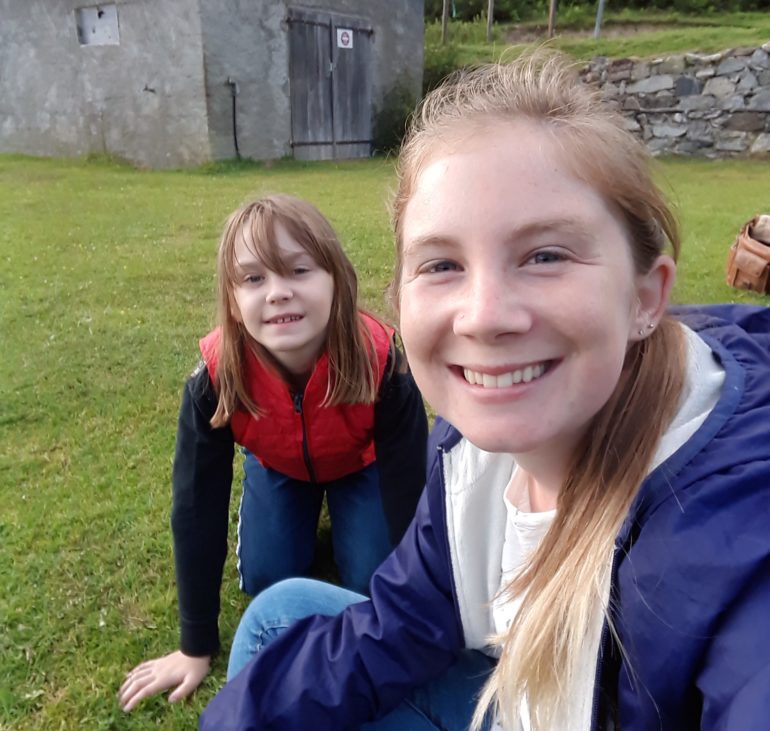
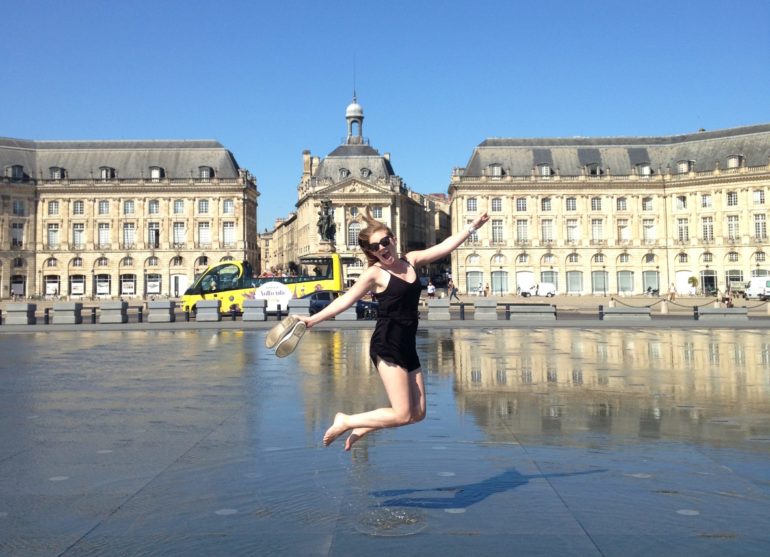
We hear from Greenheart Travelers all the time about how their adventure changed their lives. This is one of those stories with an added “Wow” for the serendipitous luck and a big “awwww” for the sweetness of it all…
Thank you Katie for sharing your amazing story!
***
On December 9th, 2015, an impromptu dinner changed my life, but I didn’t know it then.
I was in France teaching English through the Greenheart program for 2 months before starting a new job back in Boston. On my second night, my host family and I went to visit their close friends at their home. That’s when Simon and I were introduced. We hit it off, and we talked about so many things despite our language barrier (He spoke intermediate English and I spoke 0 French). We saw each other a total of 3 times in my 2 months there. I flew back to Boston and didn’t think I’d ever see him or talk to him again, but his sense of humor, optimism, and laid-back attitude captivated me. Nonetheless, I didn’t keep in touch as I was being “realistic”.
A few months later I received a message from him on WhatsApp saying hello. A message once a week to check-in quickly turned into constant texting.
Simon called me one night and told me he wanted a serious relationship with me, and that he wanted us to figure this all out together. We began our LDR (it lasted 1.5 years), and we traveled back and forth every couple of months, but the distance was hard and so was the 6 hour time difference. Our vacation time and bank accounts were quickly dwindling, and we knew we had to find a long-term solution if we wanted to stay together.
On February 14th, 2018 I packed 3 suitcases, hopped on a plane– and never looked back. I became a full time English teacher in France.
On December 9th, 2018, on the exact date we met, Simon proposed. We got married this past July at a lovely château near our home in Bordeaux.
I never expected my soulmate to live across the ocean, but we found each other with (BIG) help from Greenheart Travel!
Katie & Simon
***
While we can’t promise finding your soulmate if you go on a Greenheart Travel trip, we do think you’ll have a great time!
Visit GreenheartTravel.org to see all the Teach Abroad, Work Abroad, and Teen programs we offer all around the world!
Early in my travels, Europe was always the place I dreamt about. If you were to give me one of those “which city are you?” BuzzFeed quizzes that are utterly addicting, I would almost always be the whimsical romantic in the group, receiving Paris as my city time and time again.
There’s no denying it; that continent has incomparable allure.
It can also be mind-numbing, especially for anyone like me who is predisposed to obsess over maps and “must-see” lists. However, learn to avoid a few common pitfalls, and your 90 days could be full of unforgettable experiences.
Fly by the seat of your pants…not your pocketbook
When I planned my trip, I figured that I could always do it better and cheaper on my own. I only knew about travel agents. I didn’t know about cultural exchange programs, and I certainly didn’t think anything like that would end up saving me money.
Traveling in Europe or moving there for an extended period comes with all the same costs as living in the U.S. You have to pay for housing, utilities, food, transportation – everything just as you would back home. Even if you stay in hostels your whole trip, you’ll end up paying the same or more than rent each month. And that is one of many reasons why homestay programs are a beautiful thing.
Find the right fit
First and foremost, you have to be invested in the cultural exchange experience to commit to a homestay. If you’re genuinely interested in experiencing the day-to-day life of your host family, sharing your customs with them and learning about their own, as well as having a lot of independence and personal time to explore, then a homestay might be the right fit for you.
What’s more, it will cost you far less than trying to live in Europe on your own, whether you’re planning to stay in one place or travel around, and your travel insurance, logistics, vetting of your homestay family, and so much more will be handled for you. Most importantly, you’ll have a unique, quality experience living and learning abroad, like a local.
Making the most ≠ seeing the most
A common mistake that travelers make is to try and fit in as many cities as humanly possible. When I planned my five-week trip, I knew that I wanted cushion days where I could just sit in cafes and people watch. Sightseeing is a blast, but it’s also exhausting, and it doesn’t continue to be a blast if you do it day after day after day.
The key to travel, as with most things in life, is quality over quantity. Give yourself time to absorb each place you visit. You’ll have such a better chance to learn about the culture and history, rather than just memorize the tourist sites, and you’ll return home refreshed and ready to plan your next trip!
So, ask yourself why you want to go to Europe so badly? Is your goal to tour the country, or to teach? Is it to learn a new language or experience the culture? Or is it all of the above? Whatever combination you’re looking for, it’s possible. The following two options are just a few of the ways to fit it all in!
1. Teach English in a Homestay
If you’re highly independent and itching to spend a chunk of time gallivanting wherever you please, Teach in a Homestay is a good option for you. Greenheart Travel has placements in countries such as France and Spain with one to three-month program options as well as rolling start dates! It’s a highly flexible and cost-effective program to incorporate into your European adventure.
You’ll spend 15 hours a week teaching your homestay family, allowing you to try out teaching English in a more relaxed setting and see if it’s something you want to pursue. The rest of your time is yours to explore your new home.
If you’re looking to get a little bit of everything on your Euro-trip – professional development, cultural immersion, language practice – this is an excellent program to pair with any independent plans you want to make.
2. Teach English in a Local School
If you would like more structure to your 90 days and prefer to try teaching English in a school setting as a teacher’s assistant, Teaching English in Italy or France could be your jam. You’ll also gain the experience of a homestay, but you’ll get to go abroad with other Greenheart Travel teachers at the same time (with the same start date!), have the support and community of your school, and the opportunity to travel to destinations all over Europe on the weekends.
No matter how you decide to spend your days experiencing a new culture, you’ll come back having had a life-changing, one of a kind experience that taught you more about yourself and what you want in life.
Learning a foreign language is essential in today’s world. But learning a language is more than studying from a text book: it’s about immersing yourself in that language and experiencing true cultural exchange, and there is no better time to head abroad than in the Fall! Here are 8 reasons why you should apply for a Greenheart Travel Teach in a Homestay program.
1. No summer crowds
Avoid the herds of tourists, enjoy shorter lines to museums and take advantage of off-season prices at restaurants while exploring in your free time. No lines at the Louvre!?
2. Beautiful Weather
Save yourself from the potential of heatwaves when you arrive in September and October.
3. Cheaper Airfare
Airfare can be more than double in the popular summer months. Sometimes you can score tickets to Europe in the fall for even as low as $500 round trip from the USA.
4. Wine Harvest
Wine grape harvest season in Spain and France along with awesome harvesting festivals!
5. Good Timing
It is easier to take time off work in the fall after all of your co-workers have taken their summer vacations! Teach English in a Homestay’s flexible dates make it easy to squeeze in a month when it’s convenient for you.
6. Festivals
Attend awesome beer, food and cultural festivals like Oktoberfest in Germany or the White Truffle Festival in Italy!
7. Connect with the Locals
During the summer, many Europeans go on vacation. Visiting in the fall gives you the opportunity to meet local people and truly immerse yourself in a new culture.
8. Those Changing Leaves!
Experience the beauty of the leaves changing while in a beautiful new landscape. What is more romantic than wandering in a park halfway across the world as the trees change colors?
Greetings! I’m Emmie, a Greenheart First-Time Traveler 2019 Scholarship Winner. I chose to spend one month of my summer in France at a Homestay teaching English. In the US, I’m an elementary school music teacher, teaching ages 5 to 12. During my time in France, I learned a lot about how children learn, how they approach a new language, and best practices to develop a relationship with international students. I’m eager to share how I made the most out of my first experience living abroad!
At my homestay in Tarbes, France, I was responsible for teaching four sisters ages 3, 5, and 9 year old twins. The twins already knew some colors, animals, numbers, and key phrases in English, as they receive lessons through school one hour a week. Through planned and unplanned group instruction, the twins became leaders and helped their younger sisters, and each other.
My biggest advice in planning English lessons abroad is to plan plenty of games. Learning a new language should be fun! Valuable learning happens without the students realizing it, and you’d be surprised by how long they want to play. You’re also creating quality time with the kids, developing a relationship. We played common games together (UNO and Hangman were my go-tos) and taught each other hand-clapping games in our own languages. Particularly if your stay is during the summer, keep in mind that younger kids might not have the attention span for a full sit-down lesson. The more active and engaging it can be, the better!
I brought some fun workbooks in English for the girls to do on their own time
Teaching at a homestay was a great way to learn about another culture’s educational system. It didn’t occur to me that special education is different throughout the world. I have the privilege of teaching in a country that is very committed to the inclusion of all students, regardless of individual challenges or disabilities. I’m very thankful for that. I approach this next school year with a new gratitude for those students I teach with special needs, grateful that I get to support them and watch them grow.
As a teacher, I already know children must trust an adult before they can learn from her. At first, my girls were apprehensive about speaking English in front of me, worried about making mistakes. Once they saw that I made mistakes in French all the time, they became more comfortable practicing freely. When thrust into a new environment with strangers, hearing a few simple statements in your native language can go a long way. I even experienced myself when locals greeted me with “Hi, how are you?”. Peers who speak both languages can translate and be a great resource, yet a relationship still needs to be formed between you, the teacher, and your student.
A picnic by the lake is a perfect setting to practice food vocabulary.
Moving forward, I have a couple ideas of how to make my music classroom more internationally inclusive. I plan to practice and use some key phrases in other languages to lay the foundation for a positive teacher-student relationship, and to greet new students in English slowly, with a smile. I’ll always cherish the time I had with my host family, as it was a learning curve for all of us! I’m eager to apply my French homestay experience to my American teaching style.
Greetings! I’m Emmie, a Greenheart First-Time Traveler 2019 Scholarship Winner. I chose to spend one month of my summer in France at a Homestay teaching English. I’ve learned so many valuable lessons about France, people and customs across the world, and new things about myself and my role in it all. I’m eager to share how I made the most out of my first experience living abroad!
A funny interaction happened one weekday night during my second week in Tarbes, France. I had just cleaned my plate of another delectable local favorite: duck. My host parents asked if I wanted anymore, and I replied “Non merci, je suis pleine.” A beat. They looked at each other, then at me. Imagine my reaction when they told me, “You just said you’re pregnant…with an animal.”
Language is just a tool. If that tool isn’t serving you in your host country, pick a different one! Between knowing a little bit of vocabulary of the other person’s language, charades, and Google Translate, my host family and I communicated fine. My first two weeks in Tarbes, I would get frustrated because I wanted to understand everything immediately. Once I came to terms with the fact that I would not be fluent in ONE MONTH, and I need to soak up as much as I can, it was high flying. Try the best you can. Who cares? Maybe a great story will come out of it for the folks at home.
My host parents and I took an elevator to the top of the Haute-Pyrenees. A huge highlight of my trip!
Greenheart Travel encourages its participants to make SMART goals before traveling. Similarly, I encourage a traveler to have a motto for her experience. Anytime I felt apprehensive or homesick, I repeated to myself my motto for the trip: carpe diem. Every second abroad is a gift, and there’s not a moment to waste. Whether it’s “hakuna matata”, “#blessed”, or “I can’t believe I’m really here”, having a travel motto will keep your mind focused on the present moment, getting the most out of your voyage.
Drift toward action like a moth to a flame. As long as it’s safe, say yes every chance you get. You could sleep in tomorrow morning, or you could check out the arts and crafts festival happening in town. You could go with the popular judgment that foie gras is disgusting, or you could try it and decide for yourself. Keep your eyes and ears open to new experiences – half of the things I did occurred by happenstance, just walking around and seeing what was going on, or reading a flyer in a local cafe. And don’t forget to use your best resource – your host family!
Exploring a chateau in Lourdes
Reflecting on my own trip abroad, I became a better version of myself in France. I gained a useful perspective on the world and on myself, continually conscious of how others were perceiving the country and people I represent. After living in another country for a while, you’ll feel like there’s nothing you can’t overcome. Your adventure with Greenheart will a once in a lifetime experience; live every day to it’s fullest!
Before setting off for my homestay in France, I was rushing with excitement. After intensely studying French for the past year, I was thrilled at the chance to practice my French nonstop and live in a new environment I had never been to before. I would be living in the North of France just outside of a town called Douai with a family of three. I knew there was still so much I did not know about the French language, but that didn’t stop my excitement for what was to come.
As I arrived in France and began to experience life there, I soon discovered just how much I did not know. During my process of assimilation into a new culture and structure for communication, I soon came to see that “how much I did not know” allowed me to learn tremendously about myself and what it’s like existing inside of another language.
Not Everything Must Be Communicated Through Words
I learned this first and foremost from the family’s son who I was conversing in English with. This kid was a master at utilizing facial expressions, acting something out, or using hand gestures to convey an idea or emotion when he did not have all the words to do so. I soon came to realize how effective this could be when I did not have all the words to communicate an idea. This was a tremendously important lesson I realized in my own linguistic growth.
Often as humans, once we develop a larger vocabulary we tend to root all our experiences into words. I soon learned that not every experience or emotion must be transcribed into words. One can exist and share experiences with another human in meaningful ways without always saying exactly how one feels. In addition, we can find new ways to communicate that are not always reliant just on words. We can act something out, use gestures, or simply share an experience with one another.
Patience and Endurance
Learning to develop continual patience with myself and those around me became a big part of this experience. Throughout the first month, I would continually have to ask people to repeat themselves or tell them that I did not understand what they were saying. Other times, people would correct my pronunciation and grammar. Although I know they were only trying to help, it left me feeling frustrated and self-conscious about the way that I spoke. Especially when this language was all I had to communicate, it felt like a diminishing of my own self in this new country and town.
Within this struggle, though I realized time and time again the importance of just being patient and trying again. It challenged me to rise above my own self-consciousness within the language and keep trying to improve my grammar, improve my pronunciation and keep talking with people even if I was nervous or still speaking with errors. This process gave me mental patience and endurance that demanded me to be continually adaptable to everything that was existing around me.
Loneliness and Disorientation
Before this trip, I had traveled out of the country many times before. Because of this, I did not expect to encounter loneliness in the way that I did during my Homestay. I soon realized that traveling with my English-speaking friends and living with a new family that speaks a different language are two very different things. I began to experience how truly unique it is to exist within a language you are not fully fluent in.
I experienced a strong feeling of not being able to express myself in the same manner in French that I could previously do in English. Because of this, I was ultimately not able to exist as the same person whilst speaking French. My answers to everything felt simplified and dry in comparison to the mind I felt existed within me. This led to a sense of disorientation and feelings of loneliness because I was unable to fully exist to others as the person I previously was. Often my phone calls to friends and family in the US felt like an act of self-preservation, attempting to remind myself of the person I felt I “truly was.”
Despite this challenge, I soon came to find that as my experiences in French began to become more layered, I discovered a different sense of self that began to counter some of the previous loneliness. By the end of my two months in France, I began to sense that my French could better encapsulate the person I felt I was. Or rather, my French encapsulates a different aspect of the individual I am now able to exist as.
Although I can’t say the disorientation has completely subsided, it’s something I’ve learned to embrace as part of the experience of learning a new language and transitioning continuously between the two.
Moments of Exhilaration
At the end of my two months in France, I am nowhere close to being fluent in the language. Despite this, I have learned so much more than I thought I would about linguistic communication and learning to embrace aspects of another culture that may at first feel overwhelming. The moments of “linguistic exhilaration,” in which the language rolls off your tongue and a sense of freedom take hold, as you begin to exist within new linguistic boundaries that were previously unknown; these are the moments that make me incredibly thankful for these last two months.
I know I still have a considerable amount to learn, but existing within a new language and building entire relationships in another language has been an experience that I will never forget. It is heavy with challenges I did not expect to encounter but then countered with a richness, a new method of existing that I never fully realized until now.
It’s a beautiful summer evening in the small city of Tarbes, France, where I’ve been living with my host family for the past two weeks. I’m a music teacher from Washington, D.C, and decided to use my summer to stay with a family for a month and teach them English. Despite the late hour, there’s still a good deal of sun left as enjoy our apperitif outside. Good friends come in through the gate, and we exchange kisses and greetings before gathering at the table. Though I’ve only lived here a short while, I’m more comfortable with the way of life and customs that are different from back home.
Before arriving, we search for the best flight deals, brush up on some key phrases on Duolingo, and maybe pack a suitcase with enough room for some delicacies. But what is everyday life in France REALLY like? Here are a couple of things to expect during your stay in this beautiful country!
What I was worried about the most before coming to France was how to greet people. The number of kisses usually depends on where you are in the country – my region did one on each cheek. It went something like this: say “Bonjour”, kiss one cheek, say your name, kiss the other, and ask “ça va?” or, “How’s it going?”. My host family would do this at the beginning of the day upon waking up, and again in the evening returning home. It’s impolite not to greet someone you don’t know, no matter what the social setting. Don’t forget to say goodbye when you leave, too.
To me, the biggest difference between France and America is the speed of everyday life. Stores open late in the morning, close usually about 2 hours for lunch, and close in the early evening, between 6:00 – 8:00 pm. Plan your shopping for the day accordingly! Meals are eaten much later, too. At my homestay, the earliest we ate was around 8:30 pm, some meals going until 11:00! The relaxed atmosphere of meals in France made them some of my favorite parts of the day.
Enjoying an apéritif with my host parents and some new friends!
Meals in France are an experience to be savored; they go with the French pace of life! Lunch and dinner might start off with a beverage (flavored syrup mixed with water, juice, or an adult beverage). Look around in the middle of the day and you’ll see most people carrying a baguette for lunch (the only sandwiches worth getting are those on baguettes).
If eating out or dining at home, you’ll usually start with an apéritif. At my homestay, this looked like selections of meat paired with chips or crackers on a charcuterie board, anywhere between 20-60 minutes before the main meal. Afterward, the French love their desserts with a coffee or tea. Besides the delicious food, something else I liked about meals with my host family was that every family member was present. I looked forward to that daily time together.
On the whole, everyone I met or interacted with in many parts of France were friendly and helpful. While maybe having a more serious demeanor, the French are accepting of and eager to help travelers. Most schools teach English for a small part of the week, so many people I met could say a few things to me in English. Many clothing lines, songs, TV shows, and movies from the US are popular in France, so will always be something to talk about.
The people of Tarbes gather at City Hall for it’s Bastille Day celebration
I was surprised to find that, in comparison, Americans are very animated people who tend to exaggerate in conversation. Once at lunch, I explained to my host mom that while I wasn’t in a romantic relationship with it, it made sense in English that I “loved” my salad.
I’m grateful to Greenheart Travel and my homestay family for this incredible experience. I know that when I will return to France, it will feel like coming home. Soak up all you can and enjoy yourself on this amazing journey. Bon voyage!
Today, I embarked on the next level of my teaching English as a Second Language journey by attending orientation for new, adjunct faculty at a local community college. Two weeks ago, I was nearly crying my eyes out about leaving my host family in France. Teaching English in France was an experience like none other. I was so passionate about my mission, that I wanted it to continue after I landed back in the U.S. Returning has not been easy, but by continuing to teach English, in some ways, I’m not giving up on my dedication to learn about other cultures and help others achieve their personal and professional goals by learning English.
So, after 12 years of experience teaching in and out of the classroom, what advice can I offer my fellow teachers and prospective Greenheart tutors and teachers that might not be found using Google?
The following is my little list of things that I did not learn in Education 302:
Keep a quote handy or something to inspire you. Always, remember your “why.”
I’ve taught Title 1 students in the inner-city, and most recently, I’ve taught tweens in France. Teaching has left me with amazing days when I felt overjoyed and it has left me with exhaustion and frustration from time to time. Teaching is rewarding by all means, but it also demands your best. While serving in AmeriCorps, I learned a quote that has refueled me every time that I think about it, “Everyone can be great because everyone can serve.” – Rev. Dr. Martin Luther King, Jr. Remember, that each and every learner that you touch will be forever changed, because of you and your commitment to them!
Cookie cutter teaching just won’t do! Start from scratch.
I’m not saying that you should “reinvent the wheel”. I am saying that it’s critical that you view each teaching project and each student in a unique way. Each opportunity is a new one. Use an icebreaker and get to know your student or ask them a few questions that help you to get to know their learning style and interests. Remember to customize your lessons to meet your students’ level and needs. There are tons of online lessons and Greenheart Travel provides tons of teaching resources, so manipulate these resources to meet your needs.
Never, ever, ever feel stuck! Use your resources and ask for help.
I’ve had a variety of roles within the field of education, from being a program manager at a children’s museum to an instructional designer for a corporation. However, teaching is the one role that I’ve had where it’s so easy to get “in your zone” and not ask for help. It’s easy because it’s just you and your student, or class of students in a room. There’s no one hovering over your cubicle to see how you do things and offer on the spot advice, there’s rarely anyone asking you to share your ideas to a room full of people. While I taught abroad, I took an active role in connecting with the Greenheart Travel community on social media. I found solace in connecting via LinkedIn or Facebook with those who were teaching abroad as well. Remember, you do not have to be an island. Connect with the Greenheart Travel staff, other teachers or tutors and search for online groups or local meetups to connect with others who might be of assistance.
Thus, two degrees in education and 12 years later, I’ve learned that anyone can learn how to teach and anyone can search the web for educational games, high-quality ESL lesson plans and other resources. The web offers a wealth of resources, don’t get overwhelmed by the web. Look inside yourself, the best resource is you!
Wishing you an amazing teaching and learning journey.
“You sound white.” “You act white.” “You dress like a white person.” Growing up, these were the words that I heard from many of my classmates. I’ll never forget the feeling that I felt when I returned to the girls’ locker room after my 6th grade gym class to find my sneakers thrown in the toilet. I was bullied because I did not act, talk or dress, the way they wanted me to. What can I say? I had decided at a young age that the world that I wanted to live in was not white, black, Asian, Hispanic or any other racial identity. I simply wanted to be loved for me.
In 6th grade, I signed up to take French, when the majority of the student body signed up for Spanish. Although my family did not have much, I was thankful to have attended a middle school that offered 6-week, exploratory rotations of Spanish, French, Italian, American Sign Language and Japanese. I fell in love with the French culture and language at a pretty early age. I was enthralled with the country’s reputation for fine art, literature and cuisine. What can I say? I was an impressionable child. I ended up taking French through my freshman year in college.
Fast forward, many, many years later, I found myself in the middle of the Midi-Pyrenees in France, teaching English in the home of a family of 6 from Afghanistan. If I’m honest with you, you should know, I almost did not stay with this family due to fear.
I’ve realized that fear is not a white, black or racial thing, fear lies within each of us. It is dormant, until it is awakened. Something triggers our fear, perhaps, it’s fear of the unknown or fear of the unfamiliar. For me, it was both. Although my parents are amazing and raised me to love all types of people, I will say that their judgments about others’ religious beliefs had almost, passed on to me. This is ironic, given my experience in the 6th grade locker room. Well, perhaps we are judged and we judge others? However, it is critical that we learn to overcome these fears and tear down our judgments and stereotypes about others, especially those that we’ve yet to meet!
However, it is critical that we learn to overcome these fears and tear down our judgements and stereotypes about others, especially those that we’ve yet to meet!
I almost did not stay with my host family. I thought that most Muslims did not like Christians. I thought they would not respect my Christian ideals and beliefs. To this day, I remember how I felt when I read the Greenheart placement letter, letting me know that I’d be staying with a Muslim family who was originally from Afghanistan. Immediately, I felt conflicted. My heart wanted to love and embrace them as my own family, but everything else in me feared the worst, literally.
After talking with a friend who recently stayed with a Muslim family in Morocco, I decided to go ahead and give the family a chance and I’m so glad that I did! Taking a chance on the Greenheart France Homestay program, living with this French family from Afghanistan…it was one of the best decisions that I have made in my entire life!
I learned that my views about people from the Middle East were fueled by pop culture and the media. My relationship with my host mom showed me what love looks like. It is not a Christian love or a Muslim love. It is not an American, French or Afghani love. It is as pure as the love from my biological mother. She showed her love by picking me up from the train station at midnight when I got lost in Toulouse one night. When we went out to eat, she made absolutely sure that no food had dairy in it due to my allergy! And, we exchanged life stories over the most delicious Afghan meals that she cooked.
So, at the end of the day, I do not see myself as a black or African-American woman. I feel that I have no real place of origin. For me, home is where the heart is. And, I can rest assured that whenever I’m back in France, I always have a home to go to.
So you dream of a life teaching English in Europe. You imagine sitting at a sidewalk cafe in Paris after teaching a class, or walking past the Colosseum on your way to work, or meeting friends at a tapas bar in downtown Madrid to kick off your weekend.
Unfortunately, if you are an American or Canadian citizen, it’s not that easy. Most ESL markets demand large numbers of native English speakers from all over the world, but Western Europe is a special case.
With EU labor laws allowing the free flow of workers among the European countries, employers can hire English-speaking teachers from places like Ireland or Scandinavia (where most people speak English fluently) without the hassle and expense of sponsoring a visa, for now at least. This means that there’s not many incentives for a school in continental Europe to hire an American or Canadian teacher.
So how do you, as a North American, get to that sidewalk cafe? Here are your next steps!
1. Let go of your notions of making a lot of money.
High-paying ESL jobs are just not readily available for you in Europe. The businesses that pay the big bucks are almost always going to hire someone who doesn’t need a visa.
2. Expand your definition of teaching English.
In Asia or South America, you’d likely be in a school, teaching your own class; in Europe, teaching might instead take the form of conversation practice at the dining room table with your host family.
In some countries there are government-sponsored programs which place North Americans in public schools. These programs, however, have limited placements, are competitive, and require a full school year commitment.
People also work under the table across Europe. This means no visa, so if you stay for more than 90 days, you are illegally in the EU and you run the risk of being fined (or, in rare cases, banned from reentry) for overstaying your tourist visa. These jobs usually take the form of private tutoring or part-time work for private language academies. People who do this successfully are outgoing, hard-working, self-starters; it’s not easy to piece together a living on freelance teaching, especially if you don’t speak the local language. The business is mostly referral-based, so you have to work hard to network and get your name out there.
3. Consider investing in an organized program
As you’ve seen, moving to Europe to teach English just isn’t simple. The government programs are very limited. The freelance, go-it-alone method is highly risky–you won’t be able to line up any work until after you’ve already arrived in Europe, and you’ll probably spend several weeks living in a hostel, while you try to patch together enough private classes to pay for an apartment.
Ultimately, this is a very expensive and stressful way to kick off your life abroad, and even if you get your business off the ground, you’re living illegally in a foreign country, always running the risk of getting caught. Going through an organized program, while requiring an initial investment and program fee, eliminates that stress and uncertainty and sets you up for a positive, productive experience.
4. Do your research on your program options!
Greenheart Travel has many organized program options for teaching English in Europe. Our programs usually always include things like airport pick-up, insurance coverage for the duration of your program, pre-departure orientation & cultural training before you leave, and most important – an experienced program manager to guide you through the process and answer any and every question you might have. Here are your options for teaching in Europe with Greenheart Travel.
TEFL Certification Courses
Earn your TEFL certificate in the Czech Republic. Getting TEFL certified in Prague, Czech Republic gives you the option to find paid jobs in private and public schools with a legal EU work visa, allowing for long-term contracts in a European country! This is an intensive 4-week course with job placement assistance for graduates to find paid teaching jobs within Prague after successful completion of the course, as well as aid in acquiring a legal work visa.
If you’re interested in making a career of teaching English but not interested in Prague in particular, you could complete your TEFL certification online and use the job placement assistance to help you find work anywhere in Europe. Job placement assistance is included in the program fee!
Prague!
Teach English in Italy or France
Really want some classroom experience? Teaching English in Italy or France is the way to go. You’ll spend 3 months living with a host family and working as a volunteer teaching assistant (15-18 hours/week) at a local school. Again, your lodging and meals are covered, and the job is only part-time, so you’ll have plenty of time to travel, study the language, and immerse yourself in Italian or French culture.
Teach English in Italy alum, Mercedes!
Teach English in a Homestay
More interested in cultural exchange? Teaching English in a Homestay is a great option if you really want to immerse yourself. You’ll live for 1 to 3 months with a local family in country destinations like Italy, France, or Spain. You’ll spend 15 hours a week tutoring the family in English–the rest of the time you’re free to explore! Your program fee covers your lodging and your meals, so no worrying about rent or groceries.
Dawn exploring Madrid during her homestay program.
While the program fee for your chosen program may seem high at first glance, think about what it would cost you to backpack Europe for 3 months, or to pay for a hostel for weeks while you get that tutoring business going. Western Europe is expensive. You’d go through that money in a month (having run out of money and lived on stale baguettes in the last week of a backpacking trip, I’m speaking from experience).
Ready to kick off your European adventure? Learn more here: